


Quick Answer: What Is Huxi Thatched Cottage?
Huxi Thatched Cottage (浒溪草堂图, Hǔxī Cǎotáng Tú) is a Ming-dynasty landscape handscroll by Wen Zhengming, dated 1535. Its waterside home is a setting for meeting friends. The work belongs to the Liaoning Provincial Museum in Shenyang; it is a horizontal painting on paper, not a hanging scroll.[1][2]
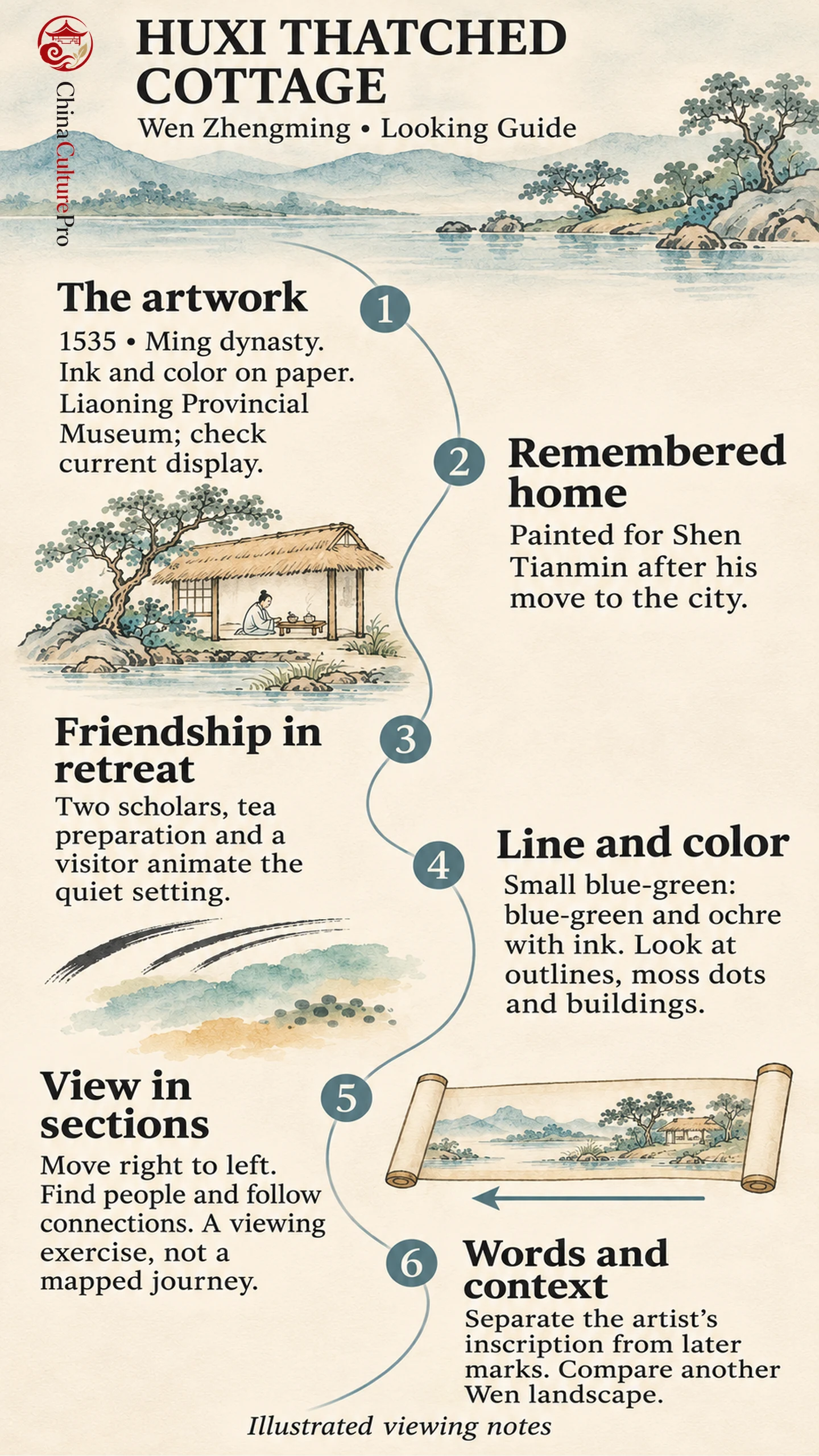
A small house can be easy to overlook in a landscape reproduction. Here, giving the house more attention changes the experience: boats and water become approaches, and the wooded setting becomes somewhere to receive visitors. This is a useful example of how Chinese painting can join a place, a social life and a way of looking.
The Artwork at a Glance
| Поле | Identification |
|---|---|
| Художник | Wen Zhengming, 1470–1559 |
| Дата | 1535, Ming dynasty |
| Format | Handscroll |
| Medium and support | Ink and color on paper |
| Recorded painting dimensions | 26.7 cm high × 142.5 cm wide |
| Holding collection | Liaoning Provincial Museum, Shenyang |
The date is given in scholarship on Wen’s blue-green landscapes; the dimensions and collection agree with the published object entry. Do not assume that a photograph including mounting fabric or added inscriptions will have the same proportions as the recorded painting.[1][2]
Wen Zhengming worked in the Suzhou artistic world and learned painting from Shen Zhou. His landscapes include both finely controlled and broader brushwork. That range matters here: calling the picture simply “delicate” can obscure the firmer lines within its quiet setting.[3]
Remembering a Home Through Friendship
The painting was made for Shen Tianmin, whose family had lived at Huxi. After moving into the city, he wanted to remember the old home through a painting and poetry. The subject is therefore a remembered residence with personal associations, rather than a generic retreat assigned a poetic name.[4]
The scene includes two scholars seated together in the cottage, an attendant preparing tea in another room, and a visitor coming ashore from a boat.[4] These details make hospitality part of the landscape. The house provides shelter, but it also gives people a reason to arrive and stay.
Read the idea of withdrawal carefully. A rural setting can suggest distance from public demands without excluding companionship. In this picture, the useful contrast is between the quiet of the setting and the movement that brings friends into it. The broader tradition of Chinese literati painting helps explain why a seemingly modest dwelling could carry more meaning than grand architecture.
This does not turn the image into a measured survey. Its arrangement can express an attachment to home while still shaping space for a satisfying painting. Keep those two possibilities together: a particular residence and an artistic construction of how life there might be remembered.
Blue-Green Color and Disciplined Brushwork
The work belongs to the small blue-green (小青绿, xiǎo qīnglǜ) approach: restrained blue-green and ochre color works with ink drawing. In this painting, stronger outlines, closely placed moss dots and relatively straight architectural lines give substance to the forms. Its color is richer than in some earlier works, while remaining short of the densely colored blue-green mode.[1]
For a close view, compare the edge of a building with the marks on nearby rocks or vegetation. Ask what each kind of stroke accomplishes. A roof needs a readable structure; a mass of trees can be built from repeated marks. The interesting question is how those different treatments hold together, rather than whether every surface has been rendered with the same finish.
Also separate hue from weight. A reproduction may make the greens look brighter or duller, but the relationship between drawn line and colored area is still worth examining. Do not identify a particular mineral pigment from a screen image alone. The broader guide to Chinese landscape painting provides context for comparing the roles of brush, ink and color without reducing the painting to a palette.
A Close-Looking Route Through the Scroll
A handscroll is traditionally viewed from right to left, a manageable section at a time. A full-width digital image is useful for orientation, but it compresses that unfolding experience.[5] Try this sequence with an enlarged reproduction; it is a viewing exercise, not an instruction to handle an original object.
- Orient yourself to the format. Notice the long, low painted field before zooming in. Begin at the right and move across in short sections, allowing each passage to register before advancing.
- Find the human scale. Locate the cottage and its occupants. Compare their size with the surrounding trees and hills. Ask how much of the scene becomes legible only when you look closely.
- Follow connections rather than a fixed itinerary. Trace water edges, boats and openings between forms. Test how they draw your attention toward or away from the dwelling, without assuming they record a visitor’s exact journey.
- Return to the words and marks. If the reproduction includes inscriptions or seals, examine where they sit in relation to the painted scene. Distinguish the artist’s inscription from later additions using a reliable catalogue or transcription; a red seal alone does not establish authorship.[5]
The guide to painting inscriptions and seals develops that last distinction. For a related comparison, turn to Wen’s Garden of the Humble Administrator. Compare how each work organizes a dwelling or garden for looking, rather than expecting them to show the same place or serve the same purpose.
FAQs About Huxi Thatched Cottage
Was this Wen Zhengming’s own cottage?
The exhibition account identifies the remembered home with Shen Tianmin and his family. Wen made the painting for him. The artist’s name identifies its maker, not the owner of the depicted residence.[4]
Is the painting monochrome ink?
No. It combines ink with color on paper. Its small blue-green approach uses restrained color, so a muted reproduction can conceal an important part of its appearance.[1][2]
Where is the original, and is it always on display?
The recorded holding collection is the Liaoning Provincial Museum in Shenyang. Collection ownership does not establish current gallery display. Check the museum’s current exhibition information before making a visit specifically to see it.[2]
Источники
[1] Shan Guolin, Palace Museum Journal. 略论文徵明青绿山水画的风格
[2] Chinese Fine Art Gallery. Huxi’s Thatched Cottage
[3] Palace Museum. 文徵明
[4] Beijing Fine Art Academy. 接力辽宁省博物馆“园林——中国文人隐与仕、物与心”第二站将在北京画院展出
[5] Dawn Delbanco, The Metropolitan Museum of Art. Chinese Handscrolls