


Quick Answer: What Is Filial Crow in the Tree?
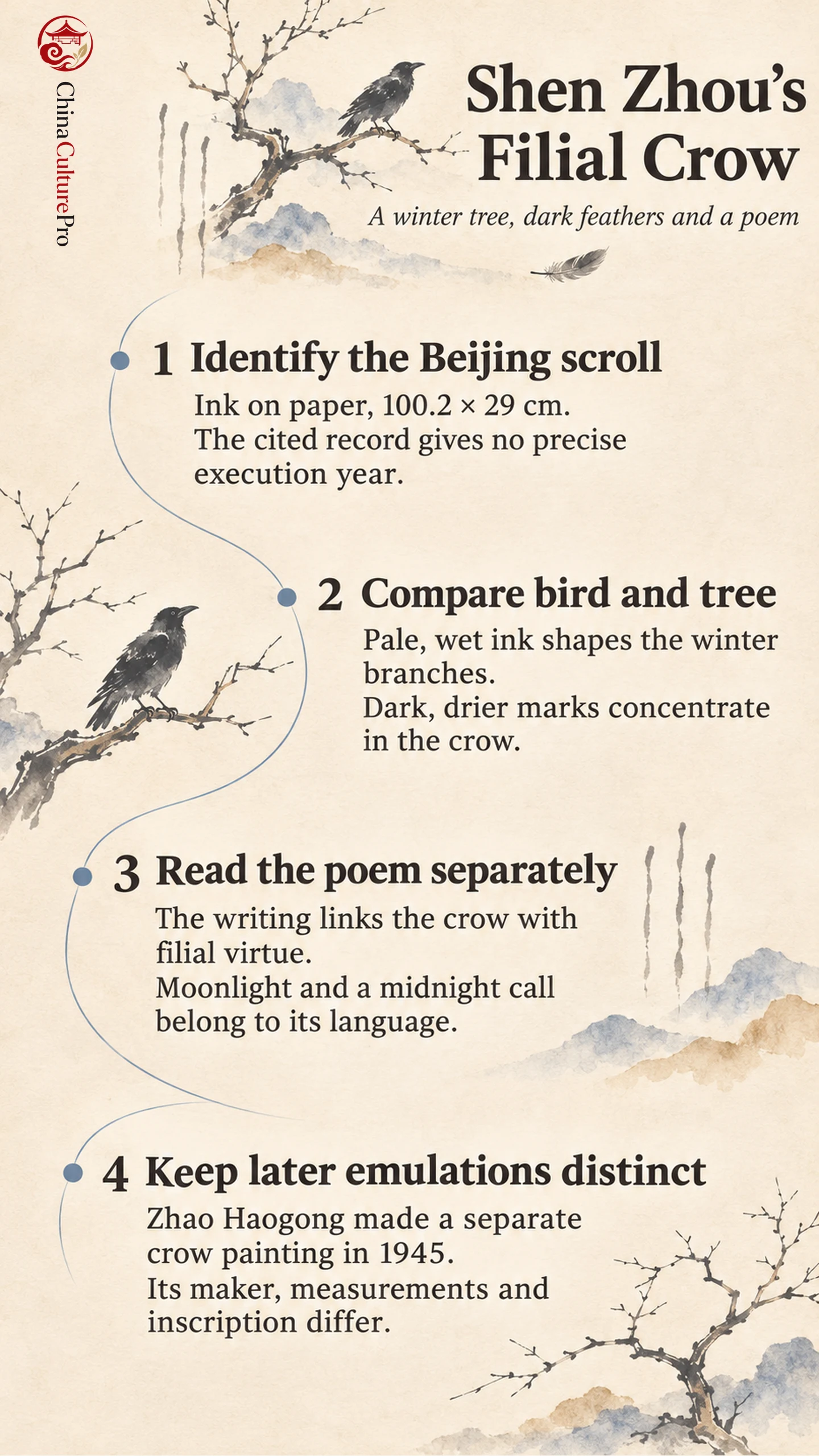
Filial Crow in the Tree (乔木慈乌图, Qiáo Mù Cí Wū Tú), by Shen Zhou (沈周, Shěn Zhōu), is an ink-on-paper hanging scroll in the Palace Museum, Beijing.
- Size: The painting measures 100.2 × 29 cm.
- Look first: A dark, compact bird sits among much paler, bare branches.
- Read next: The artist’s poem connects the crow with a household’s filial virtue.
The moral association comes through the writing; the picture shows a perched bird rather than a scene of feeding its parents.
The eye can find the bird before following the tree. Dark marks gather across its head, folded wing and tail, while paler strokes spread through the branches.
The space above is equally useful. Between the written columns and the bird, a long interval of unpainted paper leaves room to follow the irregular rise of the trunk.
Identify the Beijing Hanging Scroll
The collection number is 新00146262. The work is catalogued to the Ming dynasty without an exact execution year in this record. [1]
Its narrow vertical field gives the tree room to extend far above and below the bird. The scroll-format guide explains this format’s relation to viewing distance.
From farther away, compare the two principal shapes: the bird’s contained mass and the branching network. At a closer distance, individual interruptions in the ink become easier to separate.
The full reproduction includes mounting borders outside the painted field. Keep those borders distinct when comparing the catalogued painting dimensions with a reproduction’s overall proportions.
Compare the Pale Tree with the Dark Bird
The technical contrast is light, wet ink for the winter tree and darker, drier brushwork for the crow. [1]
Look at the trunk just above the bird. Pale sections alternate with darker knots and changes of direction, so the tree does not become one evenly shaded column.
The bird is built differently. Light gaps divide dark feather shapes across the folded wing, while the tail carries longer, closer marks toward its tip.
Compare its rounded head with the sharper turns of nearby twigs. The difference helps the living form remain distinct even though bird and tree share a limited range of ink tones.
The painting-techniques guide develops the vocabulary of moisture, density and texture. Here, a close comparison between one branch and one feather group is more revealing than treating all black marks alike.
The bird-and-flower painting guide supplies the broader genre context. This particular image concentrates attention through a single bird and sparse supporting forms.
Read the Filial Meaning in the Poem
The artist’s poem places the crow in a filial household and evokes moonlight, clear dew and a midnight call. Another inscription, by Huang Jishui (黄姬水, Huáng Jī Shuǐ), occupies the upper right. [1]
Read the poem as language that adds time and sound. A viewer can locate the perched bird and bare branches in the image, while the nocturnal call belongs to the written scene.
Nothing in the illustrated action needs to be stretched into a literal demonstration of filial conduct. The title and poem frame the bird through human ethical language; the visible pose remains quiet and self-contained.
The inscriptions-and-seals guide explains why writing by different hands matters. First identify which text belongs to the painter, then consider the additional inscription separately.
The literati-painting guide develops this exchange between image and poem. Here, reading the words changes what a still bird can suggest without requiring another painted episode.
Recognize a Later Emulation as a Different Work
Zhao Haogong (赵浩公, Zhào Hào Gōng) made a separate crow painting in 1945, now catalogued at Lingnan University as S088. Its image measures 96 × 37 cm. The inscription identifies an emulation of the earlier painter and describes a filial bird calling at night and borrowing a tall branch for its nest. [2]
This later object shows how a bird, tree and poem could remain a usable artistic theme. Its different maker, date, measurements and wording should stay attached to its own record.
Use those identifiers when encountering reproductions under similar English titles. A shared subject can explain a relationship between pictures without making their inscriptions or dimensions interchangeable.
FAQs About Shen Zhou’s Filial Crow in the Tree
Where is the painting kept?
The scroll discussed here belongs to the Palace Museum in Beijing, under collection number 新00146262.
Why is the crow called filial?
The artist’s poem associates the bird with filial virtue. The visible scene itself is a perched crow among bare branches.
Does the painting have a confirmed year?
The cited collection entry gives a Ming-dynasty attribution but no precise year of execution.
Источники
[1] Yang Danxia; Palace Museum, Beijing. Shen Zhou: Tall Tree and Filial Crow, 新00146262
[2] Lingnan University. Zhao Haogong Imitated Shen Zhou’s Crow Painting, S088