


Quick Answer: What Is Fangsheng?
Fangsheng (方胜, fāngshèng) is a Chinese decorative motif made from two diamond shapes with overlapping corners. The pair can repeat across fabric, sit among other auspicious signs or form the outline of a box.[1][2][3]
- Shape. Trace two angular outlines that meet and cross near the center.
- Material. Fangsheng appears in woven silk, metalwork and shaped objects with inlaid lids.[1][2][3][4]
- Meaning. The pair can suggest a harmonious union. A different reading may come from the objects around it.[4][5][6]
Use the overlap to identify the motif, then look at the object to interpret it.
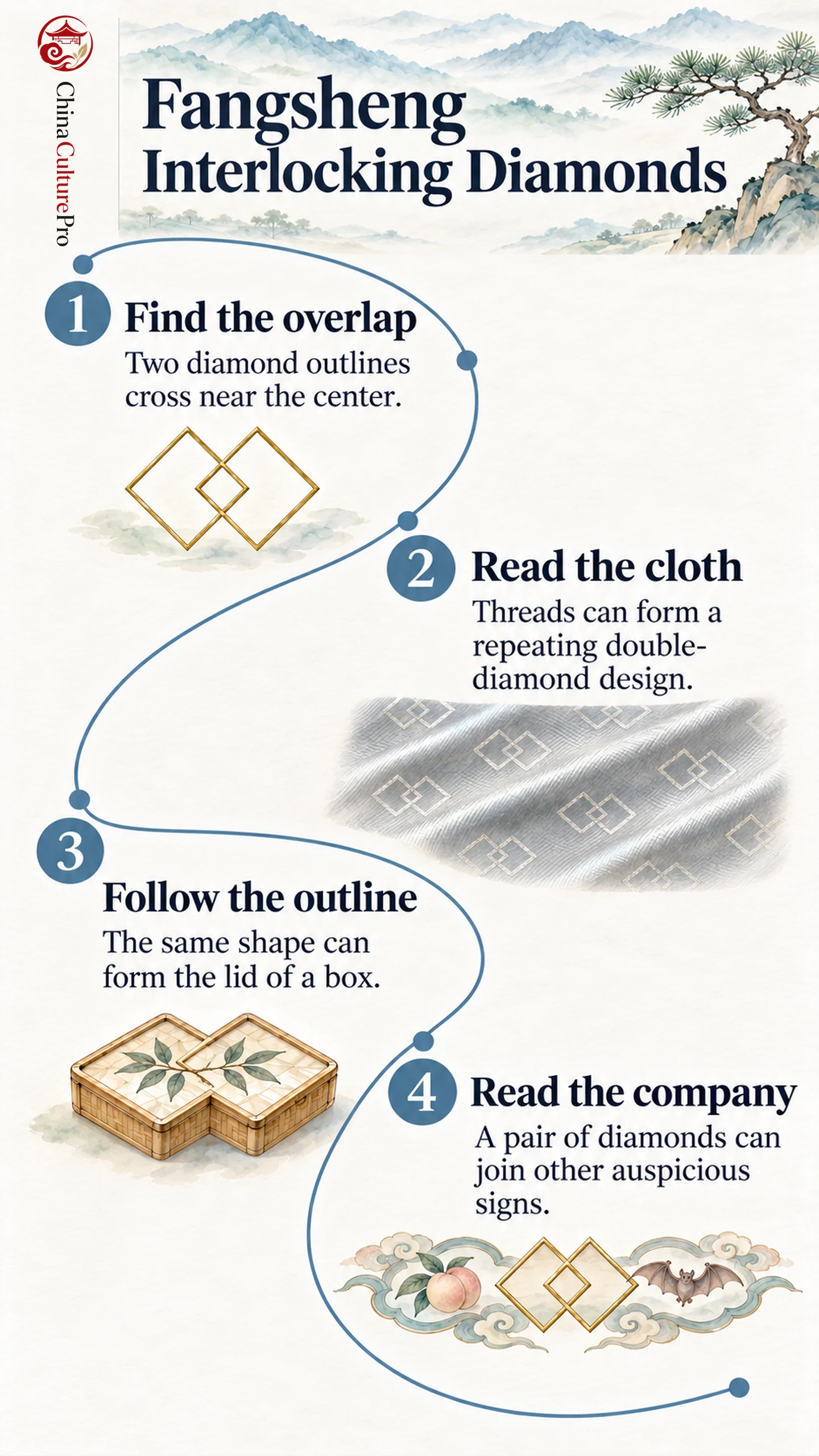
A pair of diamonds can be easy to miss on silver-gray satin. On an inlaid box, the same arrangement is large enough to shape the lid. That shift in scale helps explain why fangsheng can be both a pattern and the name of an object’s form.
How to Identify Two Interlocking Diamonds
Look for the spot where the diamonds meet. In a horizontal example, each diamond has corners that point up, down and to either side. The inner corners overlap to make a smaller angular space. A raised edge, an inlaid strip or a change of thread can reveal how the outlines cross.[1][2][3]
A round rim with a square hole points toward the double coin motif. In fangsheng, the outer edges themselves are angular. If a ribbon partially covers the middle, follow the outside edges first. Then check whether the object carries other treasures nearby.[1][6]
A Woven Pattern and a Box Shape
The Palace Museum’s silver-gray satin jacket has fangsheng designs made with silk threads that float across the ground to form the motif. The patterns repeat across the fabric, while separate decorative bands finish the opening and cuffs. The museum describes the garment as a type of informal jacket worn by women at the Qing court. Light on the raised threads helps reveal the repeated shapes on silk satin.[2]
An inlaid bamboo-faced box in the same collection uses the shape on a larger scale. Raised bands along the lid trace two overlapping squares. Each half has its own border decoration, making the lid look like two boxes joined at the corner. Inlaid images of objects associated with the Hidden Eight Immortals fill the interior of the design around a stylized longevity character.[3]
A Qing cloisonné vase in the China National Museum of Women and Children carries the outline in its body. From the front, the overlapping corners define the vessel’s profile. Along its sides, scrolling lotus decoration follows the angles of the form.[7]
How Other Motifs Shape the Meaning
An account of a Yuan gold-brocade robe in the Inner Mongolia Museum connects its overlapping diamonds with a wish for two things to unite harmoniously. On the cloth they appear with linked pearls and flowers. A museum guide to the Восемь Сокровищ gives the double lozenges a victory association within that group.[5][6]
On a Qing silver box shaped as a bat holding a peach, fangsheng is one of several signs linked with ribbons on the wings. The Palace Museum interprets the whole ensemble as a wish for blessings and long life for generations. The peach, bat and smaller emblems all help build the longevity design.[4]
FAQs About Fangsheng
Is a single diamond always fangsheng?
The usual form has two partially overlapping diamonds. If one diamond is visible, check whether another continues beneath a fold, border or missing part. An isolated lozenge alone leaves the identification open.[1]
Can you date an object by the fangsheng pattern?
The design occurs in Yuan cloth and Qing garments and objects. Weave, construction, inscriptions or a documented collection record give more precise dating evidence.[2][3][5]
Источники
[1] The Palace Museum. Fangsheng, catalogue glossary
[2] The Palace Museum. Silver-Gray Satin Jacket With a Fangsheng Pattern, object 00048686
[3] The Palace Museum. Bamboo-Faced Fangsheng Box With Mother-of-Pearl Inlay
[4] The Palace Museum. Engraved Silver Peach-Shaped Box With Bat Design, object 00137881
[5] Inner Mongolia News. Museum Account of a Yuan Gold-Brocade Robe
[6] USC Pacific Asia Museum. Rank and Style: Symbols in Imperial Chinese Dress
[7] China National Museum of Women and Children. Cloisonné Enamel Fangsheng-Shaped Vase