

Quick Answer: Who Are the Three Stars on Chinese Porcelain?
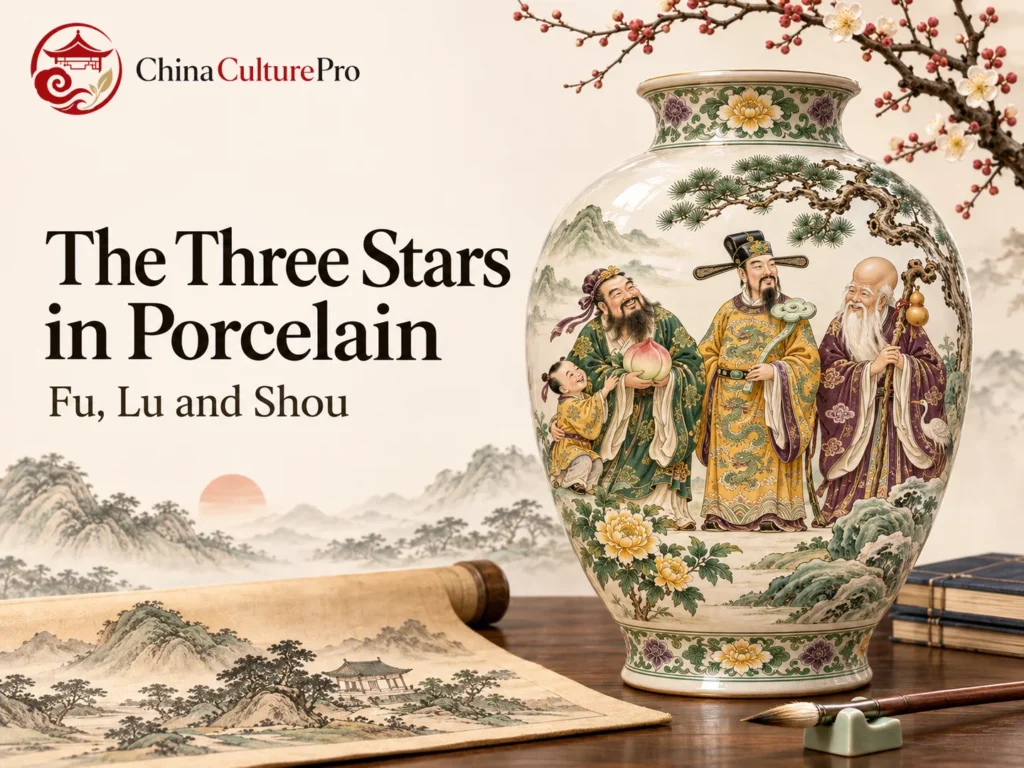
The Three Stars (三星, sānxīng) personify three wishes in Chinese popular religion. On porcelain they can appear together as robed figures, each with clues to his identity.[1][2]
- Fu (福, fú). Good fortune or happiness. A child can accompany him.[1][2]
- Lu (祿, lù). Official income and advancement. Look for the dress of an official.[1][2]
- Shou (壽, shòu). Longevity. His high, rounded forehead is often conspicuous.[1][2][3]
The figures’ positions can change from one object to another.[1][2][3]

A vase and a lantern in the Taft Museum of Art carry the same trio on enamel-painted porcelain. Their robes, companions and faces let the viewer tell the figures apart. A character-shaped ewer shows how the written word can express a related wish through the outline of the object itself.[1][2][4]
How to Identify Fu, Lu and Shou on a Vase
On a porcelain vase dated about 1700, Fu wears purple and faces a child. The child expresses a historical idea of family happiness through continuity of the family line. Lu appears in a green robe and an official hat, connecting his wish with the rewards of office. Shou wears yellow and has a conspicuously high forehead.[1]
Color helps separate the figures in this particular scene. Look for what each figure does or wears before relying on hue alone. On a woodblock print in another collection, a child is placed with Lu, so a child by itself may be an uncertain clue.[1][3]
The Same Three Wishes on a Porcelain Lantern
On a porcelain lantern also dated about 1700, Fu stands near a boy with a reed pipe. Lu occupies the center in an official’s clothing. Shou appears at the left, with the enlarged forehead that distinguishes him from the others. The three stand close together, and each silhouette helps separate him from his neighbors.[2]
The figures combine the wishes for happiness, the rewards of office and a long life. The longevity figure is one way to picture the last wish. Other works use the written shou symbol or a longevity landscape to express it.[2][5]
When the Character Becomes the Vessel
A Kangxi-period porcelain ewer takes the outline of a cursive character for good fortune. The molded and enamelled vessel has flowering branches and painted panels. The written shape gives the whole object a blessing, while the panels supply a place for figures. The ewer lets lettering, vessel shape and figures share the work of carrying a wish.[1][2][4]
FAQs About the Three Stars in Porcelain
Is Lu always in the center?
The Taft lantern shows him there. An embroidered hanging in the Met instead places Shou at the center of its upper register. Look for attributes and the arrangement of the particular object.[2][5]
Are the Three Stars the same group as the Eight Immortals?
The Three Stars personify good fortune, the rewards of office and longevity. The Eight Immortals form a separate group. The two groups can appear together in stories and art.[4][5]
Источники
[1] Taft Museum of Art. Vase with the Three Star Gods
[2] Taft Museum of Art. Lantern with the Three Star Gods
[3] University of Michigan Museum of Art. The Three Stars: Gods of Happiness, Prosperity and Longevity
[4] Los Angeles County Museum of Art. Lidded ewer in the form of the character for good fortune
[5] The Metropolitan Museum of Art. Hanging with the Three Stars