


Quick Answer: What Makes a Chinese Landscape a Longevity Wish?
Mountains, old pines, rocks and cranes can turn a Chinese landscape into a wish for long life. A birthday dedication or record of presentation can show who was meant to receive that wish.[1][2]
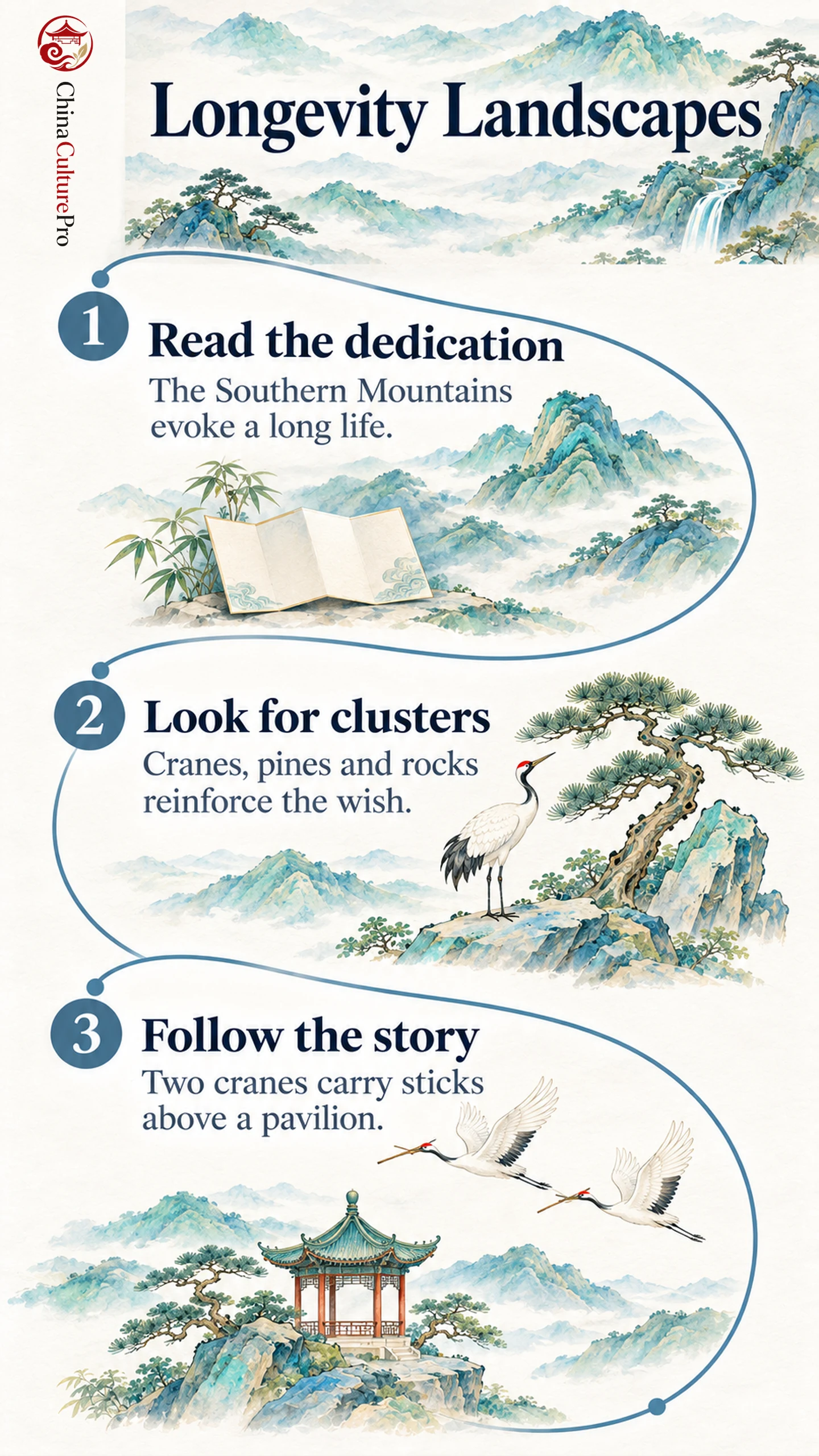
- Read the inscription. A wish for a life as lasting as the Southern Mountains can make the occasion explicit.[2][3]
- Read the motifs together. Cranes, pines and enduring rocks can reinforce one another.[4]
- Look for a story. On one Qing embroidered panel, cranes carry sticks linked to a legend about measuring age.[5]
A landscape with a pine or a mountain still needs context for a birthday reading.[1][2]
One artist turned a birthday blessing into a quiet scene of a scholar beneath a pine. A Qing textile took a more elaborate route, with two cranes carrying sticks above a pavilion. Both draw on Chinese symbols for longevity in different ways.[1][2][5]
A Mountain Wish in a Birthday Inscription
Southern Mountain longevity (南山壽, nánshān shòu) is a wish for a person’s life to last as long as the mountain. The phrase draws on the poem “Tianbao” in the Classic of Poetry, where the mountain is imagined as neither giving way nor collapsing. The image makes durability the measure of the blessing.[3]
Zhang Daqian’s Scholar and Pine, dated 1947, supplies the evidence in the artist’s own words. The dedication ends with a wish that its recipient live as long as the Southern Mountains. The painted pine also carries a long-life association. Even a simple ink composition could work as a personal birthday gift when image and dedication pointed to the same occasion.[2]
Pines, Rocks and Cranes in Court Painting
In the late Qing painter Chen Zhaofeng’s Crane, Pine, and Rock, the crane, pine and rocks occupy the foreground. The Met identifies all three elements with longevity and describes the work as suitable for a palace celebration such as an imperial birthday. The picture was originally four hanging scrolls before it was mounted as a screen in Japan.[4]
That distinction between suitability and documented use matters. A group of familiar motifs can support a longevity reading even when the recipient and occasion are unknown. A birthday dedication, such as Zhang’s, gives firmer evidence for the purpose of an individual painting.[1][2][4]
An Immortal Landscape Embroidered in Silk
In the Met’s Panel with Cranes over an Immortal Land, two cranes fly above a pavilion with sticks in their beaks. More sticks stand in a vase below. The Met relates these details to a legend about a man who counted his years with sticks placed in an immortal land. An embroidered poem dated 1777 describes that realm.[5]
Here the landscape offers room for a story to unfold. The vase repeats a small detail that can be easy to miss in the birds’ beaks. Daoist stories and objects associated with immortals could also carry long-life wishes on birthday gifts. The emblems of the Hidden Eight Immortals use individual attributes to evoke their figures in a different kind of composition.[1][5]
FAQs About Longevity Landscapes
Does the Southern Mountain wish identify a real place?
The expression functions as a conventional blessing. A specific place identification needs additional evidence from the painting, inscription or historical record.[2][3]
Does a crane prove that an artwork was a birthday gift?
A crane can support a longevity reading alongside pines and rocks. A dedication, a dated inscription with relevant content or a record of presentation gives a clearer basis for identifying a birthday gift.[1][2][4][5]
Источники
[1] The Metropolitan Museum of Art. Celebration: The Birthday in Chinese Art
[2] The Metropolitan Museum of Art. Zhang Daqian, Scholar and Pine
[3] Chinese Text Project. Dictionary entry for Southern Mountain longevity
[4] The Metropolitan Museum of Art. Chen Zhaofeng, Crane, Pine, and Rock
[5] The Metropolitan Museum of Art. Panel with Cranes over an Immortal Land