
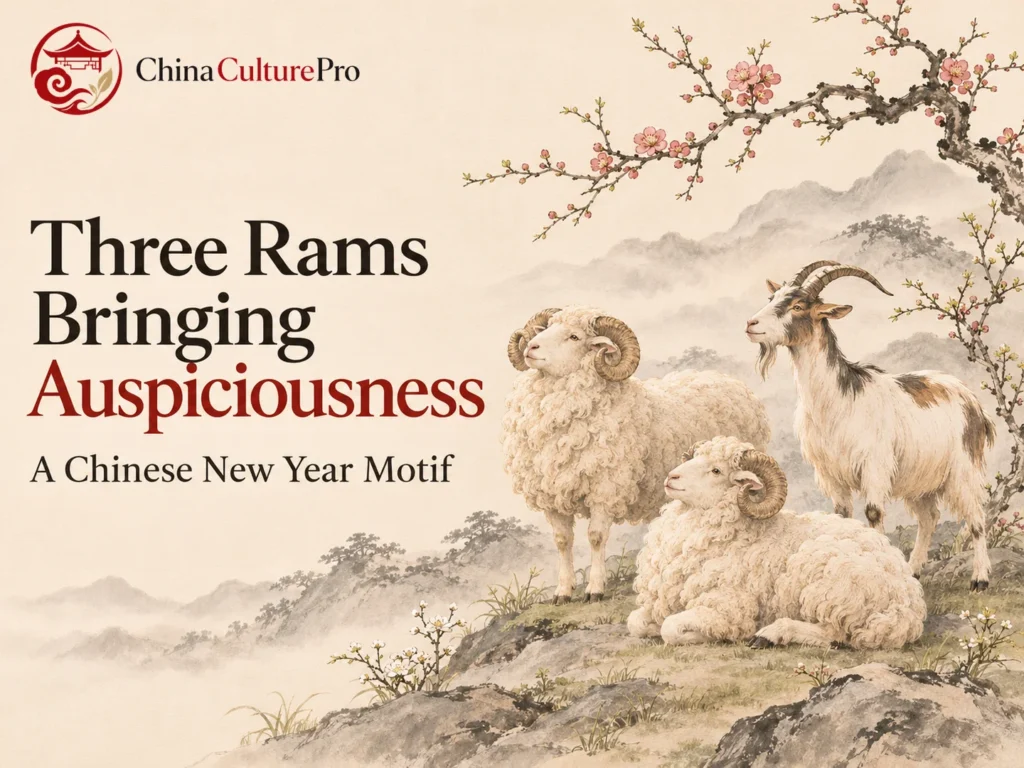

Quick Answer: What Does the Three Rams Motif Mean?
The motif called three rams bringing auspiciousness (三羊開泰, sān yáng kāi tài) uses three sheep or goats to wish for a favorable beginning. It is associated with the New Year and the turn from winter toward spring.[1][2]
- Three animals. The number helps carry the phrase.[1][2]
- Shared sound. The Chinese word for sheep or goat sounds like the word yang in yin and yang.[1]
- Seasonal wish. The group can welcome a fresh start at the New Year.[1][2]
On some objects, the written phrase appears beside or behind the animals.
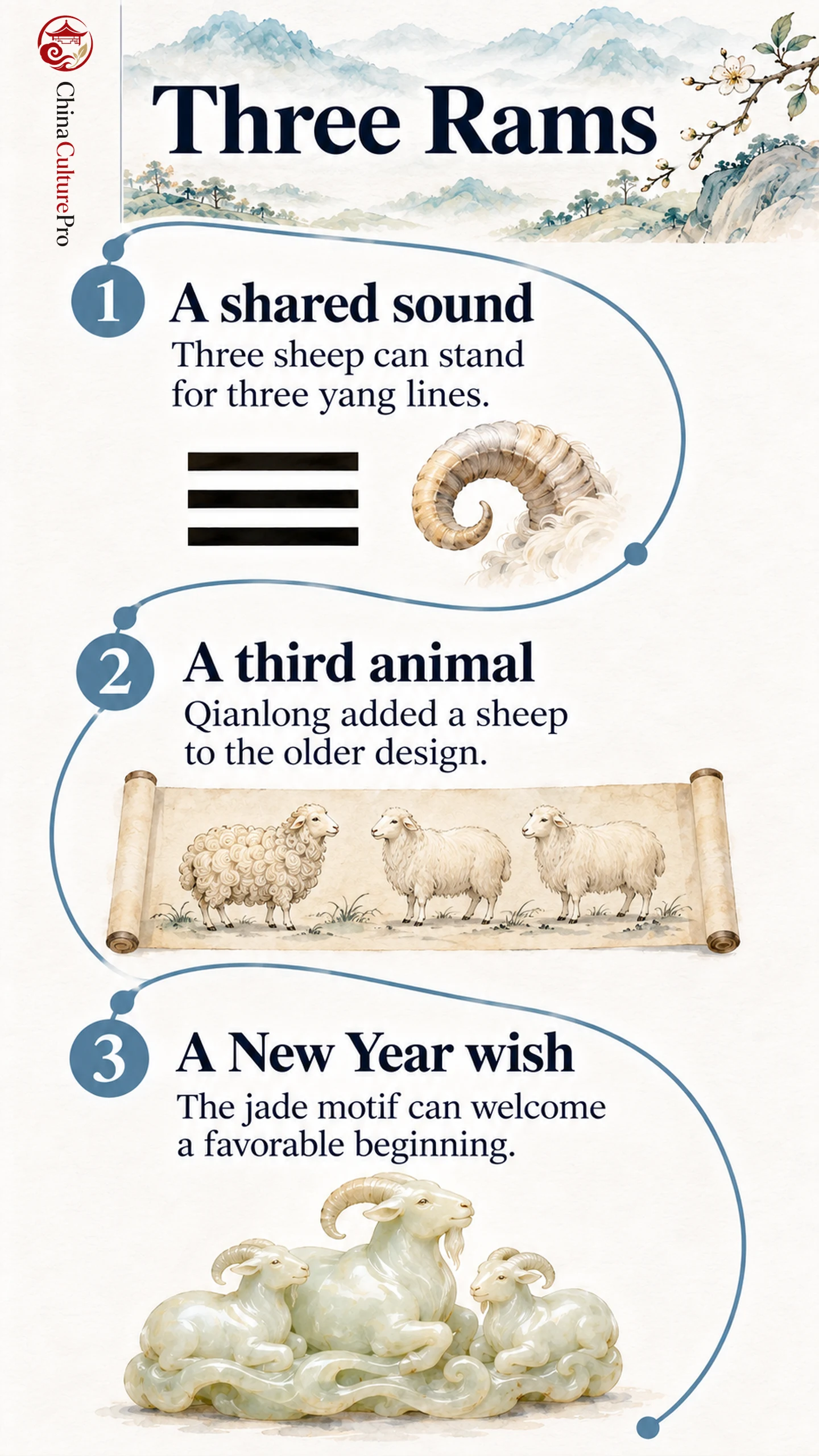
The Qianlong emperor made a version of an older painting of two animals and added a third. A small jade bottle takes another approach: one face shows the animals and the other carries the written phrase. In both works, the image relies on a shared Chinese sound.[1][3]
From Three Yang Lines to Three Animals
The written expression three yang opening prosperity (三陽開泰, sān yáng kāi tài) draws on the Tai hexagram (泰卦, Tài guà) in the Book of Changes. Its three solid yang lines sit beneath three broken yin lines. In the traditional seasonal interpretation used for this motif, the three yang lines evoke the return of spring in the first lunar month.[1]
Sheep or goat (羊, yáng) sounds like yang (陽, yáng). Three pictured animals can therefore evoke the three yang lines without drawing the hexagram itself. The animals carry a wish for an auspicious beginning through their number and name.[1][2]
The Extra Sheep in Qianlong’s Painting
Qianlong’s 1785 handscroll follows Zhao Mengfu’s earlier Sheep and Goat. He added a curly-fleeced sheep at the left. That addition changed the two-animal scene into a recognizable New Year motif. The scroll also includes Qianlong’s essay on the theme, originally composed in 1772 for the opening of the year.[1][4]
The comparison shows what the number contributes. Zhao’s pair had its own composition and inscription. The broader guide to sheep and goats in Chinese art explains other roles for the animals in paintings and vessels.[1][4]
How Jade Objects Carry the Same Wish
A small jade pendant in Taipei groups an adult goat and two young animals. The larger goat occupies the pale center of the stone. Darker areas to either side form the smaller goats. A hole between the animals allows a cord to pass through.[2]
A Qing jade snuff bottle places a relief scene on one face and carves the expression on the other. Turning the object shows both the pictorial pun and the words that resolve it.[3]
FAQs About the Three Rams Motif
Must the motif show three adult male sheep?
The animals can vary. A jade pendant uses one adult and two young goats. The shared name and the count carry the wordplay.[1][2]
Is the design used only in a Goat year?
It can be especially apt in a Goat year. The same design also expresses a broader New Year wish for renewal.[1][2][3]
Источники
[1] Музей Гугун. Qianlong’s Three Rams and Essay on Kaitai
[2] National Palace Museum. Jade pendant with the Three Goats motif
[3] National Palace Museum. Jade snuff bottle with sheep decoration
[4] Smithsonian National Museum of Asian Art. Zhao Mengfu, Sheep and Goat