


Quick Answer: What Are Common Chinese Drinks?
Chinese drinks range from leaf tea and soy milk to sour plum drinks, regional herbal infusions, modern milk teas, fermented grain wines and distilled spirits. Beer, coffee, fruit drinks and plain water also belong to everyday drinking life.
- Start with ingredients: Tea leaves, beans, fruit, herbs and grains lead to very different drinks.
- Check the category: A drink called tea may contain no tea leaves; a grain wine is different from a distilled spirit.
- Choose the setting: Breakfast, a tea gathering, a casual takeaway and a banquet create different possibilities.
No single drink represents every region or household. This overview offers a map, with specialist guides for the traditions that interest you.
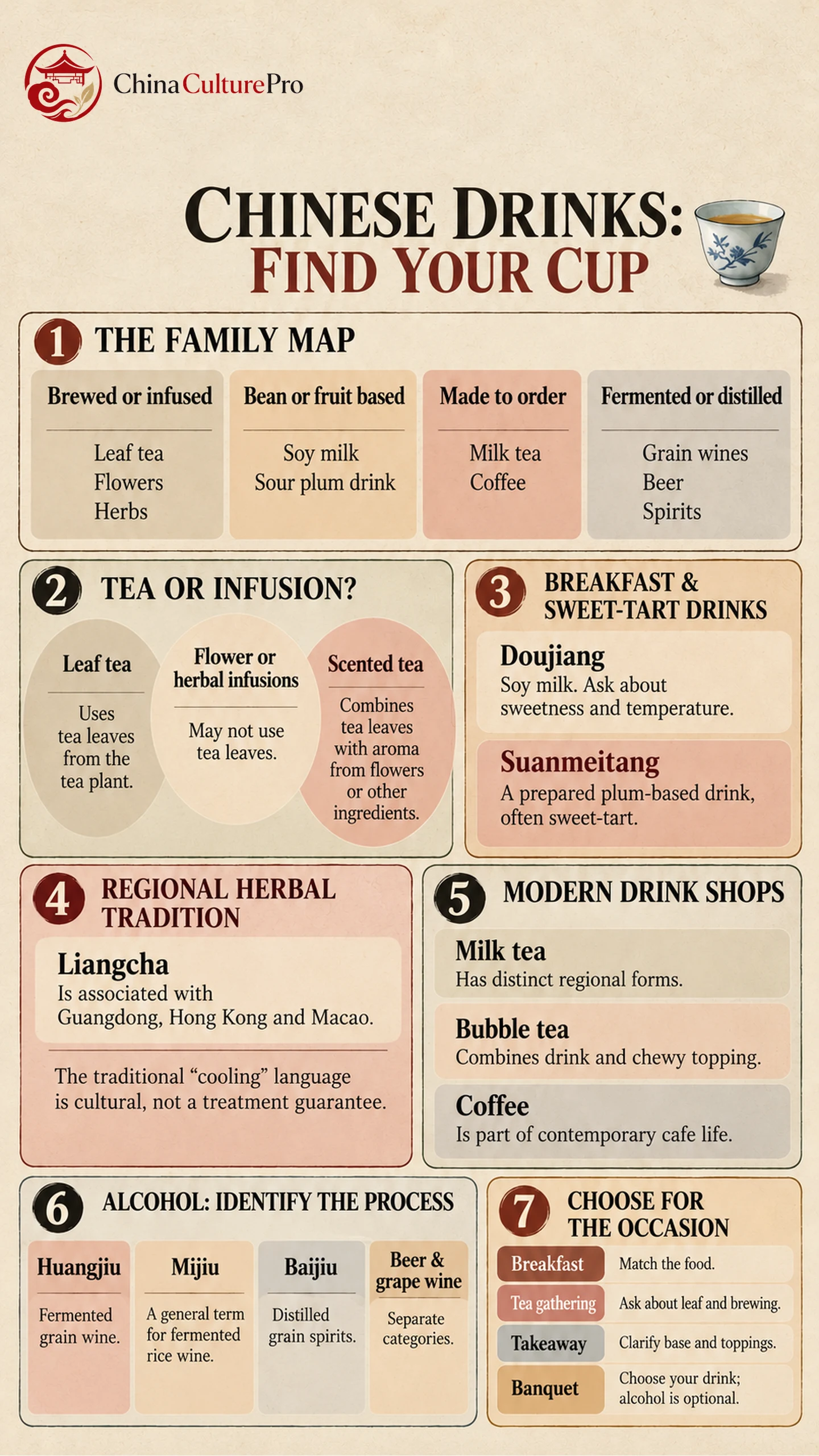
A menu can place centuries-old brewing practices beside a newly invented shop drink. Both can be part of contemporary food culture. The useful approach is to understand what is in the cup and how it is being served, then connect it with the meal, place or social setting rather than treating “traditional” and “modern” as mutually exclusive worlds.
A Map of the Main Drink Families
These are starting points, not rigid boundaries. A modern shop may combine several families in one cup, while a familiar name may cover different regional recipes.
| Drink family | What it helps you recognize |
|---|---|
| Leaf tea | An infusion of processed tea leaves, with varied tea categories and preparation styles. |
| Doujiang (豆浆, dòujiāng) | Soy milk, familiar at breakfast; ask about sweetness and temperature. |
| Suanmeitang (酸梅汤, suānméitāng) | A sweet-tart plum-based drink, strongly associated with Beijing’s summer drinking culture. |
| Liangcha (凉茶, liángchá) | A southern herbal-drink tradition; recipes and bitterness vary, and “cooling” is not simply serving temperature. |
| Milk tea (奶茶, nǎichá) | A broad combination with distinct regional forms, from tea with milk to pearl drinks. |
| Huangjiu (黄酒, huángjiǔ) and mijiu (米酒, mǐjiǔ) | Fermented grain-wine terminology; the exact product, sweetness and strength need checking. |
| Baijiu (白酒, báijiǔ) | Distilled grain spirits with several aroma families. |
| Beer, grape wine and coffee | Other established parts of contemporary drink menus, with their own local scenes. |
The sections below unpack the distinctions and point to more detailed guides. When ordering, a family name is the beginning of the conversation rather than a complete ingredient list.
Tea, Flowers and the Meaning of Tea
China’s tea traditions include green, yellow, white, oolong, black and dark teas, alongside scented teas. Their differences involve processing as well as the leaf material. Tea knowledge also includes picking, preparation, drinking and sharing; it extends beyond classifying a dry leaf.[1] Begin with the Chinese tea culture guide if tea is your main interest.
The word “tea” also appears in English names for flower and herbal infusions. These are not automatically the same thing as leaf tea. A jasmine-scented leaf tea and a cup made only from flowers have different ingredient bases. The Chinese flower teas guide helps separate scented tea from flower infusions.
That distinction is useful when asking about flavor, caffeine or preparation. Look at what was actually brewed rather than inferring everything from the word tea. Mixed cups can contain both tea leaves and other botanicals.
Breakfast Soy Milk and Sweet-Tart Plum Drinks
Soy milk is a familiar choice in Chinese breakfast settings. Its place in contemporary breakfast planning is visible in Shanghai’s official guidelines, which include soy milk among milk and bean-food options.[2] A plain bean-led cup and a sweetened cup are different choices; temperature and accompaniments also vary. The doujiang guide follows those breakfast traditions in detail.
Sour plum drink offers a different flavor direction. Common recipes center on prepared dark plums and may include hawthorn, licorice, osmanthus and sugar. Beijing accounts connect it with summer street drinking and earlier court-associated preparations, but recipes have changed over time.[3] It is not simply fresh plum juice under another name.
The suanmeitang guide explains its sour, sweet and sometimes smoky character. When choosing between these two drinks, think first about whether you want a bean-based accompaniment to food or a sweet-tart fruit-and-botanical drink. Neither has one compulsory recipe shared by every vendor.
Liangcha and Regional Herbal-Drink Traditions
Liangcha has particularly strong cultural associations with Guangdong, Hong Kong and Macao. Its inherited recipes and specialist shops belong to the wider culture of the Lingnan region. The national heritage record describes a tradition guided by Chinese medical concepts, with formulas passed through families and businesses.[4]
Here, “cooling” is a cultural and traditional medical description. It is not evidence that a drink treats an illness, and it does not tell you whether the cup will arrive cold. Some preparations are markedly bitter, while packaged versions may be sweetened.
Ask which preparation is being offered instead of assuming one taste or formula. The liangcha herbal tea guide explores this regional tradition without turning its historical claims into a universal health promise.
Milk Tea, Coffee and Modern Drink Shops
Taiwanese pearl milk tea combines a drink with chewy tapioca; customization can include sweetness, ice, pearl size and milk choices.[5] The bubble tea guide explains how to read those options. The broader Chinese milk tea guide also distinguishes Hong Kong and other styles, so the category does not collapse into one pearl-filled cup.
Coffee belongs in the overview too. Shanghai’s cafe scene includes urban, neighborhood and countryside settings, illustrating how coffee has become part of contemporary social spaces.[6] Explore Chinese coffee culture for that parallel story.
A useful question in a modern drink shop is whether the named base is actually present. A brown-sugar milk specialty may omit tea, while a mixed drink can contain both tea and coffee. Ask about the full recipe when its identity matters to you.
Fermented Wines, Beer and Distilled Spirits
Huangjiu belongs to fermented grain-wine traditions. Shaoxing’s documented craft uses glutinous rice, fermentation, pressing, clarification and later processing and storage.[7] The huangjiu guide explains its styles, while the broader Chinese rice wine guide addresses the overlapping terminology around grain and rice wines.
Baijiu is different: distillation follows fermentation, producing a grain spirit rather than an undistilled wine. Its raw materials and aroma families vary.[8] The baijiu guide introduces that process and its principal styles.
Beer and grape wine should not be squeezed into either grain-wine or baijiu terminology. On a menu, read the product category and alcohol percentage instead of translating every Chinese alcoholic drink as “rice wine.” The Chinese beer history guide offers another branch of the story. Bottle color, sweetness and an old-looking label are poor substitutes for identifying what was brewed or distilled.
Choosing a Drink for the Occasion
For breakfast, start with the food and ask whether a soy drink is sweetened, plain, hot or chilled. For a tea gathering, focus on the leaf and the preparation. For a takeaway specialty, clarify the base, topping and sweetness. At a shared meal, choose a drink that suits your own preferences and the dishes rather than assuming the most famous local alcohol is obligatory.
Toasting is a social act, and alcohol consumption is a separate personal choice. Tea or another drink can accompany your participation. The Chinese drinking etiquette guide covers the practical interactions, while Chinese food culture places drinks within the wider shared table.
Start by asking what the drink is made from. Follow it with how sweet, how hot and, where relevant, how alcoholic. Those answers give you a clearer route through the menu than a national list of drinks everyone supposedly prefers.
FAQs About Chinese Drinks
Are all drinks called tea made from tea leaves?
No. Some names refer to herbal or flower infusions. Check the ingredients to distinguish leaf tea, scented leaf tea and an infusion without tea leaves.
Is Chinese rice wine the same as baijiu?
No. Rice-wine terminology generally concerns fermented drinks, while baijiu is distilled. Rice itself can appear in different categories, so identify the process and product label.
Are Chinese drinks always served hot?
No. Temperature depends on the drink, season, shop and personal choice. Ask about the available serving options instead of assuming one nationwide custom.
Can you toast with a non-alcoholic drink?
Yes. Make your preference clear and use tea, water or another drink. Customs differ, but joining a toast does not require choosing alcohol.
Источники
[1] UNESCO. Traditional Tea Processing Techniques and Associated Social Practices in China
[2] Shanghai Municipal Health Commission and Commerce Commission. Healthy Breakfast Guidelines, Trial
[3] Beijing Municipal Government. Sour Plum Drink: From Court Medicinal Tea to Popular Beverage
[4] China Intangible Cultural Heritage Museum. Liangcha
[5] Taipei City Department of Information and Tourism. A Taster’s Guide to Taipei
[6] Shanghai Municipal Government. Cafes
[7] China Intangible Cultural Heritage Museum. Shaoxing Huangjiu Brewing Technique
[8] Wine & Spirit Education Trust. What Is Chinese Baijiu? An Introduction