

Quick Answer: What Are Baijiu Aroma Types?
Baijiu (白酒, báijiǔ) aroma types are families used to describe and classify Chinese distilled grain spirits. Four basic families provide a common introduction, while expanded lists commonly distinguish twelve named styles.[1][2]
- Aroma is not strength: Read the alcohol percentage separately from the style name.
- Names are not recipes: A sensory association does not establish that the named food was added.
- Families are not rankings: Different styles can suit different tastes, and bottles vary within each family.
Start with a familiar family name, then use the Chinese wording and the product details to identify the specific style.
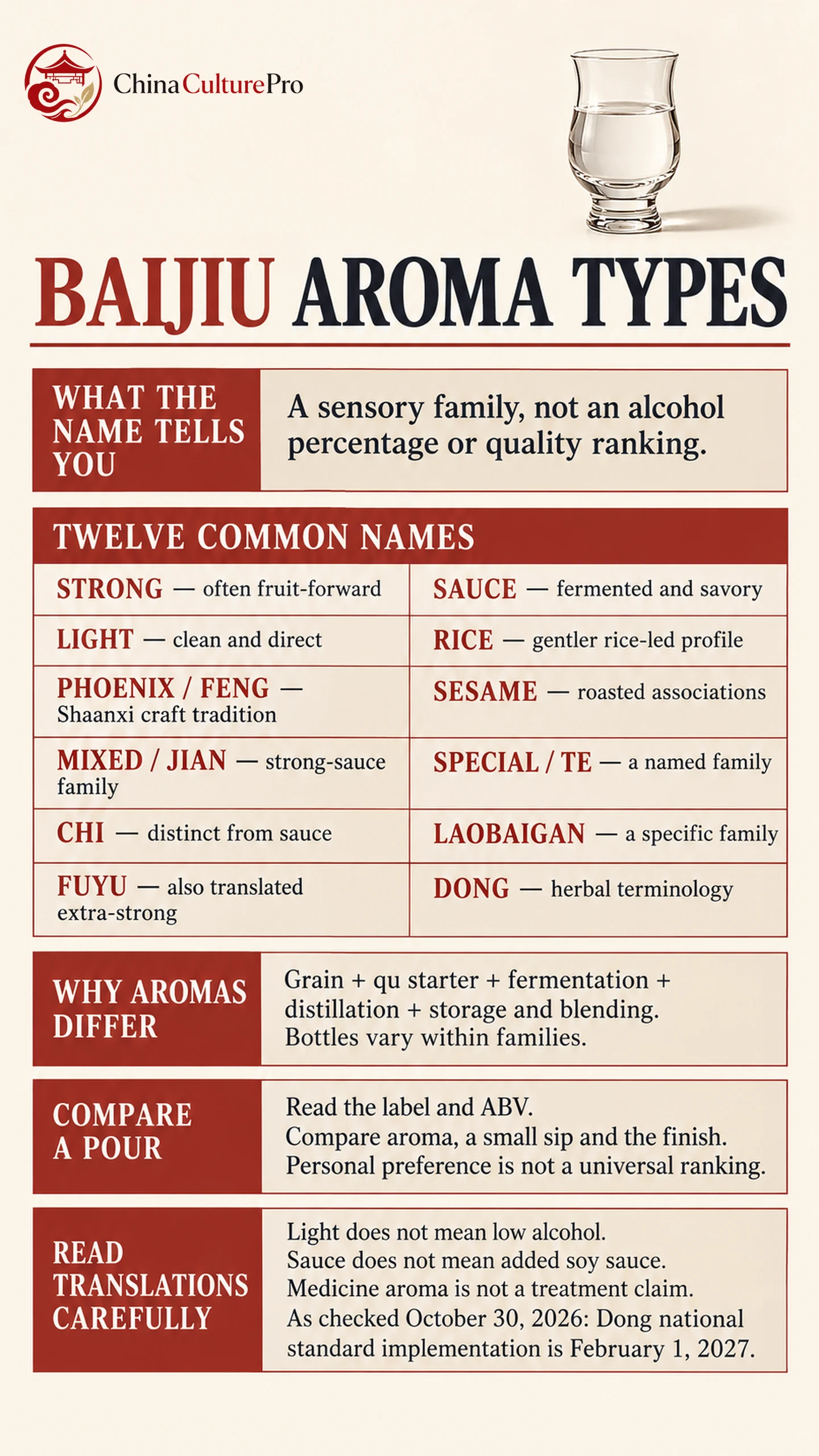
A label can look straightforward until words such as strong, light, sauce or special are read as measurements or quality grades. They serve a different purpose. This guide maps the names and shows how to compare them; the broader baijiu guide explains the spirit’s place in Chinese drink culture.
What an Aroma Type Actually Names
An aroma family identifies a recognized style, not one isolated smell. A bottle may combine fruity, floral, grain-like, savory or roasted impressions while still belonging to one named family. The classification helps orient a comparison, but it cannot replace tasting or the information on the particular bottle.
Keep three questions separate: what style is declared, how much alcohol the bottle contains and whether you enjoy the finished spirit. “Light” and “strong” belong to style vocabulary here; they are not a standardized ladder of alcohol percentages. Nor does the style name establish age, price or superiority.
The four basic families are useful entry points, while the wider set preserves traditions that do not fit neatly into those four labels. English lists can differ in translation, which is why the Chinese names below are useful anchors.[2]
Twelve Aroma Names at a Glance
The first four rows summarize the familiar introductory families. The remaining rows identify eight other common names and explain how to read them. Sensory descriptions are orientation points, not a promise that every bottle has an identical profile.[1][2]
| Aroma family | Useful orientation or reading distinction |
|---|---|
| Strong aroma (浓香, nóngxiāng) | Often pronounced and fruit-forward, with fermented-fruit associations; strong names the family rather than the alcohol percentage. |
| Sauce aroma (酱香, jiàngxiāng) | Fermented, savory and layered associations; the name does not mean soy sauce was added. |
| Light aroma (清香, qīngxiāng) | Often comparatively clean and direct, sometimes floral or fruity; light does not mean low alcohol. |
| Rice aroma (米香, mǐxiāng) | Commonly a gentler rice-led profile; it remains a distilled spirit rather than an undistilled rice wine. |
| Phoenix aroma (凤香, fèngxiāng) | Also written Feng aroma; associated with the Xifeng tradition in Shaanxi, with its own production and storage practices. |
| Sesame aroma (芝麻香, zhīmaxiāng) | Roasted associations are important; sesame-like aroma is a sensory description rather than an ingredient guarantee. |
| Mixed aroma (兼香, jiānxiāng) | Commonly refers to the strong-and-sauce mixed family; it is not a generic label for every blended spirit. |
| Special aroma (特香, tèxiāng) | Also written Te aroma; a named family rather than a premium-quality grade. |
| Chi aroma (豉香, chǐxiāng) | Keep the transliterated name when comparing lists; it is a separate family from sauce aroma. |
| Laobaigan aroma (老白干香, lǎobáigānxiāng) | A specific named family, not a substitute label for every clear or light-aroma spirit. |
| Fuyu aroma (馥郁香, fùyùxiāng) | May appear as extra-strong or richly fragrant in English lists; this translation does not quantify alcohol strength. |
| Dong aroma (董香, dǒngxiāng) | Often described with herbal terminology; older English lists may call it medicine aroma, which is not a health-benefit claim. |
Regional Phoenix craft, herbal-starter Dong production and roasted notes identified in a sesame-style product illustrate different foundations for the wider classification.[3][4][5] Research on a Fuyu product likewise treats its aroma as something to characterize, rather than reducing it to an intensity score.[6] The formal strong-sauce mixed-family name also gives more information than the English word mixed alone.[7]
Moutai is a familiar example inside the sauce family. One well-known product can introduce a category, but its reputation and process should not stand in for every bottle in that family.
Why Production Changes the Aroma
Qu (曲, qū) is a fermentation starter that supplies enzymes and microbial communities. Raw materials, starter choices, fermentation conditions, distillation and later storage and blending all contribute to the finished style. Production education distinguishes solid-state systems and some semi-solid rice-style systems, so not every family comes from one universal pit method.[2]
Aroma reflects combinations of compounds rather than one isolated substance. Sensory research can identify important odorants in a particular product, but that result is bounded by the samples and methods studied. It is not an exact compound recipe that every producer in the family must share.[5][6]
For a reader, this means a family name is a helpful starting map. The more specific explanation comes from the product’s raw materials, craft and actual sensory character. Avoid assuming that two bottles must taste alike merely because their category wording matches.
How to Compare Two Bottles
Choose a comparison that answers one clear question. Two different families can reveal broad contrasts; two bottles within one family can show how much variation the category allows. Read the labels and note the alcohol percentages before attributing every difference to aroma type.
Use small pours and compare a few ordinary observations: the first aroma, the flavor after a small sip and the lingering impression. Words such as fruity, floral, savory or roasted are enough to begin. You do not need to produce an expert vocabulary or identify a specific compound to notice a difference.
If comparing with food, keep the dish reasonably consistent so that a change in the meal does not become the whole explanation. A tasting preference is personal; it does not prove that the family you prefer is objectively the best. The Chinese drinking etiquette guide adds context for shared pours and optional participation.
Reading Translations and Standards
English aliases need interpretation. Extra-strong can sound like a measurement, and medicine can sound like a treatment claim; neither should be used that way when it translates a family name. Match the Chinese style wording before assuming two English lists describe different categories.
Standards have dates as well as titles. At the check on October 30, 2026, the Dong-family national standard GB/T 10781.12-2026 had been published on July 30, 2026, with implementation set for February 1, 2027. It was not yet effective at that check.[8] A publication announcement and an implementation date are different facts.
For everyday reading, identify the named family, the product and the alcohol percentage first. For a technical comparison, check the exact standard and its current status rather than assuming every old English chart uses the latest wording. The Chinese drinks guide places these spirits beside fermented wines and non-alcoholic drinks.
FAQs About Baijiu Aroma Types
Does sauce-aroma baijiu contain soy sauce?
The family name describes sensory associations, not a statement that soy sauce was added. Read the actual ingredient information for the particular product.
Is light aroma a lower-alcohol style?
Not necessarily. The name identifies an aroma family. Compare the alcohol-by-volume figure on the bottles to assess strength.
Is strong aroma better than the other types?
There is no universal best family. Style, individual product quality and personal preference are separate judgments; the word strong does not establish a superior grade.
Why do English lists use different names for Dong and Fuyu?
Translations vary. Dong may appear as herbal or medicine aroma, while Fuyu may appear as extra-strong or richly fragrant. Matching the Chinese names helps resolve the differences.
Источники
[1] Wine & Spirit Education Trust. What Is Chinese Baijiu? An Introduction
[2] Wine & Spirit Education Trust. Level 3 Award in Spirits Specification, May 2019
[3] China Intangible Cultural Heritage Museum. Xifeng Liquor Brewing Technique
[4] China Intangible Cultural Heritage Museum. Dong Liquor Brewing Technique
[5] Li et al. Characterization of Key Aroma Compounds in Chinese Guojing Sesame-Flavor Baijiu by Means of Molecular Sensory Science
[6] Journal of Food Composition and Analysis. Sensory-Directed Decoding of Key Aroma Compounds from Jiugui-Series Baijiu
[7] National Standard Information Platform. GB/T 10781.8-2021: Strong-Sauce Mixed-Aroma Baijiu
[8] National Standard Information Platform. GB/T 10781.12-2026: Dongxiangxing Baijiu