


Quick Answer: What Is Suanmeitang?
Suanmeitang (酸梅汤, suānméitāng) is a Chinese sweet-tart plum-based drink, closely associated with Beijing’s summer drinking traditions. Its core ingredient is prepared dried plum rather than a glass of freshly squeezed plum juice.
- Flavor: Sourness and sweetness lead, sometimes joined by smoky, floral or botanical notes.
- Ingredients: Recipes combine prepared plums with water, sweetener and a varying selection of other ingredients.
- Form: It can be made from dried ingredients or sold as a mix, concentrate or ready-to-drink beverage.
The name identifies a drink tradition rather than one fixed formula. Check the particular preparation when you want to know its taste or ingredients.
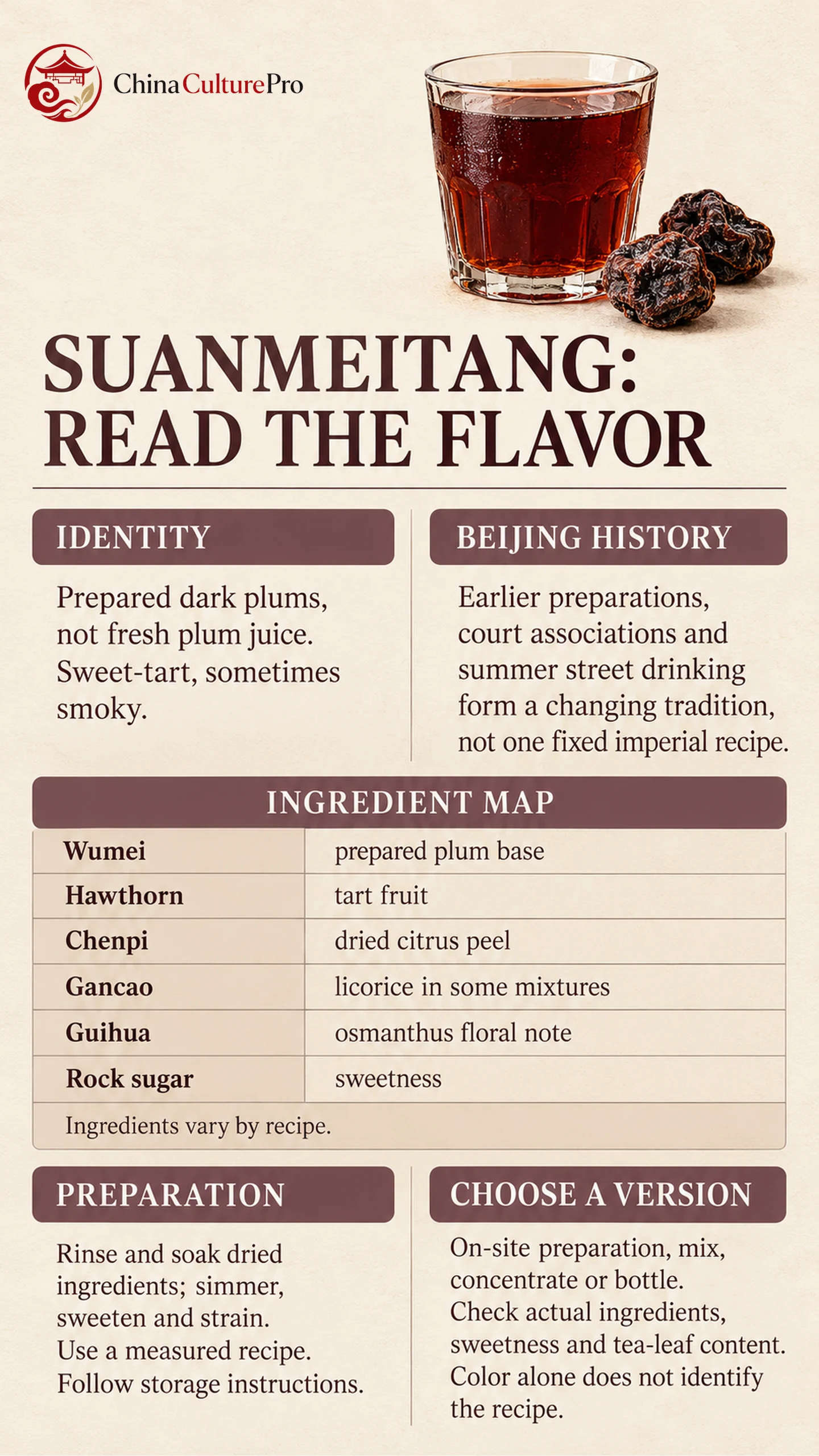
A dark glass of sour plum drink can be surprising if you expect bright fresh-fruit juice. Its character comes from the prepared ingredients and how they are extracted and balanced. Understanding those choices makes the name more useful on a menu and places it within the wider range of Chinese drinks.
A Plum Drink Rather Than Fresh Plum Juice
Wumei (乌梅, wūméi) is the prepared dark plum at the center of the tradition. Historical descriptions explain a smoking process that darkens the fruit, which helps account for the smoky association in some versions.[1] A preparation based on these plums will not taste like simply blending ripe fresh plums with water.
The English word soup sometimes appears because of the final Chinese word in the name. In this context, it identifies a drink rather than a savory bowl with vegetables or meat. The liquid may be served chilled, especially in its familiar summer setting, but the name alone is not an instruction about serving temperature.
Nor is every sour plum drink equally smoky. The actual prepared fruit, other ingredients, concentration and sweetening affect the result. If you dislike one strongly smoky example, that does not establish that every version will have the same balance.
The Ingredients and Their Flavor Roles
Common recipes share a plum base but differ in their supporting ingredients. The table combines examples from a modern Beijing formulation and a culinary preparation; it is not a list required in every version.[2][3]
| Ингредиент | What it contributes to the preparation |
|---|---|
| Wumei | The characteristic prepared-plum foundation, with sourness and sometimes smoky depth. |
| Hawthorn (山楂, shānzhā) | Another tart fruit component, commonly used alongside the plums. |
| Chenpi (陈皮, chénpí) | Dried citrus peel, providing an aromatic direction different from fresh fruit juice. |
| Gancao (甘草, gāncǎo) | Licorice root, included in some botanical mixtures; its presence is recipe-specific. |
| Guihua (桂花, guìhuā) | Osmanthus flowers, used for a floral note in some versions. |
| Rock sugar (冰糖, bīngtáng) | Sweetening that balances the tart ingredients; the amount changes the finished taste. |
These ingredients describe common flavor roles; a particular recipe may use a smaller selection. Some contemporary recipes add hibiscus, for example, while other preparations keep a smaller set of ingredients.[2] A darker or redder color is therefore not enough to reconstruct the recipe.
If you enjoy the floral side, the Chinese osmanthus desserts guide follows the same flower into other foods. For the drink itself, ask about the mixture rather than assuming that a prominent flower name describes the whole cup.
Beijing Summer Drinking and Its History
Beijing accounts connect sour plum drink with earlier medicinal preparations, Qing-era court associations and later popular street drinking. They also describe vendors sounding small copper bowls to draw attention and serving a drink chilled using ice around its container.[1]
That history is richer than a single claim that one emperor invented the modern recipe. Prepared plum drinks, court versions and street refreshments belong to a changing tradition rather than a recipe frozen at one moment. Older references can establish that related drinks existed without proving that every present-day bottle reproduces them exactly.
The history also includes powdered and bottled forms, showing how the drink adapted to new ways of buying and serving it.[1] Convenience products are part of its later story; they should be understood through their actual formulation rather than dismissed or authenticated by packaging alone.
Historical medical language explains part of the drink’s cultural setting; it does not establish a treatment effect. The cultural history and the flavor of a beverage are enough to explain its place at the table without making a health promise.
How the Drink Is Prepared
One common culinary route rinses and soaks the dried ingredients, simmers them in water, dissolves the sweetener and strains the liquid before serving. Use the proportions and extraction time specified by the chosen recipe.[2]
For home preparation, choose food ingredients intended for culinary use and follow a measured recipe. The table above identifies roles; it does not supply quantities. A strong prepared batch can be diluted, and the balance of sweetness and tartness can be adjusted, but those adjustments should start with a known formulation.
Serving temperature is another choice. Cooling the liquid and serving it over ice gives a different impression from tasting it warm, so compare versions at a similar temperature if you want to understand the ingredient balance. Follow the recipe or package guidance for keeping the prepared drink rather than assuming a homemade batch lasts like an unopened commercial bottle.
Choosing a Glass, Mix or Bottle
At a restaurant, ask whether the drink is prepared on site, mixed from a concentrate or poured from a bottle, especially if you are looking for a particular plum or floral character. These are useful preparation differences rather than a ready-made ranking of quality.
For a packaged product, read the full ingredient list, preparation directions and sweetness information. A fruit-forward formula, a more botanical mixture and a strongly sweetened concentrate can all create different expectations. If the name tea is used, check whether tea leaves are actually present; the traditional plum-based idea does not require them.
Sour plum drink is also encountered beside richly flavored food, including Chinese hot pot. Treat that pairing as a flavor preference, not evidence that the drink cancels the effects of a meal. Liangcha и flower infusions offer other drink traditions, each with different ingredients and regional associations.
FAQs About Suanmeitang
Does suanmeitang contain tea leaves?
Not necessarily. A plum-and-botanical preparation can contain no tea leaves. Check a particular product or recipe rather than inferring its ingredients from an English tea label.
Why can sour plum drink taste smoky?
Prepared dark plums can bring a smoky character. Its intensity varies with the fruit, mixture and concentration, so every version need not taste alike.
Is suanmeitang an alcoholic drink?
The usual simmered plum-and-sugar beverage is not a fermented wine. Check the actual formulation if a shop offers a cocktail or another variation under a similar name.
Источники
[1] Zhang Peng, Beijing Daily via Beijing Municipal Government. Sour Plum Drink: From Court Medicinal Tea to Popular Beverage
[2] Judy, The Woks of Life. Sour Plum Drink
[3] Beijing Administration of Traditional Chinese Medicine. Summer Tea-Drink Guide