
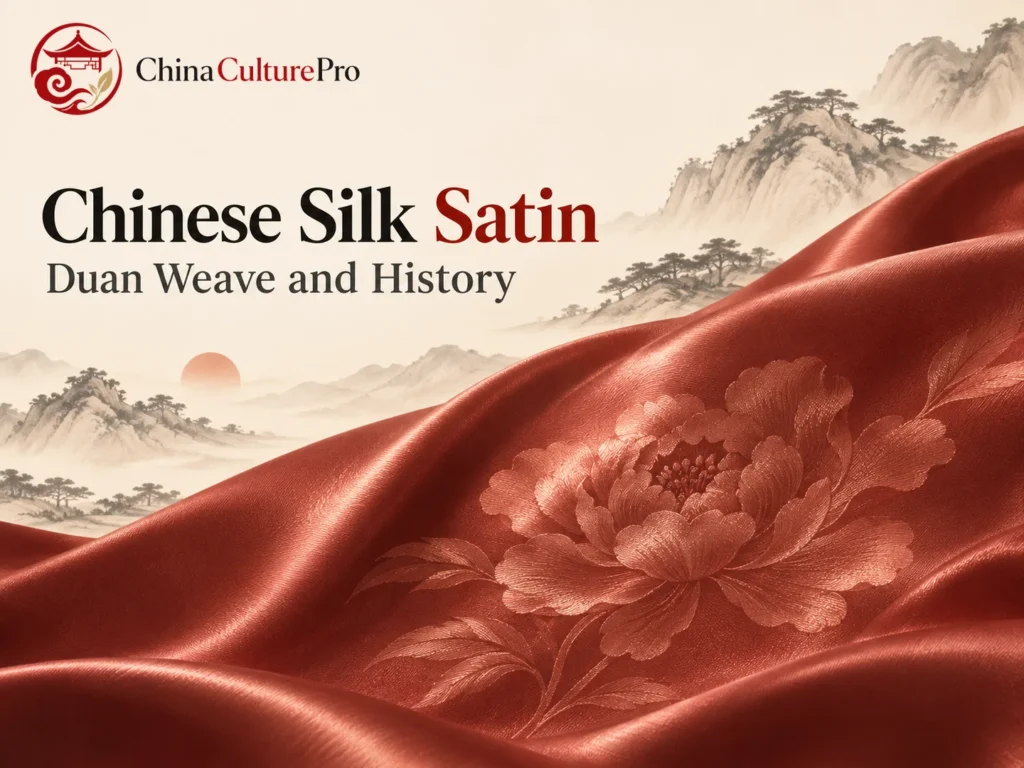

Quick Answer: What Is Chinese Silk Satin?
Chinese silk satin (缎, duàn) is a silk cloth in which long runs of thread give the surface a smooth sheen. In a common warp-faced satin, the lengthwise threads pass over several crossing threads before binding again.[1][2]
- Material: Silk is the fiber. Satin is the way the threads are woven.[1]
- Texture: The long threads on the face reflect light across larger stretches of cloth.[1][2]
- Historical use: Yuan finds include figured satin (暗花缎, ànhuāduàn). Qing examples include court dress and informal clothing.[2][3][4]
Look for the material and weave separately in a textile description.

Turn a piece of satin toward the light and its surface brightens. In some Chinese silks, a leaf or flower becomes visible only when the cloth catches the light. The silk can be one color throughout. The loom makes the design by changing which threads show on the face.
How Satin Weave Creates a Smooth Face
Warp threads run the length of a cloth and weft threads cross it. In a simple five-thread warp-faced satin, each warp thread runs over four wefts and under one. The places where adjacent warps dip below the face are staggered. This leaves a smooth surface of warp floats, or lengths of thread between binding points.[1]
On plain warp-faced satin the reverse shows more weft and often looks duller. For a closer look, use a detail photo or an enlarged weave diagram and follow one thread through several crossings. If the satin is figured, compare the pattern and background separately. Shine alone leaves the weave and fiber uncertain. Compared with Chinese silk gauze, satin emphasizes a smooth face, while gauze emphasizes openings between threads.
Plain, Figured and Shot Satin
Plain satin (素缎, sùduàn) has a consistent satin ground without a woven figure. That ground can still carry designs worked later with a needle. Figured satin can alternate warp-faced and weft-faced areas. The figure and background reflect light differently, so a pattern can be visible even in a single color. The difference is easiest to see where the same motif looks light from one angle and dark from another.[2]
Shot satin (闪缎, shǎnduàn) uses different colors for the warp and weft. The China National Silk Museum describes Ming and Qing examples in which a warp-faced satin ground carries areas of weft-faced satin or twill. When the two sets of yarn are sharply different in color, even small glimpses of the weft change the look of the ground.[2]
The word brocade can describe other approaches to a woven figure. In Song brocade, the term also names a textile tradition with its own structures, patterns and uses.[2]
From Yuan Finds to Qing Robes
The China National Silk Museum cites figured satin from Qian Yu’s Yuan dynasty tomb in Wuxi, Jiangsu. The Wuxi find establishes the presence of figured satin in a Yuan burial. The museum notes that duan became more frequent as a fabric name in Ming and Qing sources. Guangdong’s satin was traded within China and overseas.[2] A Canton export shawl with shaded blue silk stitches, described in the guide to Yue embroidery, shows one use for satin as an embroidery ground.
An eighteenth-century woman’s state robe at the Metropolitan Museum of Art has a silk satin ground patterned with extra wefts. Silk and metallic threads were also used to embroider the cloth. A nineteenth-century short informal robe in the same collection has silk and metallic-thread embroidery on satin, showing its use outside formal court dress. The state robe also retains its attached collar and uses a high-ranking orange-yellow color, details that help explain its place at court. The short robe’s catalog identifies its informal use without assigning it the same ceremonial role. In a museum label, “satin” tells you about the ground, “extra wefts” describes patterning done at the loom, and “embroidery” describes needlework added to the cloth. All three can appear on one garment. If a description names only embroidery on satin, it establishes a woven ground with added stitches but leaves open whether the ground has a separate woven figure.[3][4]
Shu embroidery offers another example of how a needleworker builds a design on an already woven ground.
FAQs About Chinese Silk Satin
Is satin always made of silk?
No. The name satin describes a weave. A label that reads silk satin gives both the fiber and the structure.[1]
Is satin stitch the same as satin weave?
Satin stitch uses parallel embroidery stitches to fill a shape on a fabric that is already woven. Satin weave is made on a loom.
Do 缎 and 段 mean the same thing in old records?
The older spelling (段, duàn) could denote a unit for measuring cloth in earlier Chinese sources. Read it in context before identifying it as satin.[2]
Источники
[1] Textile Research Centre, Leiden. Satin Weave
[2] China National Silk Museum. What Are Ling, Luo, Chou and Duan? Part Two
[3] The Metropolitan Museum of Art. Woman’s Robe of State
[4] The Metropolitan Museum of Art. Woman’s Short Informal Robe