


Quick Answer: What Is Shu Embroidery?
Shu embroidery (蜀绣, Shǔxiù) is a regional needlework tradition associated with Chengdu and the wider Bashu area of southwest China. Embroiderers work designs onto prepared fabric, often using silk threads on soft satin. The work can decorate garments and furnishings or form a picture for display.[1][2][3]
- Material: Silk threads can differ in thickness and twist, even within one picture.[2]
- Technique: Some stitches blend colors, while others build clearly repeated patterns.[3]
- Forms: Accounts document both single-sided and double-sided work.[4][5]
Read the ground, thread and stitch before making an attribution from the subject alone.
The surface of an embroidered fish can change from bright to pale as the light moves. In another work, small repeated shapes can organize an entire scene. Both effects come from how the embroiderer places the silk.
Silk Thread, Satin and Two Stitch Effects
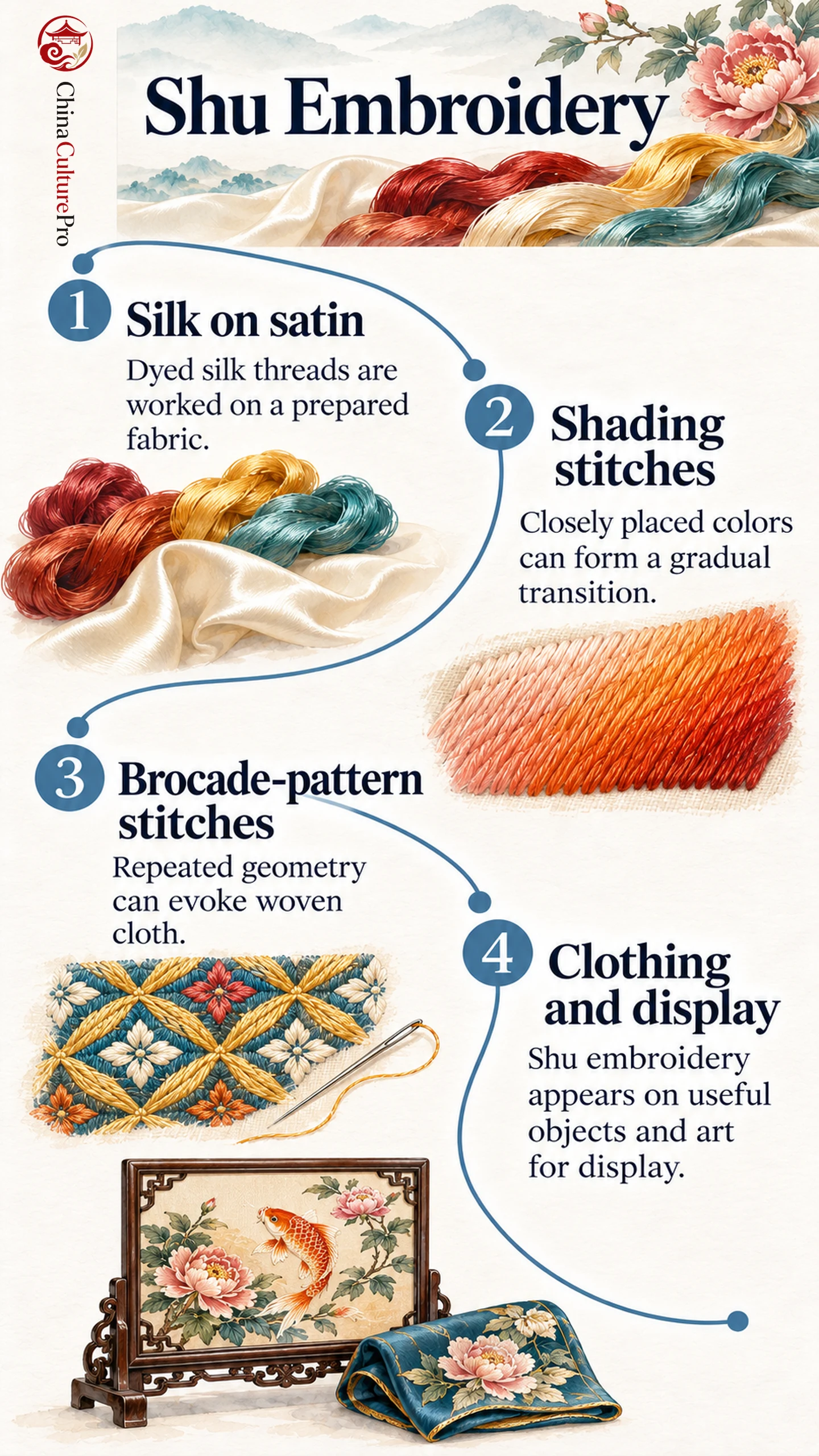
A heritage account from Chengdu describes soft satin and dyed silk threads, including relatively loose, coarse strands and finer, more tightly twisted silk. A loose strand can spread over more of the surface, while a tighter strand can keep a narrower line. A close-up of the finished work can show where the embroiderer needed even coverage or a sharper edge. The satin provides the ground for the stitches. Its smooth face is a feature of Chinese silk satin, which has its own woven structure.[2]
A shading stitch (晕针, yùnzhēn) can help one thread color blend into another. A gradual transition needs stitches and neighboring colors that can meet without an abrupt line. That approach suits a rounded surface or an area where light fades into shadow. A brocade-pattern stitch (锦纹针, jǐnwénzhēn) instead uses repeated geometric arrangements. It can suggest the regular look of woven brocade on an embroidered figure’s clothes. Look at the boundary between two colors. A graded passage can soften that boundary, while an embroidered geometric unit has an edge that recurs. Those effects can sit side by side on a single piece of fabric.[3]
From Household Needlework to Professional Workshops
The Chengdu heritage entry places the craft in the history of silk production in the region and describes professional embroiderers and workshops in Ming and Qing times alongside household needlework. A study of the brocade-pattern stitch describes an embroidery department at the Sichuan industrial promotion bureau established in Chengdu in 1903. The bureau’s department also brought painters’ drawings into embroidery designs. The study cites drawings of landscapes, birds, flowers and fish among its examples.[1][3] In Xi’an Qin embroidery, the openings in the gauze itself help the embroiderer turn a drawn design into stitches.
The same study describes the influence of Gu embroidery on Sichuan makers. The Chengdu tradition entered the national list in 2006. In 2008, Yuzhong in Chongqing was added as an extension. The broader Chinese embroidery guide places these traditions alongside others, including Hunan’s Xiang embroidery.[1][3][4]
Two Shu Embroideries and How to Read Them
A heritage account names a large Hibiscus and Carp screen for the Sichuan Hall of the Great Hall of the People. The work is an example of needlework made at a scale suited to display. Fish and flowers can also appear on smaller domestic pieces, so subject alone does not establish the size or use of a work.[5]
In 1989, Cui Hong designed and Wei Guangjian embroidered Flooding of Jinshan, a scene from the White Snake story. A study of the piece notes that repeated brocade-pattern stitches help organize the picture itself. The regular texture establishes repeated units across the picture. A technique used for a small section of an image can also shape the whole composition. The familiar story provided the subject, and the layout of the stitches gave the work its modern appearance.[3]
FAQs About Shu Embroidery
Is Shu embroidery the same as Shu brocade?
Shu embroidery is made with stitches on an existing fabric. In Shu brocade, a loom makes the pattern as it weaves the cloth. An embroidered surface can imitate the look of woven brocade.[2][3]
Are all Shu embroideries double-sided?
No. Heritage records describe single-sided and double-sided work. A catalogue or workshop description can identify whether both sides were intended to be seen.[4][5]
Can a fish motif identify a Shu embroidery?
Fish appear in documented Shu works and can occur elsewhere. Consider the catalogue attribution, construction and place alongside the subject.[1][5]
Источники
[1] China Intangible Cultural Heritage Digital Museum. Shu Embroidery in Chengdu
[2] China Intangible Cultural Heritage Digital Museum. The Shu Embroidery Tradition in Sichuan
[3] China Arts and Crafts Association. Shu Embroidery’s Brocade-Pattern Stitch, From Representation to Modern Design
[4] China Intangible Cultural Heritage Digital Museum. Shu Embroidery in Yuzhong
[5] China Intangible Cultural Heritage Digital Museum. Shu Embroidery and Its Representative Works