
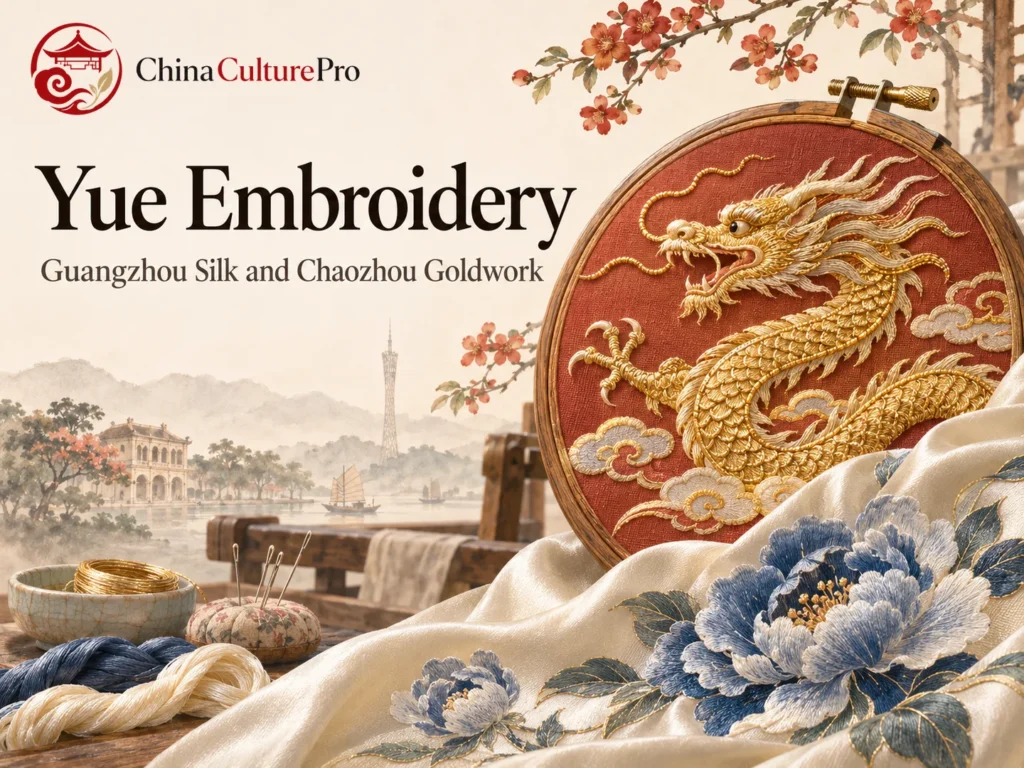

Quick Answer: What Is Yue Embroidery?
Yue embroidery (粤绣, Yuèxiù) is a Guangdong needlework tradition. Its principal branches are Guang embroidery (广绣, Guǎngxiù), centered on Guangzhou, and Chao embroidery (潮绣, Cháoxiù), centered on Chaozhou.[1][2]
- Silk shading: Fine colored threads can give leaves and petals a gradual change in tone.[1][4]
- Metal threads: Metallic threads can lie flat against the fabric or rise over padding.[1][2]
- Objects: Examples include Canton export shawls, Chaozhou stage costumes and embroidered screens.[1][3][4]
A label that identifies the place, object and stitch technique is more informative than a description based on gold color alone.

On a Canton export shawl, a peony can appear to fold inward because its shades of blue change across the petal. On a Chaozhou screen, a dragon can cast a tiny shadow because its body is raised above the background. The shawl creates depth through color. The screen creates it by lifting the thread above the cloth.[1][4]
How Silk and Metal Threads Create Different Surfaces
The national heritage entry groups Yue work by materials, including silk floss, gold and silver threads, other thread work and beading. Silk floss can follow a curved outline or fill it in several shades. The visual effect depends on the direction of the thread and where neighboring colors meet.[1]
Metallic thread can be laid across the surface and fastened with small stitches. This is called couching. To create raised work, an embroiderer builds up the shape below the visible thread. Chaozhou embroiderer Kang Huifang, a nationally recognized practitioner, has been documented teaching students how to use cotton padding. If the thread sits over padding, the shape can remain visible even when the metallic thread is in shadow.[1][2]
Guang Embroidery and the Canton Export Trade
The Guang tradition developed in Guangzhou and nearby districts, including Panyu and Shunde. The Hong Kong Museum of Art documents a Canton embroidered shawl made with three blues embroidery (三蓝绣, sānlánxiù). On satin, graded shades of blue silk make the petals and leaves of peonies appear to have depth. The textile itself can be understood through Chinese silk satin, which explains the ground under the stitches.[1][4]
The museum also holds a black silk shawl with figures in a garden, long fringe and knotted edging. The fringe gives the embroidered rectangle a flexible edge that hangs freely when worn. The museum links this format to fashion from the late nineteenth to the early twentieth century. These objects show how workshops could adapt decorative needlework to objects in Guangzhou’s export market.[3][4] The same museum collection includes an export tea service made in gilt Chinese silver filigree, where floral scrolls take shape in wire.[3]
Chao Embroidery on Costumes and Screens
Chao embroiderers made things for daily use, stage performance, ceremonial use and display. The national heritage entry cites the Nine Dragons Screen as an example of multiple methods on a single piece. Raised gold-thread work brings the dragons into relief. On a costume, the same distinction between raised and flat work can help you see which details were meant to catch the light as the fabric moved.[1]
The same city developed carved and gilded wood surfaces. A comparison with Chaozhou woodcarving helps separate the source of relief in the two crafts. An embroiderer builds the forms above cloth, while a woodcarver shapes them in a solid block.
FAQs About Yue Embroidery
Is Canton embroidery the same as Yue embroidery?
Canton embroidery often refers to Guang embroidery from Guangzhou, particularly in discussions of export textiles. Yue is the wider Guangdong name and includes the Chaozhou tradition.[1][2][4]
Does Yue embroidery always use gold thread?
Silk floss, metal thread and beads are all documented materials. The all-blue thread work on a satin Canton shawl is a concrete example of color shading in silk.[1][4]
Источники
[1] China Intangible Cultural Heritage Digital Museum. Yue Embroidery and the Guang Tradition
[2] Outlook Weekly. Chaozhou Heritage Crafts and Kang Huifang
[3] Hong Kong Museum of Art. Muwen Tang Collection
[4] Hong Kong Museum of Art. Three Cities Exhibition Pamphlet