


Quick Answer: What Is Fan Ju?
Fan Ju (范雎, Fàn Jū) was a native of Wei who became chancellor of Qin in the third century BCE. His biography in Sima Qian’s Records of the Grand Historian links his advancement to political counsel and to his challenge to powerful figures around the Qin ruler. Some editions write his name as 范睢.[1][2]
- Career: Fan Ju found an opening at the Qin court after fleeing Wei.
- Patronage: A Qin envoy introduced him and gave his advice a hearing.
- Policy: His biography associates him with a change in how Qin approached other states.
The surviving speeches reveal how later writers presented counsel at court. Their exact wording is difficult to verify.
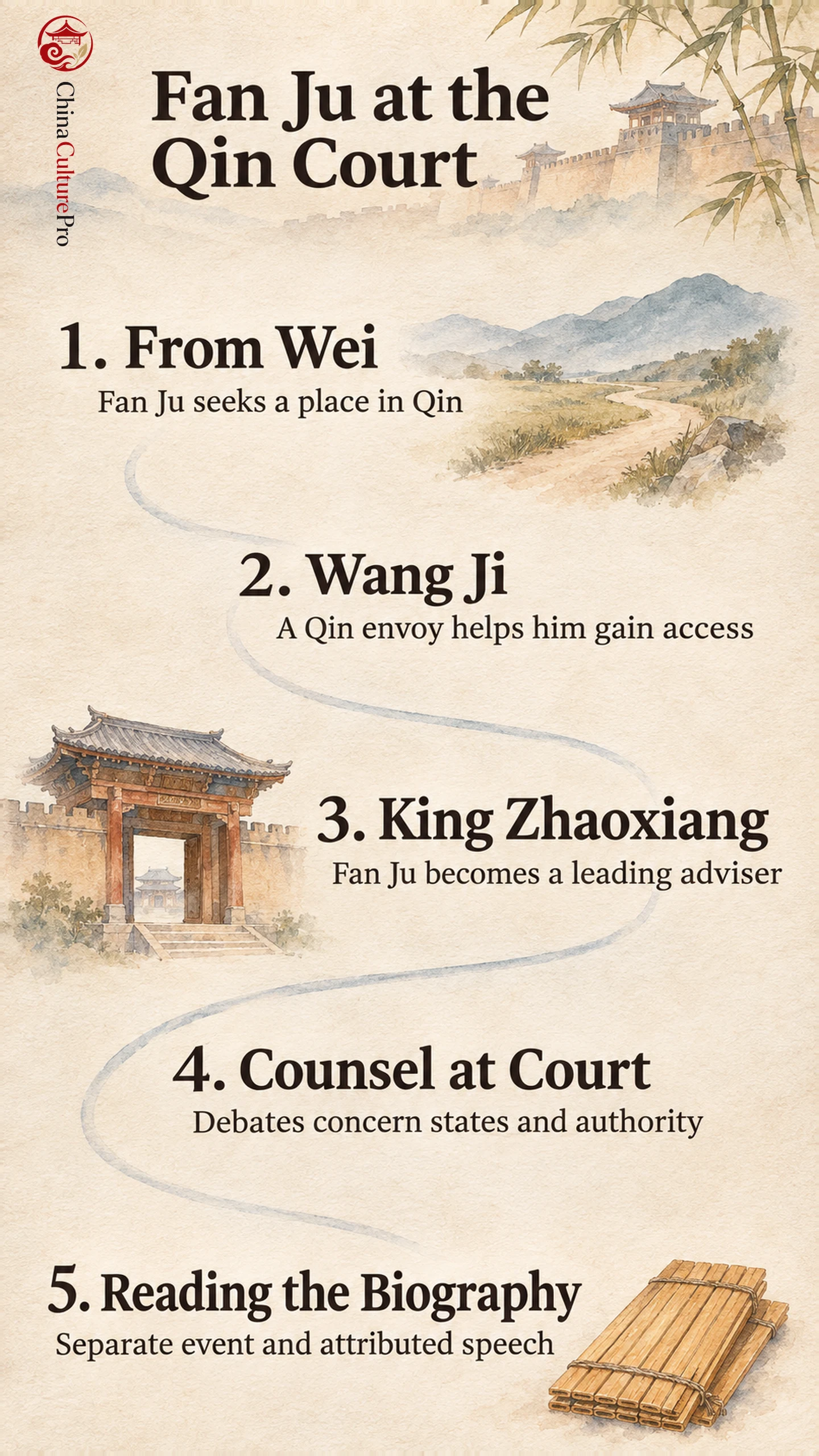
An outsider entering Qin needed both a patron and a reason for the king to listen. Fan Ju’s biography turns those problems into a story about persuasion, access and the ties between service and power.
How Fan Ju Entered Qin
The biography portrays Fan Ju as a man who survived a violent break with patrons in Wei. He travelled to Qin with help from the envoy Wang Ji (王稽, Wáng Jī). In Qin he gained the attention of King Zhaoxiang (秦昭襄王, Qín Zhāoxiāng Wáng) and became a leading adviser.[1][2]
The episode shows how one court could recruit talent from a rival state during the Warring States period. The story of his first audience matters partly because it explains how an outsider became eligible to challenge established officeholders.
What His Best Known Policy Meant
The biography associates Fan Ju with counsel summarised as ally with distant states and attack nearby ones (远交近攻, yuǎn jiāo jìn gōng). In the narrative, the advice calls into question a project directed at the distant state of Qi. The state of Qin under Zhaoxiang preceded the later Qin dynasty that ruled after unification in 221 BCE.[1][2]
Fan Ju also criticized the concentration of power in the families and associates of the ruler’s relatives. In the biography, advice about relations between states and advice about who should exercise authority at court reinforce each other.[1]
How to Read the Speeches
Start by separating actions from dialogue. A change of office, a mission and a speech placed in someone’s mouth have different kinds of support. A later chronological retelling sometimes points to inconsistencies between the claims in the speeches and the recorded sequence of events.[2]
Collections of Warring States persuasion reward close reading because the speaker’s authority is part of the story. The words attributed to Fan Ju reveal what made a proposal persuasive to the compiler’s audience, even when an exact exchange cannot be recovered.[1][3]
FAQs About Fan Ju
Why Is Fan Ju Sometimes Written Fan Sui?
Some editions use the visually similar character 睢 where others use 雎. The name denotes the same adviser and chancellor.
Did Fan Ju Serve the First Emperor?
He served King Zhaoxiang earlier in the third century BCE. The First Emperor’s rule over a unified empire began in 221 BCE.
Источники
[1] Sima Qian, Records of the Grand Historian. Chapter 79, Biographies of Fan Ju and Cai Ze
[2] Lü Zuqian, Records of Major Events. Chapter 20, Narrative and Notes on Fan Ju
[3] Yuri Pines. A Speechless Monarch: Early China’s Battle for Intellectual Authority