


Quick Answer: Who Was Li Shishi?
Li Shishi (李师师, Lǐ Shīshī) was a singer remembered in an account of the Northern Song capital, Kaifeng. Meng Yuanlao lists her among noted performers. Later accounts connect her to Emperor Huizong, and historical fiction gives her a role in the affairs of the Liangshan outlaws.[1][2][3][4][5]
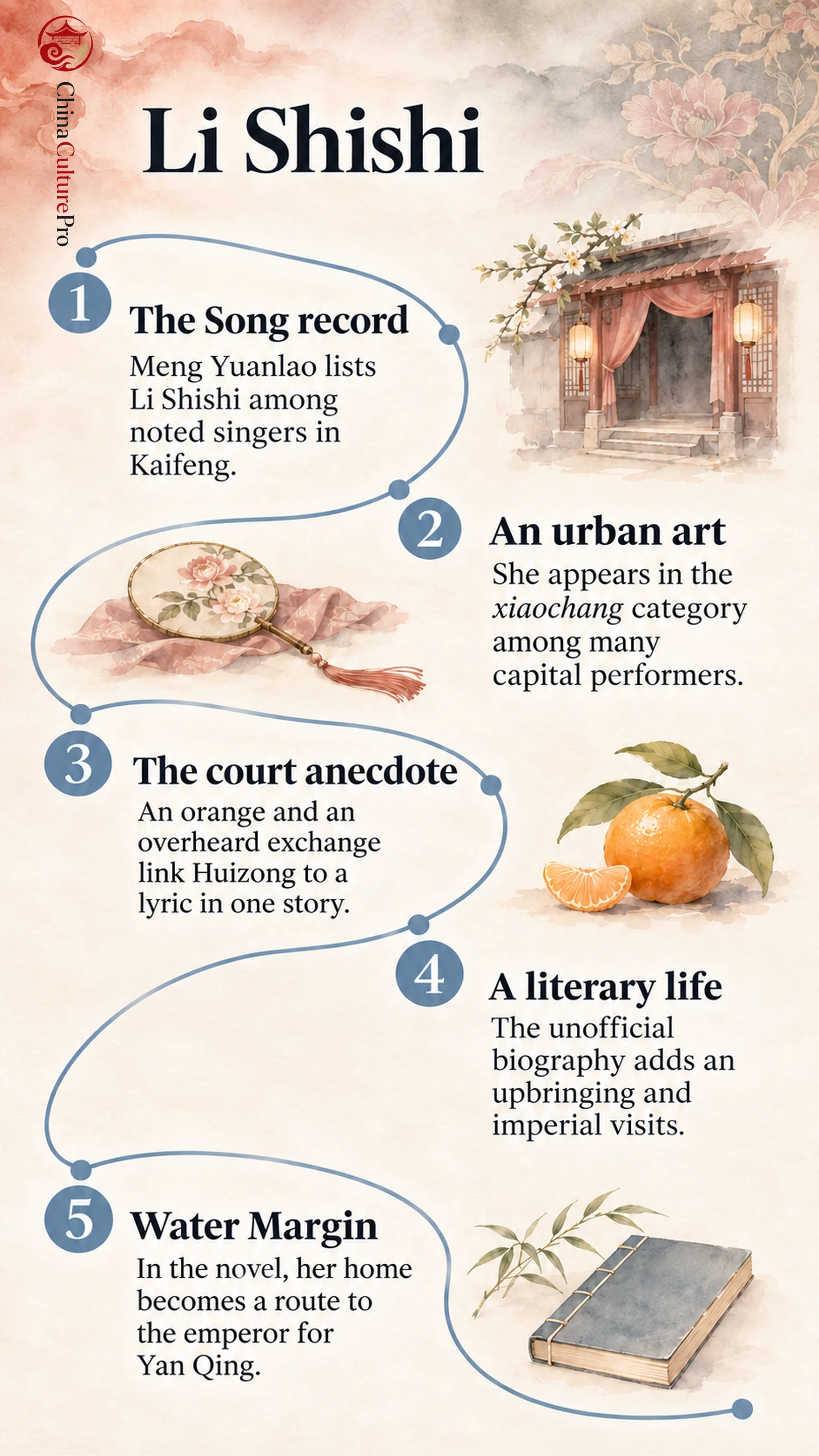
- Song record: A memoir of the capital identifies her among performers of a particular kind of singing.[1][2]
- Court anecdote: Stories about Huizong and the lyricist Zhou Bangyan add private visits and dialogue.[3][4]
- Later fiction: A classic novel makes her household a way to reach the emperor.[5]
The records give a firm place to start with her public reputation. They leave much of her private life and final years uncertain.[1][3][4]
Open a Song account of Kaifeng’s entertainment quarters and you find a singer listed alongside other performers. Open a later tale and the same name leads to a private meeting with an emperor. The difference gives us two ways to understand why she is remembered.
What the Song Record Says About Li Shishi
In a section on the capital’s entertainment quarters, Meng Yuanlao places her among the leading performers of xiaochang (小唱, xiǎochàng), a form of singing. Nearby entries name storytellers, puppeteers and actors, along with other kinds of singers. The list gives a professional context for her reputation.[1][2]
The memoir looks back at Kaifeng, the Northern Song capital. It describes entertainment as part of city life, with performers known for particular arts. The account of Song Kaifeng city life gives this world more room. For Li Shishi herself, the list supplies a name and a performance category, with few details about her life outside that setting.[1][2]
What the Huizong Anecdotes Add
One anecdote involves Emperor Huizong, Li Shishi and the lyricist Zhou Bangyan. An emperor’s visit, a fresh orange and an overheard exchange supply the material for a song in the story. It is a vivid explanation for how a lyric came to be written. Scholars handle the anecdote carefully because its details depend on the transmission of a story about the lyricist.[3]
The anonymous tale often called the Unofficial Biography of Li Shishi gives her an elaborate upbringing and depicts a visit by the emperor. Such details show what literary accounts could add to a remembered performer’s life. For the broader political and cultural setting, the Song dynasty guide covers the world in which those accounts place her.[4]
How Water Margin Used Her Fame
Water Margin (水浒传, Shuǐhǔ Zhuàn) uses Li Shishi as a character. In the novel’s 120-chapter version, Yan Qing enters her household and gains a way to approach the emperor about the Liangshan group. The scene gives her a place in the plot between the outlaws and the court. It also shows what a novelist could do with her reputation.[5]
FAQs About Li Shishi
Was Li Shishi a real performer?
A Song account of Northern Song Kaifeng names her as a singer among the capital’s leading performers. That is the strongest starting point for identifying her historical role.[1][2]
Was her relationship with Huizong established by the performance list?
The performance list records her public art. The stories about Huizong’s private visits come through anecdotes and literary accounts.[1][3][4]
Источники
[1] Meng Yuanlao. Dreams of Splendor of the Eastern Capital: Performers in the Capital
[2] Korean Journal of Chinese Language and Literature. Reading Meng Yuanlao’s Account of Northern Song Kaifeng
[3] Library and Archives Canada. The Lyrics of Zhou Bangyan: Study and Translation
[4] Anonymous. The Unofficial Biography of Li Shishi
[5] Chinese Text Project. Water Margin, Chapter 81