

Quick Answer: What Is Consort Wan and the Chenghua Court?
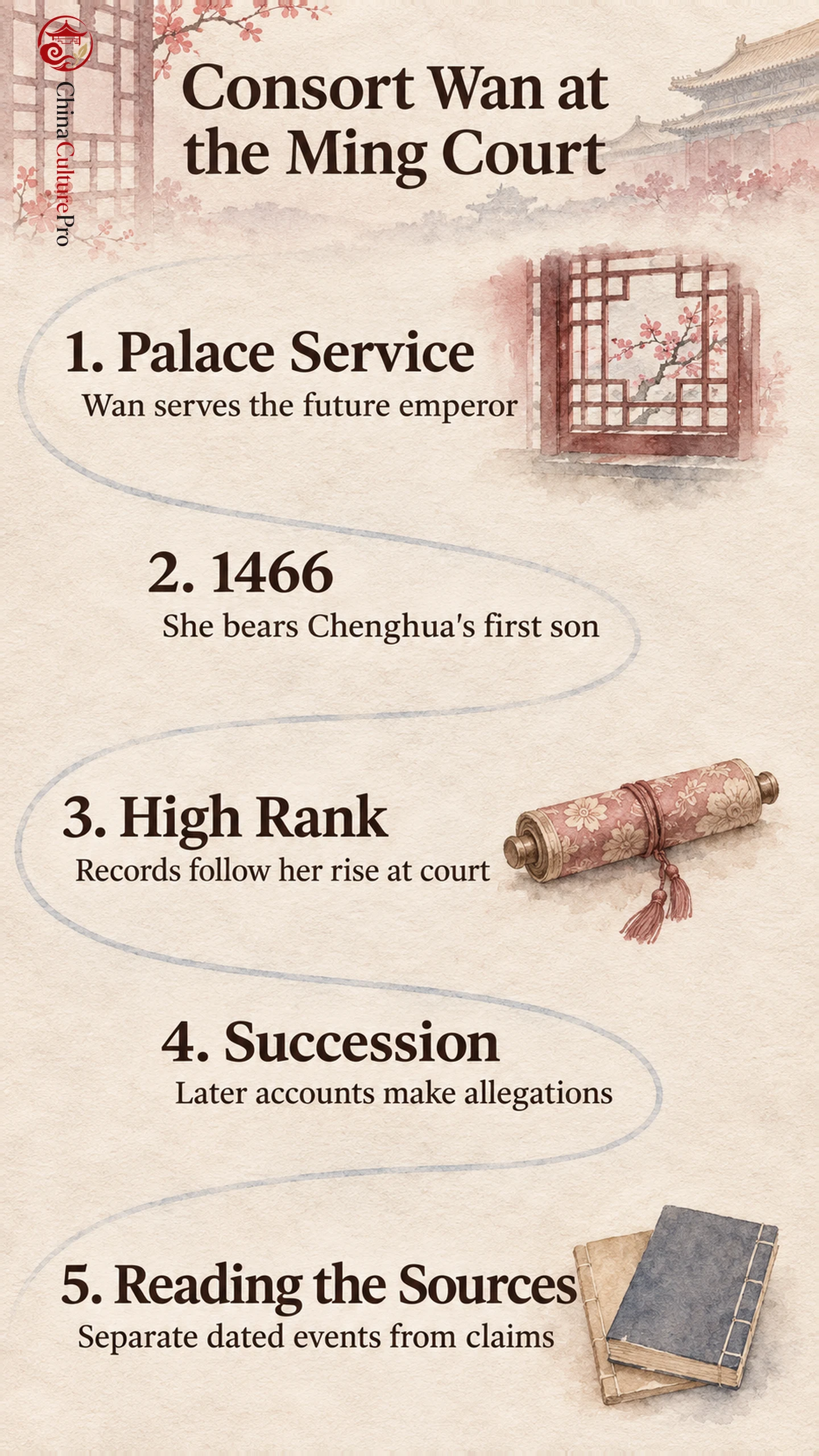
Wan Zhener (万贞儿, Wàn Zhēn’ér) served in the Ming palace and became a favoured consort of the Chenghua Emperor (成化帝, Chénghuà Dì). She bore his first son in 1466 and received a higher rank. Her position in the court is well established. Later accounts of her conduct require more careful reading.[1][2]
- Palace service: She served in the household before the emperor took the throne.
- Rank: Official histories record her elevation following the birth of a son.
- Reputation: Later sources linked her to struggles over succession and cast her as a villain.
A recorded birth, promotion or funeral carries a different kind of evidence from an accusation about a death behind palace walls.
Wan appears in court records under a series of titles. Later readers may know her by her personal name or by a dramatic characterization. The difference can obscure what each source actually tells us about her place in the palace.
From Palace Service to High Rank
The History of Ming places Wan in the service of Empress Dowager Sun as a girl. She later served the future Chenghua emperor while he was still heir. He became emperor in 1464, so their association preceded his reign.[1]
Their son was born in 1466 and died in infancy. Sources register her changing titles and high position through events such as promotions and honours. She later held the title imperial noble consort (皇贵妃, huángguìfēi), a distinct rank below empress in the palace of the Ming dynasty.[1][2][3]
Why the Succession Shaped Her Reputation
The lack of a surviving son during part of the reign made imperial births a concern at court. Another consort, Lady Ji, bore the son who later reigned as the Hongzhi emperor. The official history connects that succession story with serious allegations about Wan, including responsibility for Lady Ji’s death.[1]
Those allegations circulated through different kinds of writing. Some authors recorded court business and others told stories about palace intrigue. A close reading of women in Chinese history considers how rank and access shaped court politics as well as how later writers cast women in stories about a dynasty’s fortunes.[2][3]
How to Read the Accounts
Start with the dated record of a birth, appointment or death. Then ask which source first adds an accusation, what evidence it cites and how much later it was written. A modern television plot may draw on this tradition while supplying motives and conversations the surviving documents cannot establish.[1][3]
Wan died in 1487. The official record of mourning and honours helps establish how she was treated at the end of Chenghua’s reign. Questions raised after that reign tell us how quickly the political circumstances for describing her could change.[1]
FAQs About Consort Wan and the Chenghua Court
Was Consort Wan an Empress?
She was an imperial consort and held high rank. The title imperial noble consort and the title empress were distinct.
Do the Sources Prove the Allegations Against Her?
The History of Ming records accusations, but its account was compiled under the Qing. A specific charge needs independent evidence before it can be taken as an established event.
Источники
[1] History of Ming. Chapter 113, Court Women and Consort Wan
[2] Imperial Compendium. Palace Section, Account of Chenghua’s Consort Wan
[3] Ye Fangru. Consort Wan’s Image in Historical Writing Since the Ming and Qing