

Quick Answer: What Is The Lay–Osborn Flotilla?
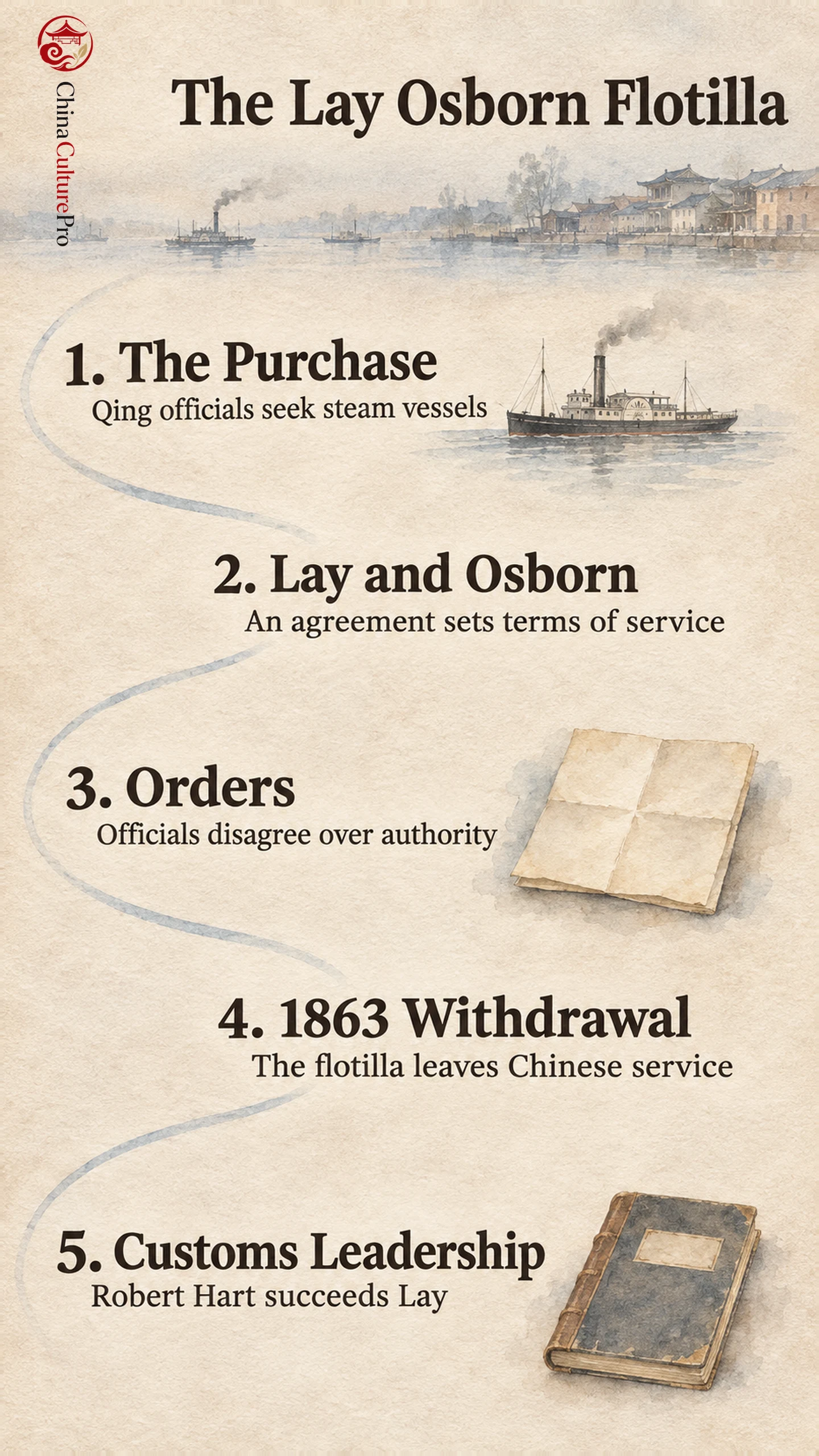
The Lay–Osborn flotilla (阿思本舰队, Āsīběn Jiànduì) was a Qing attempt to acquire a steam fleet with a foreign commander. Horatio Nelson Lay arranged the purchase and reached an agreement with British naval officer Sherard Osborn. The ships arrived in China in 1863, but a dispute over whose orders Osborn could accept led to their withdrawal.[1][2][3]
- Purchase: The Qing sought to buy vessels abroad and bring in foreign expertise.
- Agreement: Lay and Osborn set conditions for command that Qing officials declined to accept.
- Outcome: The flotilla was withdrawn, and Lay lost his post at the Imperial Maritime Customs.
The failure turned on who could exercise authority over the fleet after purchase.
The court could pay for a fleet and still have no agreed way to issue it orders. That question became the centre of negotiations once the people who had made the arrangements came back to China.
What the Qing Commissioned
The Qing made the purchase during the Taiping War, when officials wanted new capabilities quickly. Lay, the chief inspector of the Imperial Maritime Customs, helped arrange the acquisition in Britain. Osborn undertook to command the force under the agreement he made with Lay.[1][2]
The episode belongs to the wider Self-Strengthening Movement, which involved obtaining foreign equipment and expertise while building Qing institutions. It illustrates how hardware and personnel could arrive before officials agreed how to govern them.
Who Would Give Orders?
The agreement envisioned orders being passed to Osborn through Lay. The Zongli Yamen (总理衙门, Zǒnglǐ Yámén), which handled foreign affairs, had its own proposals for putting Qing officials in positions of authority. The disagreement affected who would answer for the fleet’s work as well as who could direct it.[1][2][3]
British correspondence describes the Qing refusal to ratify Osborn’s terms. Read this beside the Chinese proposals. The documents come from participants with distinct roles and show why agreeing to buy ships was insufficient to establish a chain of command.[1][3]
What Followed in Late 1863
The flotilla was withdrawn after talks failed, and Lay was dismissed. Robert Hart succeeded him as inspector general. Diplomats’ reports on Lay’s dismissal show the dispute had also damaged trust in his role at the customs service.[2][4]
The much later Qing constitutional reform concerned a different set of institutions. Following the two episodes separately helps keep questions of command in the 1860s distinct from twentieth-century plans to reshape the state.
FAQs About The Lay–Osborn Flotilla
Did the Flotilla Reach China?
It reached China in 1863. The command agreement remained unresolved and the flotilla was subsequently withdrawn.
Why Did the Command Agreement Fail?
Lay and Osborn expected orders to pass through Lay. Qing officials sought an arrangement that preserved greater authority for their own appointees.
Источники
[1] British Parliamentary Papers, 1864. Correspondence About the Fitting Out and Withdrawal of the Anglo-Chinese Fleet
[2] Jia Shucun. Robert Hart and Late Qing Foreign Relations
[3] Complete History of China’s Maritime Frontier. The Qing and the Flotilla Command Dispute
[4] U.S. Office of the Historian. Anson Burlingame’s Dispatch of November 23, 1863