


Quick Answer: What Is Emperor Minghuang’s Journey to Shu?
Emperor Minghuang’s Journey to Shu (明皇幸蜀图, Míng Huáng Xìng Shǔ Tú) is a mountain-travel painting traditionally associated with Li Zhaodao (李昭道, Lǐ Zhāo Dào). Its surviving authorship and date require qualification.
- Collection: National Palace Museum, Taipei, 中畫000003.
- Material and size: A silk hanging scroll, 55.9 × 81 cm.
- Look first: Find the small riders at the lower right, then compare them with the tall peaks above.
- Attribution: Museum commentary discusses a possible later copy, rather than a securely identified autograph.
Read the riders, mountain forms and later writing as different kinds of evidence.
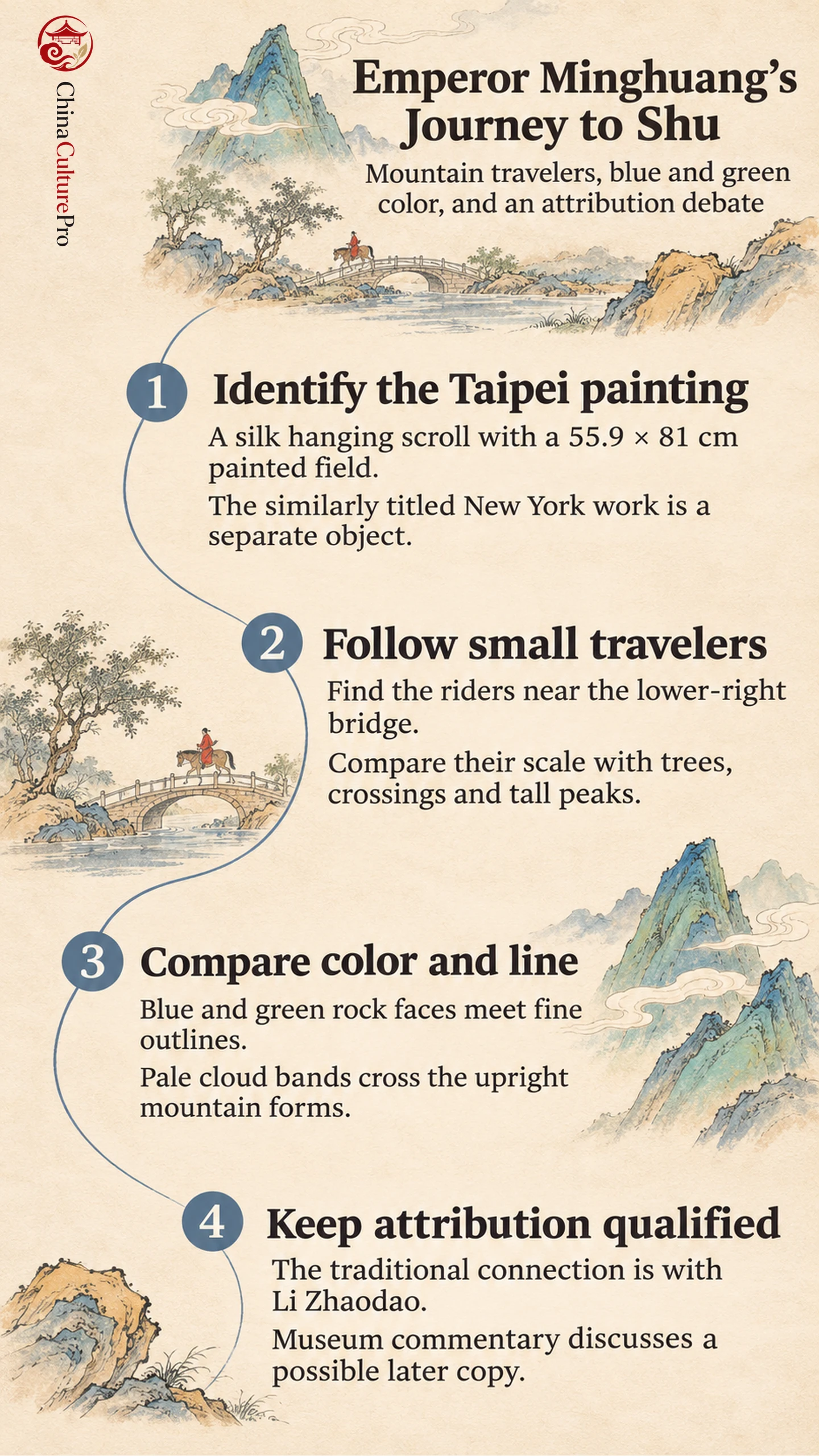
Sharp blue and green peaks rise above a crowded network of trees, paths and small figures. Pale cloud bands cut sideways through the much taller rock forms.
Near the lower right, a red-robed rider approaches a bridge. The figure occupies little of the surface, yet becomes a useful point from which to follow the terrain’s changing scale.
Identify the Taipei Painting and the Separate New York Work
The Taipei work’s painted field is 55.9 × 81 cm. It is a hanging scroll whose landscape extends farther sideways than upward. [1]
A separate New York painting bears a closely related title. It is attributed to an unidentified artist and dated to the mid-twelfth century. Its image measures 113.7 × 82.9 cm. [3]
| Work | Collection and object number | Painted dimensions |
|---|---|---|
| Taipei journey painting | National Palace Museum, 中畫000003 | 55.9 × 81 cm |
| New York flight painting | Metropolitan Museum of Art, 41.138 | 113.7 × 82.9 cm |
The Taipei image is wider than it is high; the New York image has a taller vertical format.
The scroll-format guide explains why the proportions of a painted field should be distinguished from the mounting around it. For the Taipei work, begin by comparing the wide lower foreground with the vertical peaks within that field.
Trace the Travelers through the Mountain Passes
Start at the lower-right bridge. The riders and attendants gather beside a narrow crossing, while the steep rock face behind them takes up a much larger area.
Follow the visible path only where it remains legible. Trees and rocks hide parts of the route, so the gaze has to move between revealed and concealed stretches.
Farther toward the center, smaller groups occupy a grove below the peaks. Compare the spacing among those figures with the tighter procession at the right.
The trees provide an intermediate scale. They are larger than the people but much shorter than the towering rock columns, helping the eye move between the human activity and the mountain mass.
At a higher level, a narrow crossing stretches between rocks near a band of cloud. Compare that small horizontal structure with the long, nearly vertical edges descending beside it.
The landscape-painting guide develops the relation between paths, obstacles and distance. Here, the crossings offer specific places to examine how movement becomes possible within difficult terrain.
The foreground also contains lower bridges and water channels. Return to these after looking at the high crossing: a repeated kind of structure appears at very different scales and heights.
Compare Blue and Green Color with Fine Outlines
Blue-and-green landscape (青绿山水, Qīng Lǜ Shān Shuǐ) is the relevant color tradition here. The received painting’s fine, elaborate style has been discussed in relation to the earlier tradition associated with Li. [2]
Compare one blue-green face of a peak with an ochre-brown face beside it. The color difference helps separate adjacent surfaces without requiring every edge to carry the same darkness.
Some rock contours form sharp, almost blade-like projections. Inside those boundaries, much smaller marks articulate the surfaces. Follow an outer edge first, then look at the thinner drawing contained within it.
The painting-techniques guide explains differences among outline, texture and color application. Those distinctions become concrete when a peak’s strong silhouette is compared with the fine lines on its face.
The cloud bands behave differently. Their pale, curling shapes run sideways across the upright peaks. Compare the colored rock immediately above and below one cloud band.
Compare a cloud edge with the nearby branches. The cloud remains broad and light; the branches divide into narrow dark lines that can overlap one another densely.
The guide to meticulous and freehand approaches provides a wider context for controlled drawing. In this picture, look closely at a small rider or bridge before returning to a large colored rock face.
Keep the Historical Story and Attribution Apart
The traditional interpretation identifies the red-robed rider as Emperor Xuanzong (唐玄宗, Táng Xuán Zōng), also known as Minghuang. It connects the scene with his flight to Shu during the An Lushan Rebellion (安史之乱, Ān Shǐ Zhī Luàn). [1]
The Tang dynasty guide gives the broader historical setting. The painting’s particular arrangement remains an artistic treatment, rather than a precisely surveyed record of an imperial route.
The work was formerly catalogued as an anonymous Song mountain-travel picture. Its present subject identification developed through comparison with Song literary accounts, while museum commentary discusses a possible eleventh- or twelfth-century copy. [1]
That history of naming matters. A title can guide viewers toward an episode, while style and physical evidence raise another question about when the surviving picture was made.
The traditional connection with Li therefore remains different from verified autograph authorship. The Palace Museum’s artist entry also treats the received work as a Song painting associated with that earlier artistic lineage. [2]
The poem at the top is a later imperial addition dated 1774. It belongs to the painting’s reception, not its original execution. [1]
The inscriptions-and-seals guide develops that distinction. Return afterward to the red rider and bridge: the traditional story, later writing and physical composition can each be considered without collapsing them into one date or author.
FAQs About Emperor Minghuang’s Journey to Shu
Did Li Zhaodao paint the surviving work?
A traditional association with Li remains, but verified autograph authorship is not established. Museum commentary discusses the surviving work as a possible later copy.
Who is the red-robed rider?
The traditional interpretation identifies him as Emperor Xuanzong. That identification belongs to the reading of the subject, rather than independent proof of a portrait likeness.
Is the New York painting the same object?
No. The Met’s 41.138 is a distinct, taller painting by an unidentified artist, dated to the mid-twelfth century. The Taipei work has different dimensions and its own collection record.
Источники
[1] National Palace Museum. Emperor Minghuang’s Journey to Shu, collection record 中畫000003
[2] Palace Museum. Li Zhaodao: artist entry
[3] Metropolitan Museum of Art. Emperor Xuanzong’s Flight to Shu, collection record 41.138