

Quick Answer: What Is Chinese Mulberry Paper?
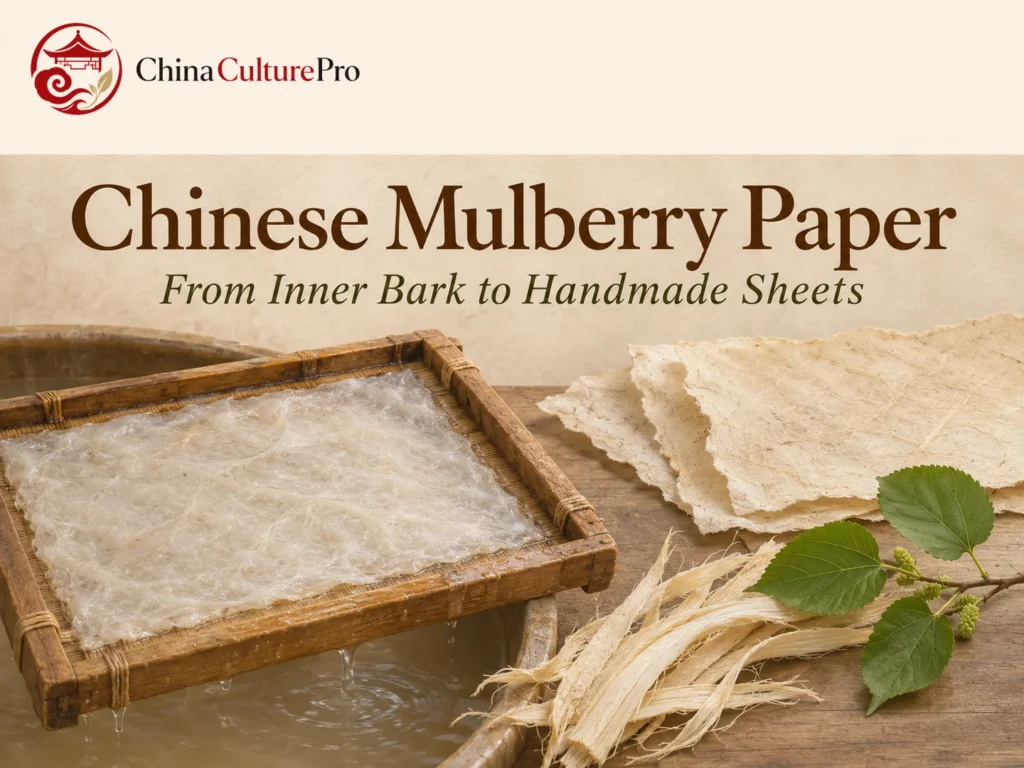
Chinese mulberry paper (桑皮纸, sāngpízhǐ) is made from the fibrous inner bark of mulberry branches. The fibers are separated, mixed with water and formed into a sheet on a screen. Uyghur workshops in Xinjiang and makers in Anhui are two documented settings for the craft. [1][2][3][4]
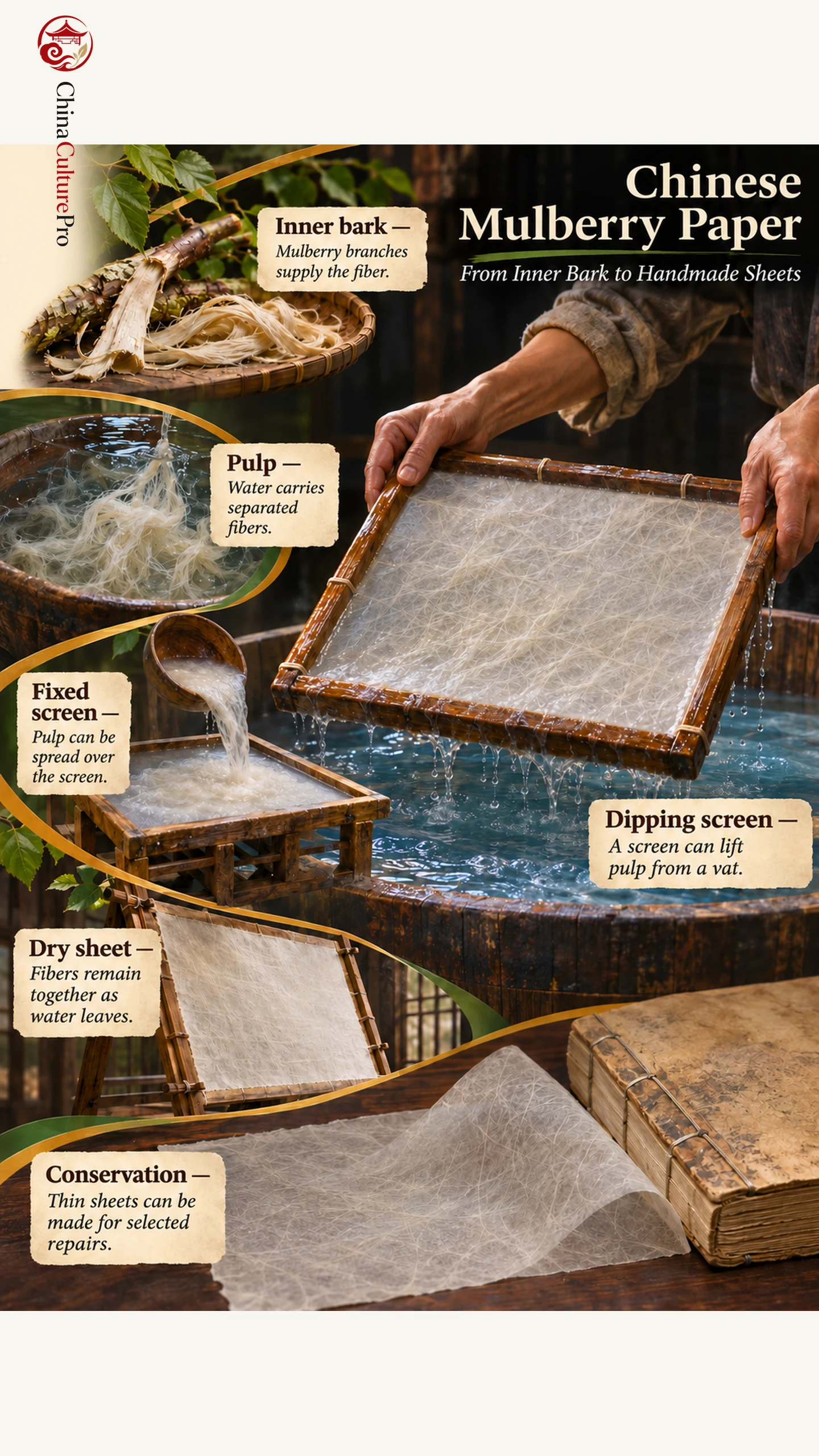
- Fiber: Mulberry inner bark supplies the pulp.
- Sheet: A screen holds the fibers while water drains.
- Use: Grades have served for writing, wrapping, mounting and selected conservation work. [2][3][4][5]
The term refers to the plant fiber. The look and feel of the finished sheet can vary with how it is formed and finished. [1][2]
Hold a sheet of bark paper toward the light and its fibers can become easier to see. Their distribution depends on what happened before drying, when the wet pulp was still free to move across the screen. That moment helps determine the surface a reader or painter will use.
Mulberry Bark and Paper Mulberry Are Different Fibers
The English name mulberry paper can cover several products. Hong Kong conservation researcher Angela Wai-sum Liu distinguishes mulberry bark paper from paper mulberry paper (楮皮纸, chǔpízhǐ). The first uses fibers from mulberry, including white mulberry of the genus Morus in documented Xinjiang examples. Paper mulberry belongs to the genus Broussonetia. [1][2][7]
A paper can also have a trade name that gives limited information about its fiber content. An account that identifies the plant and method gives a more precise basis for comparing it with other papers in the history of paper in China. [1][2]
How a Screen Forms a Sheet
Papermakers remove the useful inner bark, soften it and beat it to separate the fibers. Water lets those fibers move over a screen before they settle. As water drains, a wet layer remains. The papermaker spreads the fibers so they cover the frame evenly. After draining, a sheet with thicker and thinner patches can show where the pulp settled unevenly. [2][3][4]
Mengling Cai describes a Hotan method in which pulp is poured onto a fixed screen and spread while it floats. The sheet can dry on its mould. Cai describes makers smoothing this paper after drying to give its rough surface a more even finish. Cai also describes a dipping method in which a maker lifts a screen through pulp in a vat. An Anhui practitioner’s profile records his use of a one-person screen-lifting method for very thin sheets. [2][5]
Uyghur Papermaking in Xinjiang
Cai’s study records family papermaking in Moyu, Pishan and Luopu counties in the Hotan area. The national heritage register has a separate Uyghur mulberry papermaking entry submitted by Turpan in 2006. The Turpan entry names the submitting region. Cai’s account describes production farther south in Hotan, where the study documents family workshops and access to mulberry trees. [2][3]
The register describes how finer sheets were used for books and how other grades were used to wrap goods or cover window openings. It also profiles Tuohuti Tuerdi, a Moyu maker who learned the craft in 1950 and opened a workshop later that decade. His profile describes a yellow, soft sheet with fine fibers. Those qualities belong to the paper he made and provide one example of the craft’s variation. [3][6]
Anhui Mulberry Paper and Conservation
The Anhui record links mulberry bark paper with Qianshan and Yuexi and names painting, mounting, book repair and umbrella making among its uses. In Qianshan, Liu Tongyan’s profile records that his thin, pure mulberry sheets were used for old-book repair in 2002. That is a specific application within the wider world of traditional Chinese bookbinding and conservation. [4][5]
The same profile says the Palace Museum selected Liu’s paper for the Juanqinzhai restoration project in 2004. The museum restoration and the earlier use in books were separate applications. Liu’s thin book-repair sheets illustrate how a maker can vary the paper for a specific job. The museum selection illustrates a separate use in the conservation of a historic interior. [4][5]
FAQs About Chinese Mulberry Paper
Is Chinese mulberry paper made from mulberry leaves?
The traditional fiber described in the heritage records comes from the inner bark of branches. The bark is processed into pulp to make a sheet. [2][3]
Is sangpi zhi the same as paper mulberry paper?
In Chinese conservation terminology, sangpi zhi and paper mulberry paper name different fibers. English labels can use mulberry broadly, so look for the plant name or Chinese term. [1][2]
Is any mulberry paper suitable for repairing an old book?
Suitability depends on the paper and the object. Liu Tongyan’s profile documents a very thin mulberry paper chosen for old books. The generic material name gives only part of the information needed to assess another sheet. [1][5]
Источники
[1] Angela Wai-sum Liu, Hong Kong Leisure and Cultural Services Department. Thousand Years Old Paper: Chinese Paper
[2] Mengling Cai, Z Badań nad Książką i Księgozbiorami Historycznymi. Overview of Paper and Papermaking in Xinjiang, China
[3] China Intangible Cultural Heritage Digital Museum. Uyghur Mulberry Bark Papermaking
[4] China Intangible Cultural Heritage Digital Museum. Mulberry Bark Papermaking in Anhui
[5] China Intangible Cultural Heritage Digital Museum. Representative Practitioner: Liu Tongyan
[6] China Intangible Cultural Heritage Digital Museum. Representative Practitioner: Tuohuti Tuerdi
[7] Shan-Shan Jin and colleagues, Chinese Journal of Polymer Science. Research on Bast Fiber Extracted from the White Bark of Three Species in the Genus Broussonetia