

Quick Answer: What Are Chinese Fish Lanterns?
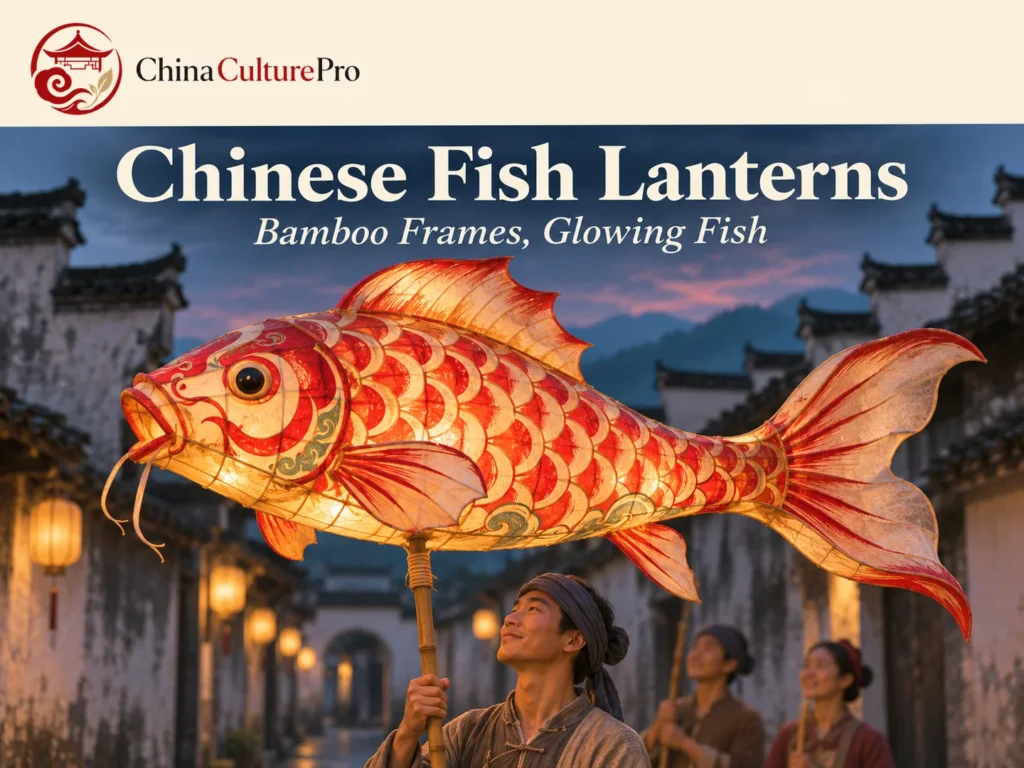
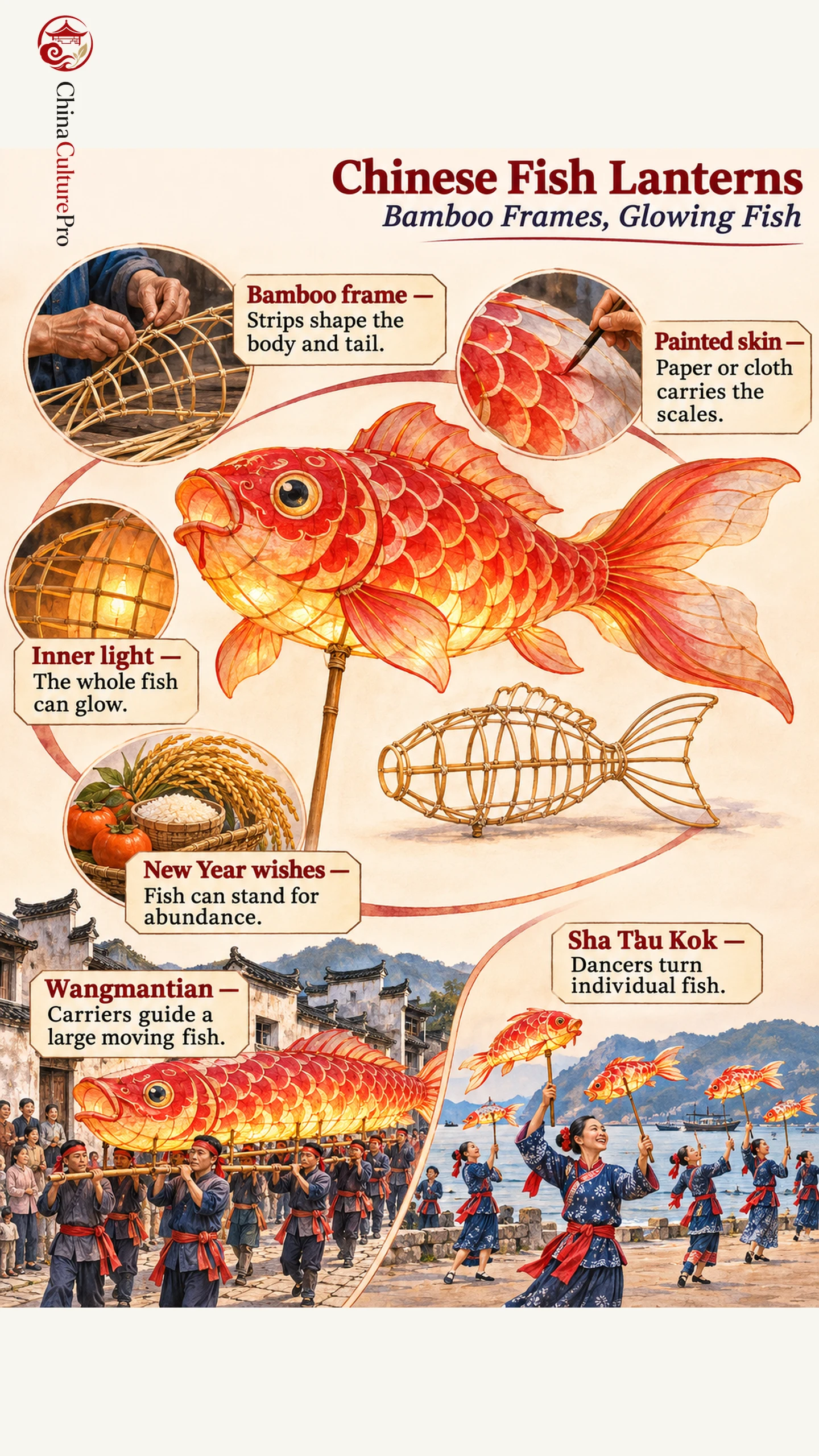
Chinese fish lanterns (鱼灯, yúdēng) are illuminated figures in the shape of fish. A maker can build the outline from bamboo strips, cover it in paper or cloth and paint on scales, fins and eyes. The light inside turns the body into a glowing shape when it is lifted and carried. [1][2][6]
- Frame: Bamboo gives the head, belly and tail their shape.
- Skin: Painted paper or cloth makes the fish visible in light and shadow.
- Movement: One dancer can control a handheld fish. Carriers work together on larger parade fish. [1][2][6]
Scale and shape tell you something about the performance the lantern was made for. [2][5][6]
A fish lantern has to read as a fish across a dark lane. Its eye and tail give the crowd two points to follow. Then the people carrying it bring that outline to life, with a dip of the head or a swing of the tail.
How Bamboo, Paper and Light Form a Fish
Strips of bamboo give the frame enough length to outline the fish and enough flexibility to form its rounder sections. The covering spans the spaces between the strips. The painted scales stay visible when the lantern is lit, so the frame and the surface contribute different parts of the image. [1][2][6]
Accounts of older lanterns describe candles inside the body. Modern examples can also use LED lighting. As with many Chinese lanterns, the covering carries both color and light. A painted scale near the edge of the fish comes into view as the body turns toward the crowd. [1][2][6]
How the Lantern Moves
In Wangmantian, a fish lantern procession (嬉鱼灯, xī yúdēng) can feature fish several meters long. A 2024 account describes joints that let sections of the body move independently. That articulation gives carriers room to move the head and tail through different arcs so the fish appears to swim down the lane. [2]
A small fish held by one person responds to changes in the angle of its handle. In a parade with a longer articulated fish, motion also depends on how the carriers step and turn together. Watch whether the entire fish tips as one body or whether the head begins to turn while the tail is still swinging. [2][4][6]
Three Fish Lantern Traditions in Shexian
Wangmantian, Zhanqi and Yuliang are in Shexian County, in the Huizhou region of southern Anhui. Wangmantian is known for large fish carried by groups, and its tradition entered Anhui’s provincial heritage list in 2022. Its procession is associated with wishes for peace and well-being, themes found across Chinese New Year symbols. [2][3]
In Zhanqi, a 2025 report shows local teams swinging and turning fish lanterns and makers producing smaller versions for visitors. Yuliang, a historic riverside community, has a separate fish lantern tradition known for relatively naturalistic fish forms. Local records and reporting distinguish its county-level entry from Zhanqi’s municipal entry and Wangmantian’s provincial entry. [1][3][4]
The Sha Tau Kok Fish Lantern Dance
The Sha Tau Kok fish lantern dance (沙头角鱼灯舞, Shātóujiǎo yúdēngwǔ) is a coastal group performance documented in Shenzhen and the surrounding area. Guangdong’s cultural center describes individual bamboo-and-paper props shaped as several kinds of fish. Each dancer can tilt and turn a fish on a handle, and their movements together suggest a school of fish. [5][6]
In the dance, a red carp leads a group of fish against a threatening creature with a dragon-like head and a fish tail. Different silhouettes and movements make the characters distinguishable from a distance. Drums, gongs and other instruments accompany the movement, giving the dancers an audible rhythm as they move behind the blue curtain that represents the sea. China added the Shenzhen dance to its national intangible cultural heritage list in 2008, under traditional dance. [5][6]
How the Craft Is Passed On
A 2025 account of Zhanqi describes lantern-making experiences alongside the processions. Later reporting names a Zhanqi maker, Wang Guanhai, and a Yuliang maker, Xu Jili, working on their communities’ lanterns. These accounts show that knowledge of the frames and painted surfaces is still shared through making and performance. [3][4]
In 2025, three Shexian industry standards addressed making, quality and performance across the three local traditions. The standards name Wangmantian, Zhanqi and Yuliang together. Reporting from the same county still describes different silhouettes and styles of motion for each place. [3][7]
FAQs About Chinese Fish Lanterns
What does a fish lantern symbolize?
Fish can express the wish for abundance year after year (年年有余, niánnián yǒu yú), because the words for fish (鱼) and surplus (余) are both pronounced yú in Mandarin. Different communities also associate their lanterns with peace, good fortune or harvests. [2][3][4]
Are fish lanterns only used at the Lantern Festival?
The Lantern Festival is a familiar occasion, especially for the Wangmantian procession. Zhanqi has also held fish lantern parades in the days before the Spring Festival. [2][4]
Are Chinese fish lanterns all shaped like carp?
Carp are familiar subjects, but the Sha Tau Kok repertoire includes several other kinds of fish as well as imagined sea creatures. [5][6]
Источники
[1] China Tourism Office, Travel China. Fish Lanterns in Shexian
[2] Tianjin Polytechnic University, reproducing Xuexi Qiangguo reporting. How Shexian Keeps Its Fish Lanterns Alive
[3] Xinhua News Agency. A Fish Lantern Carries Huizhou Traditions Forward
[4] Xinhua News Agency. Parades with Fish-shaped Lanterns in Eastern Anhui
[5] China Intangible Cultural Heritage Digital Museum. Sha Tau Kok Fish Lantern Dance
[6] Guangdong Provincial Cultural Center. Sha Tau Kok Fish Lantern Dance
[7] Gu Xuefei, China News Service. Shexian Releases Three Fish Lantern Standards