


Quick Answer: What Is Chinese Cloisonné?
Chinese cloisonné (掐丝珐琅, qiāsī fǎláng) is a way of decorating metal with colored enamel. Thin metal strips form partitions that hold the glass-based colors. After firing and finishing, the metal lines remain visible between the colored areas.[1]
- Structure: The metal body supports the design. Attached wire partitions divide the surface into cells.
- Color: Fired enamel fills the cells. Several colors can appear on a single object.
- Evidence: A period name or mark needs to be read with the object’s attributed date.
The clearest clue is the relationship between metal partitions and the color they enclose.
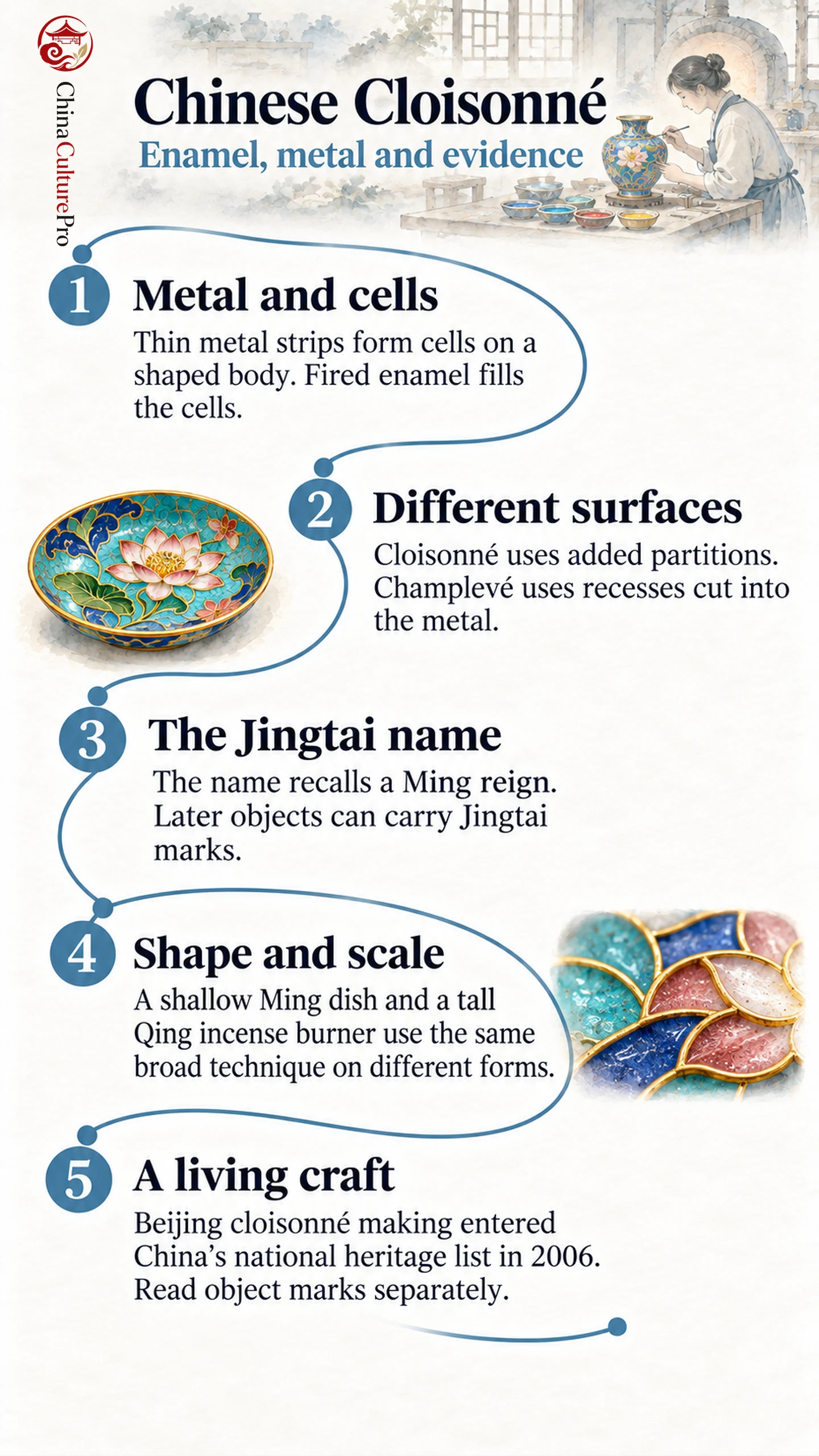
Follow one narrow metal line across a cloisonné surface. It may define a petal, turn into a stem and meet another line at the edge of a colored cell. The line is part of the object’s construction as well as its drawing.
How Wires, Glass and Metal Form the Surface
The shaped metal body supports the enamel, with copper used in the Beijing tradition. Thin strips are bent to make the design and attached to the support. The partitions separate adjacent patches of enamel. The base determines the silhouette, whether the object is a dish, vessel or incense burner.[3]
The color comes from enamel that fuses during firing. It may shrink as it fires, so makers can add more and fire again. Polishing levels the surface and brings the metal edges into view. Gilding can finish exposed metal lines and other surfaces.[1]
Look at the boundaries of a petal or a small patch of background. The wire and the enamel can be nearly level after polishing. Follow the divisions to see which lines are physically part of the design. The object’s shape can recall Chinese bronze vessels, while the visible color depends on the enamel structure.
How Cloisonné Differs from Other Enamel Techniques
Enamel describes a glass-based material and its fired surface. Several decorative techniques use it, and their visible boundaries come from different structures.
| Treatment | How the color is held or applied |
|---|---|
| Cloisonné | Metal strips added to the support divide the enamel into cells.[1] |
| Champlevé | Recesses cut into a metal surface receive the enamel. The intervening metal remains part of the original base.[4] |
| Painted enamel on porcelain | Color is painted on a ceramic support. Examples from the Qing court show how enamel could be used on Chinese porcelain with a different surface structure.[7] |
Why the Name Jingtai Blue Needs Context
Jingtai blue (景泰蓝, Jǐngtàilán) is a Chinese name associated with cloisonné and the Jingtai reign of the Ming, 1450–1457. Later connoisseurs praised works attributed to that reign. The name remained in use as later objects acquired retrospective Jingtai marks.[2]
The technique is recorded in the Yuan period, and securely dated Chinese pieces are associated with the early Ming Xuande (宣德, Xuāndé) reign, 1426–1435. Some objects are assigned earlier dates on stylistic grounds. A text can establish that the technique was known, while a dated vessel gives evidence about an individual object.[1]
An inscription that names Jingtai needs interpretation alongside the metalwork, enamel and other documentation. The name alone cannot settle the date of manufacture.[2]
What Actual Objects Show About Style and Use
An early fifteenth-century dish with a scalloped rim is 15.2 cm across. It has stylized lotus scrolls and several colors against a turquoise background. The floral pattern connects its decoration with ceramics, lacquer and textiles of the early Ming court tradition.[5]
A Qianlong (乾隆, Qiánlóng) period incense burner is 62.9 cm high. Its tall form gives the enamel design a different surface from the shallow dish. The examples show how the method adapts to both a small open plate and a large vessel.[6]
The medium served a range of settings, including palace and temple furnishings. A museum’s “incense burner” or “dish” label describes the form. The record for the individual object can add a more specific context.[1]
Reading Marks and the Living Craft
In museum collection records, separate the support material, technique, inscription and attributed period. Look at photographs of the body and base when available. Record the wording of a mark separately from what the catalogue concludes about the date.
Beijing cloisonné making entered the first batch of China’s national list in 2006. The listing recognizes the workshop practice of making and finishing the enamel surface. It is a case of Chinese intangible cultural heritage focused on transmitted skills.[3]
FAQs About Chinese Cloisonné
Is Chinese cloisonné always blue?
Blue grounds are familiar, including on early works. The enamel can also appear in reds, yellows, whites, greens and other colors.
Are the outlines painted in gold?
The lines are metal partitions attached to the support. Exposed edges can be gilded during finishing.
Does a Jingtai mark prove a Ming date?
The mark is one item of evidence. Later pieces can carry a Jingtai mark, so read the attributed period and supporting notes for the object.
Is cloisonné the same as painted enamel on porcelain?
The two treatments use enamel differently. Cloisonné uses partitions attached to a metal body. A painted enamel on porcelain uses a ceramic support.
Источники
[1] Department of Asian Art, The Metropolitan Museum of Art. Chinese Cloisonné
[2] National Palace Museum. The Mystery of the Jingtai Cloisonné Unveiled
[3] China Intangible Cultural Heritage Digital Museum. Cloisonné Making Technique, VIII-43
[4] Victoria and Albert Museum. A Guide to Metalworking Techniques
[5] The Metropolitan Museum of Art. Foliated Dish with Floral Scrolls, 1993.338
[6] The Metropolitan Museum of Art. Incense Burner, 22.93a–c
[7] National Palace Museum. Story of an Artistic Style: The Imperial Porcelain with Painted Enamels