

Quick Answer: Who Was Chinese Gordon?
Charles George Gordon was the British officer who led the Ever Victorious Army (常勝軍, Chángshèngjūn) on the Qing side of the Taiping Rebellion from 1863 to 1864. The nickname Chinese Gordon grew out of that service. He took command of a force of Chinese soldiers with foreign officers that already had ties to Qing provincial authorities.[1][2][3][5]
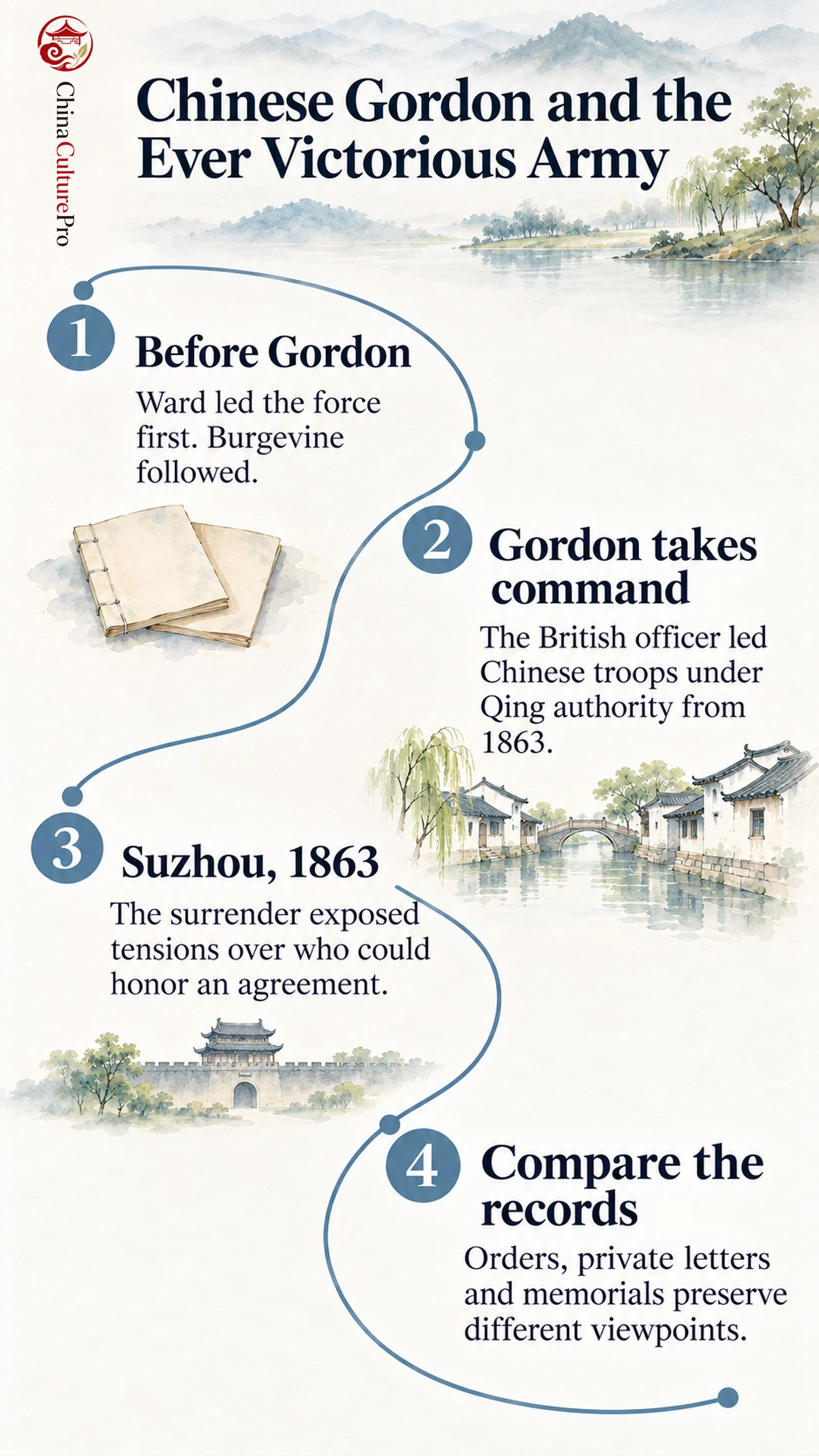
- Earlier commanders: Frederick Townsend Ward led the force first. Henry Burgevine held command before Gordon.[1][2]
- Qing authority: Jiangsu governor Li Hongzhang had a central role in its employment.[1][2][3]
- Historical memory: British letters and Qing honors tell different parts of the story.[3]
The nickname refers to Gordon’s service in China.[1]
A British account can put Gordon’s name in the foreground. Read it beside a governor’s order, an imperial honor and a local memorial, and the same episode opens onto the Qing institutions that made his service possible.[1][2][3]
The Army Gordon Inherited
The army took shape around Shanghai during the Taiping Rebellion. Ward’s surviving papers show him working with Qing authorities well before Gordon’s arrival. Yale’s finding aid records an 1862 order to Ward from Li Hongzhang, then acting governor of Jiangsu, and an imperial edict considering honors for Ward and Burgevine.[1][2]
Gordon took command in March 1863 after British and Qing officials agreed to the appointment. Li’s provincial forces continued to operate in their own right. The Ever Victorious Army was demobilized in 1864, with some men reassigned. Gordon’s reputation outlasted his roughly fourteen months in command.[1][3][5]
Suzhou and the Limits of the Partnership
After Suzhou surrendered in December 1863, Qing authorities executed surrendered Taiping leaders. Gordon protested and temporarily withdrew from command. Accounts of this episode discuss assurances of safety and who had the authority to make or honor them. They also show the consequences of an arrangement in which a British officer served with a provincial Qing command.[4]
Separate two questions when reading the episode. One is what surrendering leaders expected. The other is who could enforce an agreement in a command shared across different authorities. Diplomatic responses and Gordon’s own version offer evidence about those questions from particular positions.[3][4]
Read the Records Behind the Reputation
| Источник значения | На что обратить внимание |
|---|---|
| Provincial order | A named official’s relationship to a commander at a specific date. Li’s 1862 order to Ward is an example.[2] |
| Personal letter | Gordon’s sense of the meaning of a Qing honor, including the yellow riding jacket he discussed with his mother.[3] |
| Memorial or gazetteer | Which contributors an official account chose to celebrate and which episodes it passed over.[3] |
Awards and memorials show how the participants wanted the force’s service to be remembered. Chappell’s study connects those choices to honors, local commemoration and claims about foreign involvement. For the later institutional story, late Qing constitutional reform takes up a separate phase of changes to Qing government.[3]
FAQs About Chinese Gordon and the Ever Victorious Army
Did Gordon found the Ever Victorious Army?
Frederick Townsend Ward commanded the force first. Henry Burgevine succeeded him, and Gordon took command in 1863 after Burgevine’s dismissal.[1][2][3]
Was it a British army?
It was a Chinese force under Qing authority with foreign officers. Gordon remained a British officer while serving as its commander.[1][2][3]
Why is Suzhou important in accounts of Gordon’s service?
The execution of surrendered Taiping leaders in 1863 provoked Gordon’s protest and made differences over authority and responsibility especially visible.[4]
Источники
[1] American Historical Review. Late-Qing Naturalizations and the Ward, Burgevine and Gordon appointments
[2] Yale University Library. Frederick Townsend Ward Papers, finding aid
[3] Jonathan Chappell, Modern Asian Studies. Some Corner of a Chinese Field, on commemoration in the Taiping war
[4] J. S. Gregory, Australian National University. Great Britain and the Taipings, discussion of Suzhou
[5] University of California, Berkeley. Transferring Technology to China, on the army’s demobilization