
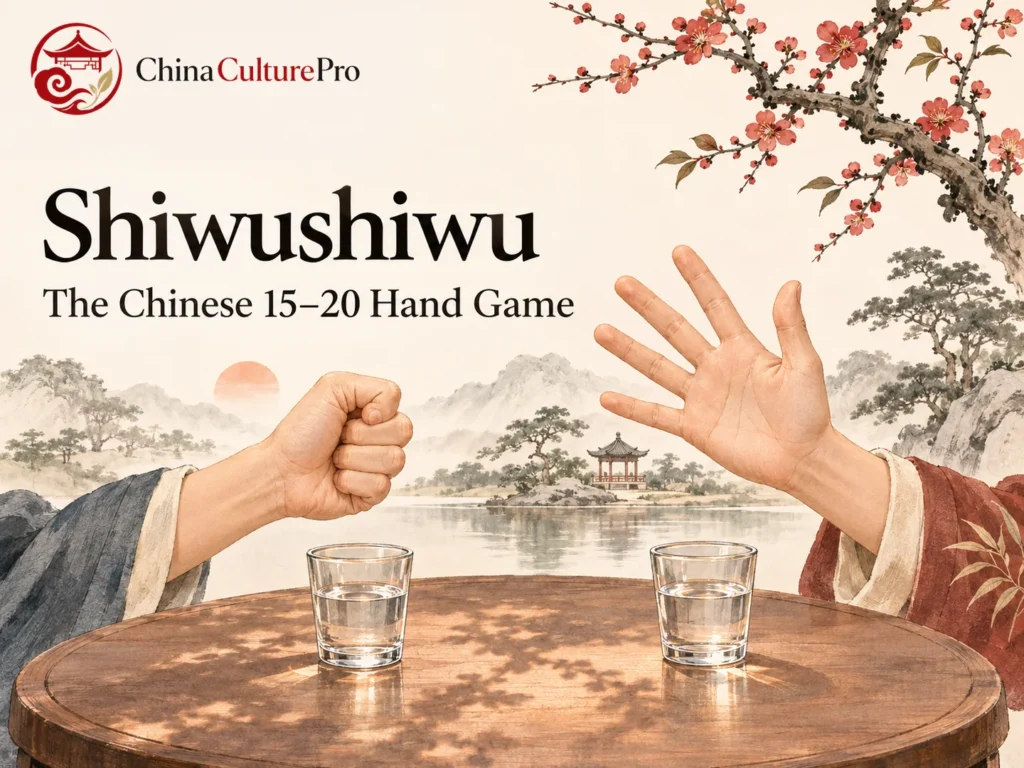

Quick Answer: How Do You Play Shiwushiwu?
Shiwushiwu (十五十五, shíwǔ shíwǔ) is a two-player hand game also called 15–20. A closed fist counts as 0, while an open hand counts as 5. A caller guesses the total across both players’ four hands. The possible totals are 0, 5, 10, 15 and 20.[1][2]
- Show: Both players use both hands, with each either fully open or closed.[1][2]
- Call: In one version, one person guesses as both players reveal their hands.[1]
- Score: Two consecutive correct guesses can win a round. Agree on the scoring rule before playing.[1][3]
Try a slow practice round to get the hand movement and call in time.[1]
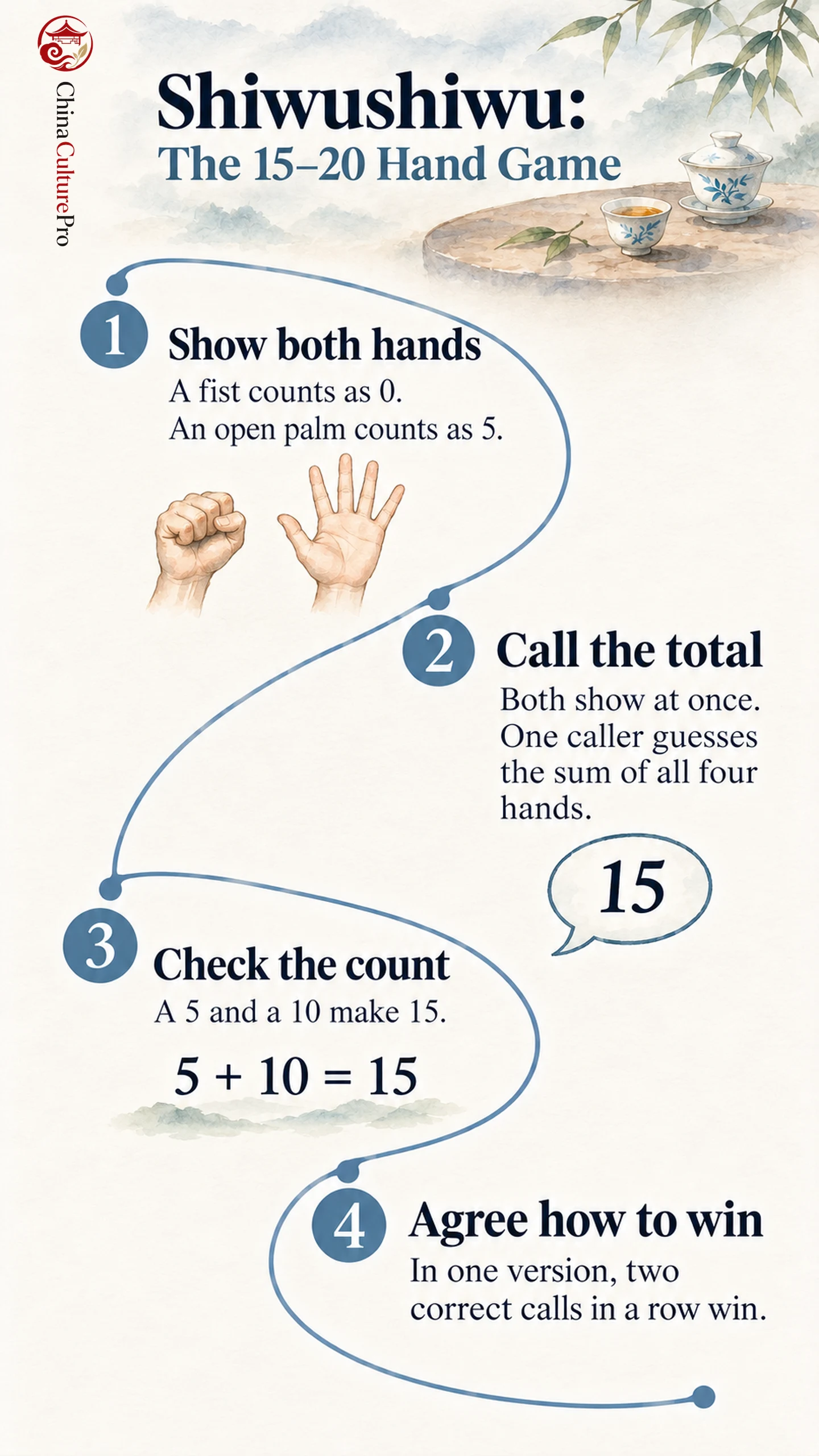
A player shows one open palm and calls fifteen. Across the table, the other player opens both palms. That makes fifteen exactly. The challenge is getting the call out at the same moment the hands appear.[1][2]
Count the Two Hand Shapes
Each hand is a unit of zero or five. Across two hands, a player can show zero, five or ten. Add the other player’s value to get the full total. Your own hands set the lowest possible call, and your partner can add up to ten.[1][2]
| Your two hands | Your value | Possible totals across both players |
|---|---|---|
| Two fists | 0 | 0, 5, 10 |
| One open palm and one fist | 5 | 5, 10, 15 |
| Two open palms | 10 | 10, 15, 20 |
To call the numbers in Mandarin, use líng for zero, wǔ for five, shí for ten, shíwǔ for fifteen and èrshí for twenty. In a rhythmic version, a caller uses the repeated fifteen chant as a lead-in. The final number is the guess.[1]
Play a Round with One Caller
- Pick a caller. Face your partner with both hands ready and decide who will call first.[1][2]
- Show and call together. Both players reveal or change their hand shapes at the same moment. The caller says the estimated total on that beat.[1]
- Check the total. If the caller shows one palm and the partner two, the score on the table is 5 + 10 = 15. A call of fifteen earns one correct guess.[1][2]
- Keep or pass the call. A caller who guesses correctly calls again. In this version, a second consecutive correct call wins the round. A miss gives the other player the next call.[1][2]
Agree on House Rules Before You Start
Some groups let both players call on the same beat and replay when both are right or both miss. In the one-caller version, an impossible guess can carry a penalty or simply pass the turn if you set that rule. Before a practice round, agree on the beat, who calls and how many correct guesses win.[1][3]
Shiwushiwu belongs in a wider family of Chinese traditional games played with the hands and voice. It also appears in accounts of Chinese drinking games. For family play, keep score with a point for each round won.[1][3]
FAQs About Shiwushiwu
Can a player show exactly three fingers?
Each hand is either fully closed or fully open. One player shows a total of 0, 5 or 10.[1][2]
What happens if I show 10 and call 5?
With 10 already showing, the combined total starts at 10. In the two-correct-call version, an impossible call loses the round or passes the turn if you agreed to a gentler rule.[1]
Can two people call numbers at once?
Yes, in a simultaneous-call variant. A different version uses one caller at a time. Agree which one you are playing before starting.[1][3]
Источники
[1] Chinese Language Institute. 15-15-20 rules, vocabulary and variants
[2] Sweet Note Learning. Cantonese Games, 15–20 hand gestures
[3] Baidu Jingyan. A simultaneous-call version of Fifteen–Twenty