


Quick Answer: How Do You Cite a Chinese Museum Object?
To cite a Chinese museum object, open its official collection record and copy the title, maker or attribution, date, holding institution and accession or object number. Add the record’s URL so another reader can find the same item. Check the asset’s rights field if you plan to reproduce an image.[1][2][3]
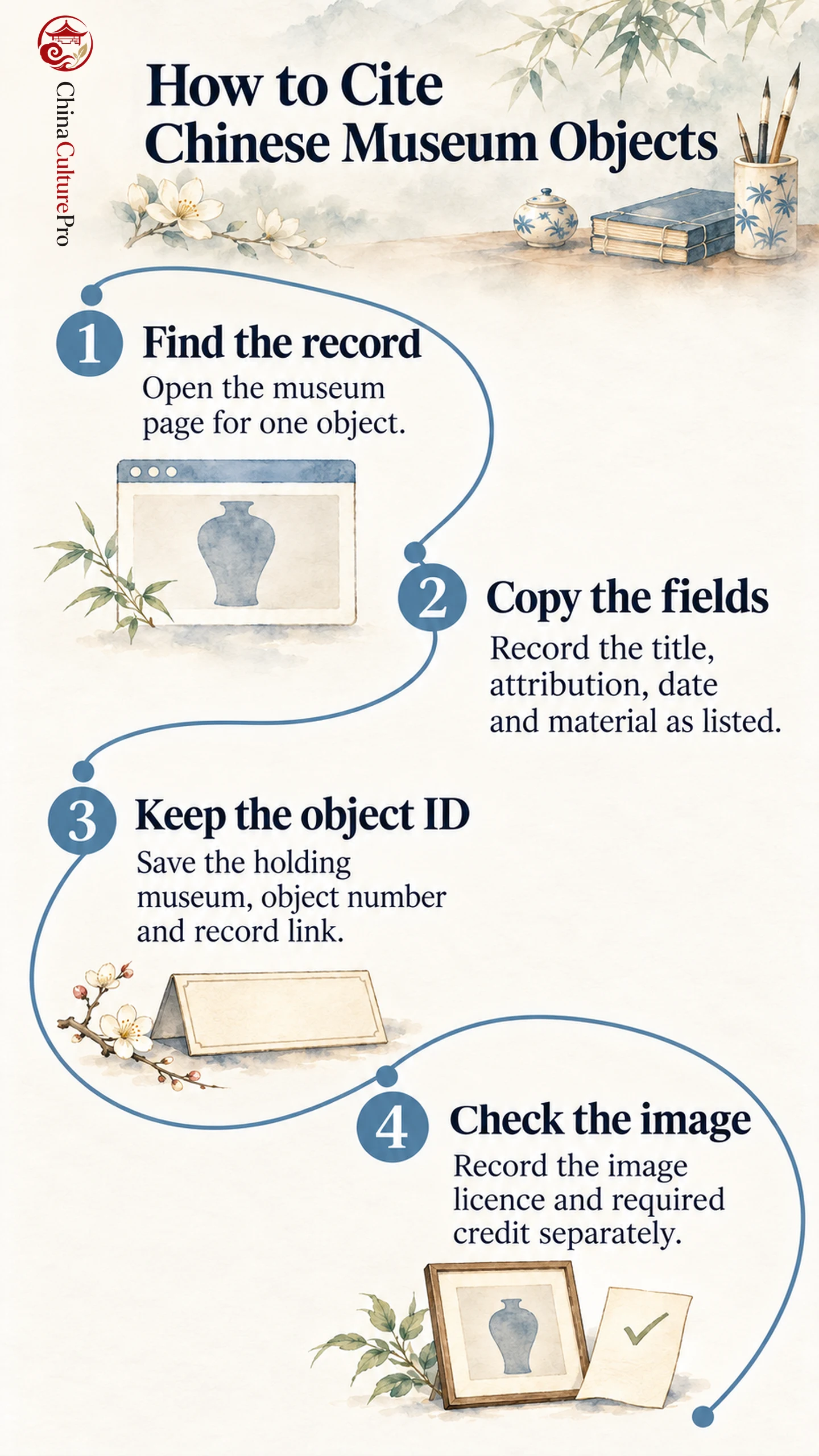
- Find: Search the museum catalogue by title, material or known object number.[1][2]
- Identify: The collection number distinguishes one object from similarly named items.[1][2]
- Record: Keep the museum’s wording for uncertain dates or attributions, and save the image credit separately.[1][2][3]
Use the catalogue record as the main reference.[1][2]
A search for a Chinese boat painting can bring up many pictures with similar titles. The museum’s object number gives you a reliable way to find the same painting again.[1][2]
Find the Individual Collection Record
Start with a museum’s Collections Online search. Combine a subject with a medium or material. For Chinese export paintings, try searching for pith paper and one element of the subject, such as boat. Royal Museums Greenwich lists a nineteenth-century example, Chinese junk and a sampan, as PAJ0244.[1]
Open the individual entry and confirm its ID, material, and holding collection. A page about how people make Hong Kong paper crafts can tell you about process. A catalogue entry identifies which object you are describing. The guide to reading a Chinese museum label explains how to interpret similar fields in an exhibition.[1][2]
Build a Citation from Its Object Fields
- Copy the object title and attribution. Use the label as written. Here the creator field reads Chinese School.[1]
- Keep the date and materials. This record gives the nineteenth century and lists gouache and pith paper.[1]
- Add the holder and number. Give the National Maritime Museum credit and the object ID PAJ0244.[1]
- Link to the individual entry. Use the catalogue URL cited below. Add your access date when the citation style calls for it.[1][3]
Worked citation: Chinese School. Chinese junk and a sampan. 19th century. Gouache on pith paper. National Maritime Museum, Greenwich, London, PAJ0244. Royal Museums Greenwich collection record.[1]
Check Image Rights Separately
An object number, a credit line and an image licence each answer a different question. On the Smithsonian’s Old scholar playing the qin record, F1911.163a identifies the painting, Gift of Charles Lang Freer is its credit line, and CC0 1.0 is the published rights designation for the image. Keep each field in your notes so you can match a citation or image caption to the actual item.[2][3]
Read rights information for the particular image you want to use. If its record lacks a clear reuse label, consult the institution’s current terms or rights contact. A source notebook for studying Chinese culture can hold the title, object number, direct link and rights note together.[1][2][3]
FAQs About Chinese Museum Object Citation
What if two objects have the same museum title?
Use the institution and the inventory, object or accession number to distinguish them. A title alone can describe more than one item.[1][2]
Should I cite a museum page or a direct image URL?
Use the object page as the main link so others can find the date, materials, collection number and rights fields. For image reuse, record the relevant credit or licence too.[2][3]
What if no artist is identified?
Keep the attribution as the museum presents it. If there is no maker field, begin the citation with the displayed title, as your citation style permits.[1][2][3]
Источники
[1] Royal Museums Greenwich. Chinese junk and a sampan, object PAJ0244
[2] Smithsonian National Museum of Asian Art. Old scholar playing the qin, accession F1911.163a
[3] Smithsonian Institution. Open Access FAQ and citation guidance