
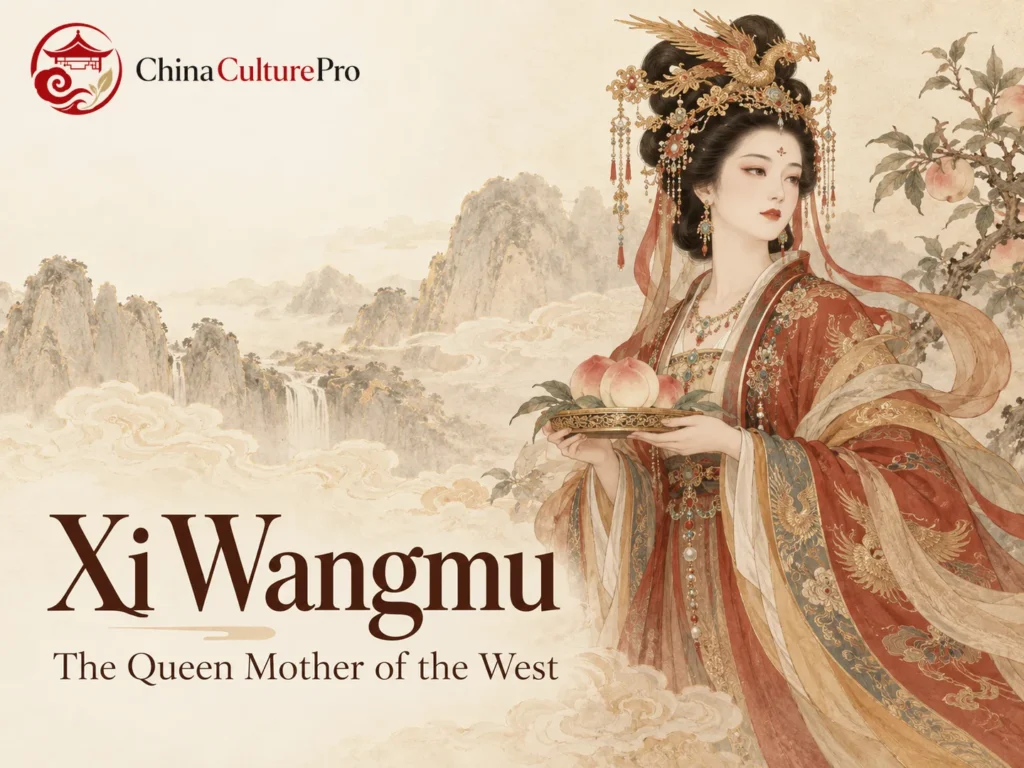

Quick Answer: Who Is Xi Wangmu?
Xi Wangmu(西王母,Xī Wángmǔ), the Queen Mother of the West, is an ancient Chinese goddess associated with a western immortal realm, extraordinary longevity and religious authority. Later stories and artworks often present her as the regal host of a peach banquet.
- Early sources: Classical descriptions and Han-period art preserve forms different from the familiar later courtly image.
- Peaches: Her fruit symbolizes immortality or wishes for long life within myth and auspicious art.
- Images: Headdress, attendants, peaches and the surrounding assembly help identification.
- Worship: Daoist and popular traditions use several titles and more than one commemorative date.
Xi Wangmu is a divine figure, not a securely documented earthly queen with one recoverable biography. Her early texts, later legends, artworks and living worship should be interpreted in their own settings. [1][2][3][6]

A crowned woman receiving immortals may be Xi Wangmu, but a peach-bearing courtly figure is only one part of her long history. Reading her place in religion in China requires both the banquet stories and the much earlier evidence.
Names, Kunlun and the Western Realm
Xi Wangmu is also written Xiwangmu in English, while older publications use Hsi Wang Mu. The familiar title Queen Mother of the West names a goddess; it should not be read as a claim that she was the historical mother of a particular Chinese emperor.
Later religious language includes Wangmu Niangniang(王母娘娘,Wángmǔ Niángniang), an honorific maternal form. Kunlun(昆仑,Kūnlún)is the western mountain realm associated with her paradise, while Yaochi(瑶池,Yáochí), often translated as Jasper or Jade Pool, names a famous setting for her gatherings. [4][5][6]
These are sacred and literary geographies. An artwork’s jeweled palace or immortal garden should not automatically be assigned the address of a modern mountain site. [3][5]
Early Texts and the Han Goddess
The Classic of Mountains and Seas(山海经,Shānhǎi jīng)gives a striking early description: a human-like being with a leopard’s tail, tiger’s teeth, disordered hair and a distinctive headdress. It also connects her with threatening forces. This is a formidable presence, far removed from a simple modern image of a gentle queen holding fruit. [1]
Han art supplies a different kind of evidence. An early second-century tomb relief shows her larger than surrounding figures, seated in a pavilion with a bird-shaped cap and flowing gown. The organized court and attendants relate heavenly authority to earthly court structure. Her role in Han funerary belief was therefore already substantial. [2]
Textual description and tomb imagery answer different questions. Their contrast does not require a story in which one historical woman changed from a “monster” into a queen on a known date. They show how different media and religious concerns could shape the same divine identity. [1][2]
Peaches, Imperial Visitors and the Immortal Banquet
Peaches became a particularly familiar attribute. In a well-known story, Xi Wangmu presents magical peaches to Emperor Wu of Han(汉武帝,Hàn Wǔdì). The fruit is said to ripen only after an extraordinary interval, often given as 3,000 years. This is a mythical timescale expressing rarity and immortality, not a botanical claim about ordinary peach trees. [3]
Other stories describe a meeting with King Mu of Zhou(周穆王,Zhōu Mùwáng). Imperial visitors seek access to knowledge or a realm beyond ordinary life. A tale set during a real ruler’s reign does not independently verify that ruler’s encounter with the goddess. [5]
The banquet motif brings these themes into a celebratory assembly. Immortals travel across water or through landscapes, attendants prepare the reception, and peaches signal the occasion’s auspicious meaning. The Eight Immortals(八仙,Bāxiān)can be among the guests. A banquet picture is thus more than a portrait with extra figures: its gathering expresses divine status and wishes for long life. [3][5]
Recognizing Xi Wangmu in Art
Use the complete scene. An inscription or museum identification is stronger evidence than one peach, since the fruit occurs in many longevity designs. The following clues are especially useful for later courtly representations. [3][4][5]
| Clue | Meaning within a work |
|---|---|
| Elaborate headdress and regal robe | Can express the goddess’s elevated authority. A phoenix headdress appears in one familiar Japanese portrayal, but is not an unchanged requirement across all periods. [4] |
| Peaches carried or presented by attendants | Point toward her immortal orchard and auspicious banquet traditions. Read them with the central figure and setting. [3][4] |
| Palace, garden and assembled immortals | May identify a reception or birthday feast rather than an isolated divine portrait. The guests and arrangement vary by artwork. [3][5] |
Dongwanggong and the Question of Divine Relationships
A single heavenly family tree does not cover all the sources. Dongwanggong(东王公,Dōngwánggōng), the King Father of the East, appears as a male counterpart and, in some later accounts, her consort. A Korean banquet screen seats the two together, linking the eastern male and western female figures with cosmic harmony. [5]
The Jade Emperor(玉皇大帝,Yùhuáng Dàdì)is another major heavenly ruler. Calling Xi Wangmu his wife gives one simplified household arrangement; it does not account for the Dongwanggong pairing in the works discussed here. Read a stated relationship within the particular text or image that supplies it. [5]
Birthday Traditions and Living Worship
Two lunar dates are important to distinguish. One religious account gives the eighteenth day of the seventh lunar month as her birthday and the third day of the third lunar month as the heavenly peach assembly. Other summaries record both as alternative birthday observances. These traditions should be named rather than reduced to one universally compulsory date. [6][8]
A concrete Taiwanese example is Yuli Cihui Temple in Hualien. It honors Yaochi Jinmu(瑶池金母,Yáochí Jīnmǔ), the Golden Mother of the Jasper Pool, and marks her birthday on the eighteenth day of the seventh lunar month. The temple’s own anniversary is a separate occasion. [7]
Living devotion can therefore be maternal and communal as well as connected with elite immortal imagery. A local celebration is evidence of that community’s practice; a painted divine banquet is evidence of a symbolic theme. They should not be assumed to have identical participants or procedures. [6][7][8]
The Queen Mother in Korean and Japanese Art
The subject also developed beyond China. In Japan, the Queen Mother is known as Seiōbo. A nineteenth-century painting by Kano Osanobu gives her a phoenix headdress and an attendant with peaches, showing a local artistic treatment of a Chinese divine theme. [4]
In eighteenth- and nineteenth-century Korean screens, Seowangmo’s banquet could celebrate birthdays or royal occasions. One work’s catalogue notes a possible reference to the Korean novel A Dream of Nine Clouds, showing how local associations could join the imported divine theme. [5]
FAQs About Xi Wangmu
Is Xi Wangmu the Jade Emperor’s Wife?
Do not assume that relationship across all traditions. Dongwanggong is her paired eastern counterpart in important imagery, and some later accounts make him her consort. Individual stories may organize heavenly relationships differently. [5]
Why Is Xi Wangmu Associated with Peaches?
The legendary fruit is associated with immortality, while peach imagery also conveys wishes for long life. The extraordinary ripening cycle belongs to myth. [3]
When Is Xi Wangmu’s Birthday?
The seventh lunar month’s eighteenth day is observed in traditions including Yuli Cihui Temple. The third month’s third day is also associated with her peach assembly or birthday in other accounts. [6][7][8]
Is Every Crowned Goddess Xi Wangmu?
No. Read the inscription, attendants, peaches and setting together. Regal dress alone does not establish a goddess’s identity. [2][4][5]
Sumber
[1] Classic of Mountains and Seas, public-domain primary text. Western Mountains section, with later commentary
[2] The Metropolitan Museum of Art. Tomb Panel with Relief of Figures in a Pavilion, early second century, 20.99
[3] National Museum of Asian Art, Smithsonian Institution. The Peach Festival of the Queen Mother of the West, F1908.170
[4] The Metropolitan Museum of Art. Kano Osanobu, Queen Mother of the West, 36.100.99
[5] Los Angeles County Museum of Art. The Banquet of Seowangmo, Joseon-period screen, M.2000.15.31a-h
[6] Chinese Taoist Association. Xi Wangmu: names, peach assembly and birthday traditions
[7] Yuli Township Office, Hualien. Yuli Cihui Temple: main deity and seventh-lunar-month celebration
[8] Daoist Culture Centre database. Xi Wangmu: traditions and alternative birthday observances