
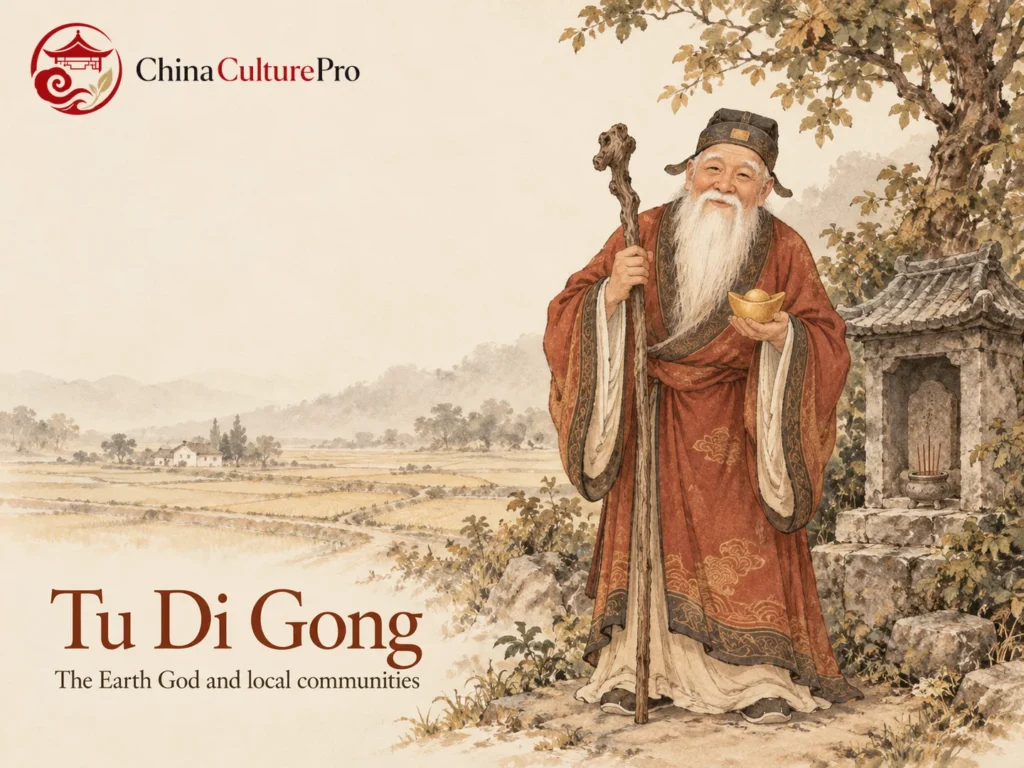

Quick Answer: Who Is Tu Di Gong?
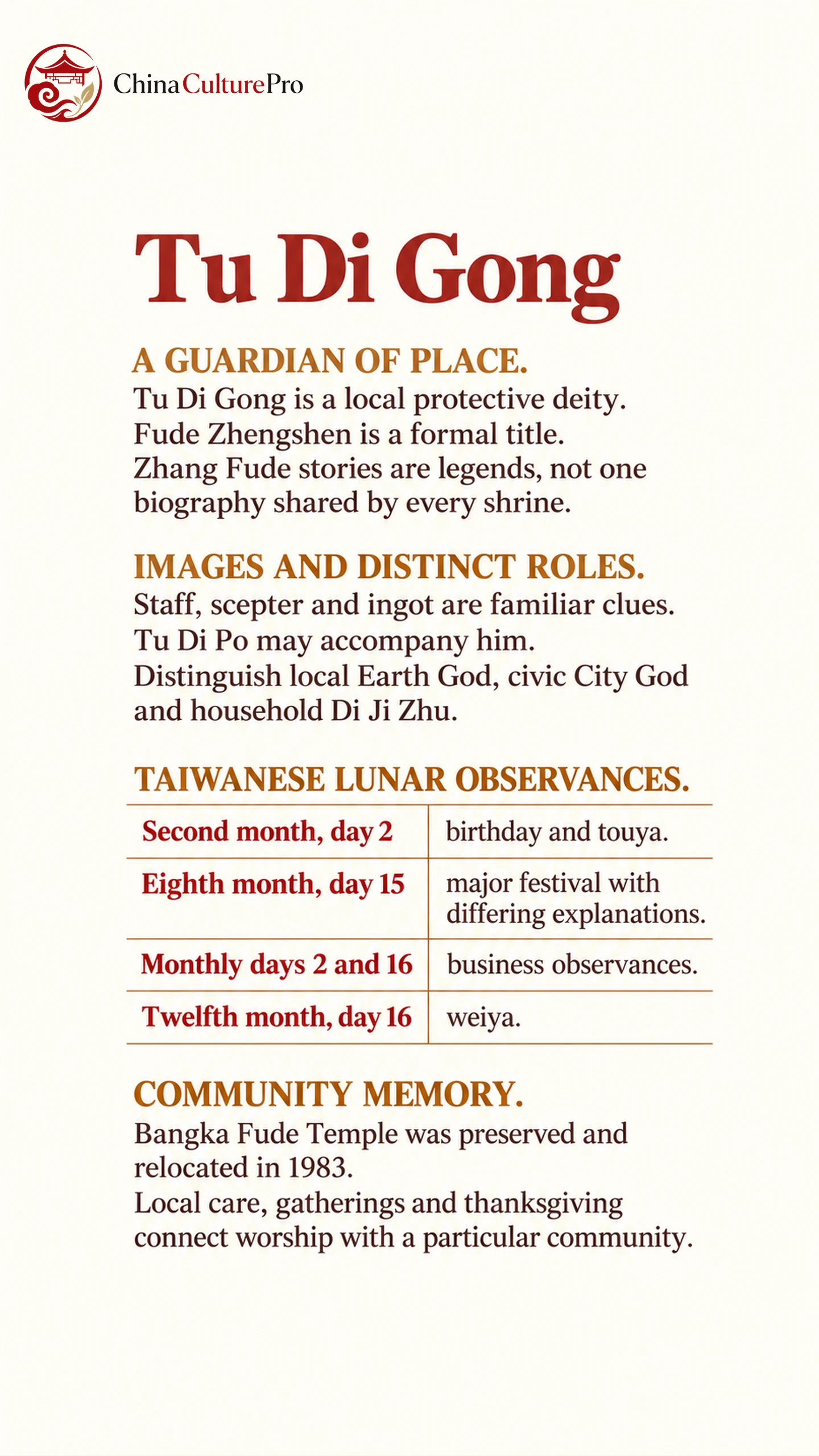
Tu Di Gong(土地公,Tǔdì Gōng), often called the Earth God or Lord of the Soil, is a local protective deity in Chinese popular religion. His worship connects people with the land where they live, farm or conduct business. [1]
- Locality: Different villages, neighborhoods and other places can have their own Earth God. [2]
- Concerns: Protection, harvests and livelihood are familiar associations. [1]
- Images: Statues may hold a staff, scepter or ingot, but shrine forms are diverse. [4]
- Community: Seasonal festivals and regular observances express relationships with a particular place. [6]
“Earth God” here does not mean one universally identical ruler of the entire planet. Local identity is central to understanding the title.
A small roadside shrine, a stone altar or an elaborate temple may all honor a local Earth God. The scale of the building tells less than its relationship with the surrounding community and the people who care for it.
Names, Local Territory and Everyday Protection
Fude Zhengshen(福德正神,Fúdé Zhèngshén), often translated as the Righteous God of Blessing and Virtue, is a formal title frequently encountered at shrines. Tu Di Gong is the more familiar honorific. Bogong(伯公,Bógōng)is another name associated especially with Hakka communities; the pronunciation given here is Mandarin. [3][7]
Locality is central. An established account of popular religion describes each village’s Earth God as its own guardian. This helps explain neighboring communities’ distinct attachments, while leaving room for differences in how particular shrines define their relationships. [2]
Agricultural protection and commercial hopes belong together in this setting. Land sustains crops, residence and livelihood, so gratitude for harvests can extend to hopes for business prosperity. This helps explain the connection with Chinese wealth gods without reducing the Earth God’s entire role to money. [1]
Soil Worship and the Legends of Zhang Fude
Worship of soil and place provides a broader background than any one mortal-origin story. Religious accounts connect the local Earth God with older reverence for land, trees or rocks. Such connections explain a cultural relationship; they do not establish a single date when every later Tu Di Gong tradition began. [3]
Zhang Fude(张福德,Zhāng Fúdé)is a familiar name in stories of becoming the Earth God. Versions differ: one makes him a compassionate official, another a loyal servant who protects a child during severe weather. Their moral emphasis is care for people and place. These are devotional legends, not interchangeable evidence for one securely reconstructed ancient biography. [3]
Recognizing Tu Di Gong, Tu Di Po and Shrine Images
Common implements include a walking staff or ceremonial scepter in one hand and an ingot in the other. Headgear, posture and materials vary. Clay, stone, brick, porcelain and wood can all be used, while a shrine may range from a few stones to a substantial building. The range shows several ways communities give the deity a visible local presence. [4]
Tu Di Po(土地婆,Tǔdì Pó)is the Earth God’s female companion or spouse in traditions that include her. One wooden image presents an approachable older woman with a walking stick and an object identified as an ingot or longevity peach. Her presence is a distinct devotional and artistic choice, not a requirement at every shrine. [5]
Printed images also broaden the visual record. A twentieth-century woodblock print places the Earth God among other figures around an offering table. Its catalogue tentatively identifies some companions, a useful reminder that the central god may be more securely recognized than every surrounding person. [10]
Tu Di Gong, the City God and the Household Land Spirit
English labels such as “land god” and “household god” can hide differences. Compare the title, location and worship context. Chenghuang(城隍,Chénghuáng)and Di Ji Zhu(地基主,Dìjīzhǔ)are especially important distinctions. The Kitchen God has another household role, centered on the hearth. [2][8]
| Sosok | Typical scope in the traditions discussed |
|---|---|
| Tu Di Gong | A local guardian associated with a neighborhood, village, land or community. [2] |
| Chenghuang, the City God | A broader civic jurisdiction, often imagined through the role of a magistrate. Local Earth Gods can be placed below him in a divine administrative model. [2] |
| Di Ji Zhu, a household land spirit | In Taiwanese usage, a spirit associated with earlier occupants or owners of the plot; this is not simply another spelling of Tu Di Gong. [8] |
Birthdays, Zuoya and Seasonal Gratitude
The Taiwanese calendar offers concrete examples. The lunar dates below describe documented customs, rather than a compulsory schedule for every Chinese community. [6]
- Second month, day 2: commonly celebrated as the Earth God’s birthday and touya(头牙,tóuyá), the opening major observance of the annual cycle. [6]
- Eighth month, day 15: another important seasonal festival, described in some traditions as his attainment or elevation day, and in others as a birthday observance. [1][7]
- Monthly days 2 and 16: business observances called zuoya(做牙,zuòyá); some household calendars instead use days 1 and 15. [6]
- Twelfth month, day 16: weiya(尾牙,wěiyá), the year-end observance associated with thanking the deity and communal meals. [7]
Local Shrines and Community Memory
Bangka Fude Temple in Taipei illustrates the link between a shrine and neighborhood memory. The temple was threatened by road widening and, after local preservation efforts, relocated to Changsha Park in 1983. Its history remains connected with the former market and the development of the surrounding settlement. [9]
Hakka records likewise connect Earth God celebrations with community gatherings and thanksgiving performances. These activities make worship a relationship among residents as well as between people and a deity. Local customs belong within the varied practices of religion in China, rather than one standardized ceremony. [7]
FAQs About Tu Di Gong
Is There Only One Tu Di Gong?
Different localities can honor distinct Earth Gods. The shared title describes a recognizable religious role without requiring every shrine to share one biography. [2]
Is Tu Di Gong a Wealth God?
He can be. Associations with harvests and local livelihoods extend into business prosperity, alongside protection and gratitude for the land. [1]
When Is Tu Di Gong’s Birthday?
The second lunar month’s second day is widely observed in Taiwanese traditions. The eighth month’s fifteenth day is also important, with its meaning varying between birthday and attainment accounts. [6][7]
Is Tu Di Gong the Same as Di Ji Zhu?
They should be distinguished. Di Ji Zhu refers to a household or plot-related spirit in Taiwanese usage, while Tu Di Gong is a local protective deity. [8]
Sumber
[1] Taiwan Historica. Dictionary of Taiwanese Folk Objects: Touya and the local Earth God
[2] Asia for Educators, Columbia University. The Earth God, City God and household religious space
[3] Guandu Temple. Fude God: names and divergent Zhang Fude legends
[4] Taoyuan Tudigong Culture Museum. Temple and Statue: materials, implements and shrine forms
[5] National Museum of Taiwan History, through National Cultural Memory Bank. Wooden image of the wife of Fude Zhengshen
[6] Taoyuan Tudigong Culture Museum. Festivals and ritual observances
[7] New Taipei City Hakka Cultural Collection Database. Bogong and Tu Di Gong worship: seasonal and monthly customs
[8] Ministry of Education, Taiwan Taiwanese Dictionary. Di Ji Zhu: household land-spirit definition
[9] Department of Cultural Affairs, Taipei City Government. Bangka Fude Temple: local history and preservation
[10] University of Michigan Museum of Art. True God of the Earth, twentieth-century print, 1989/2.141