

Quick Answer: Who Is Kui Xing?
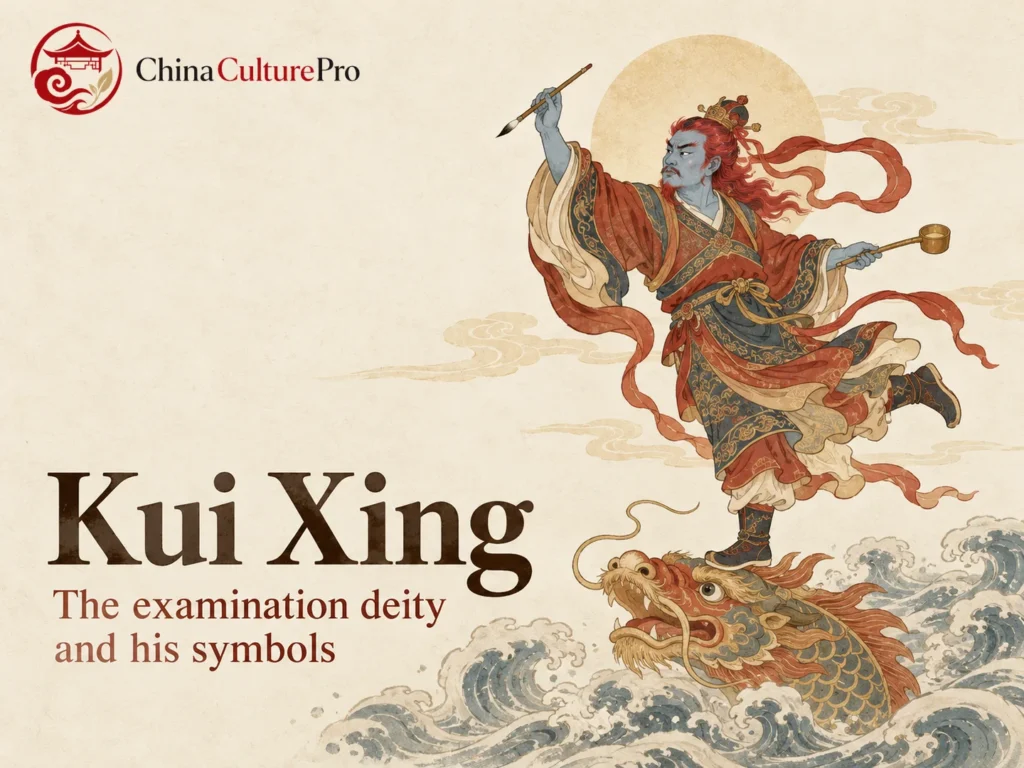
Kui Xing(魁星,Kuí Xīng)is a Chinese deity associated with examination achievement and literary distinction. His striking image often combines a fierce face, a writing brush, an upturned leg and a creature rising from water. [1]
- Role: Students and scholars have honored him in hopes of examination success. [2]
- Wordplay: The character 魁 contains elements resembling “ghost” and “dipper,” important to his visual interpretation. [8]
- Attributes: A brush and measure are familiar, but an ingot can appear instead. [1]
- Related figure: He is associated with Wenchang Dijun(文昌帝君,Wénchāng Dìjūn), yet remains a distinct deity. [7]
His appearance is religious imagery, not evidence of an evil role. Interpret names, stories, artworks and community practice separately.
A deity balancing above waves with a raised brush is an image of scholarly ambition. Understanding the name’s visual jokes and the objects beneath his feet makes Kui Xing easier to recognize than relying on a fierce face alone.
Reading the Name and the Stellar Associations
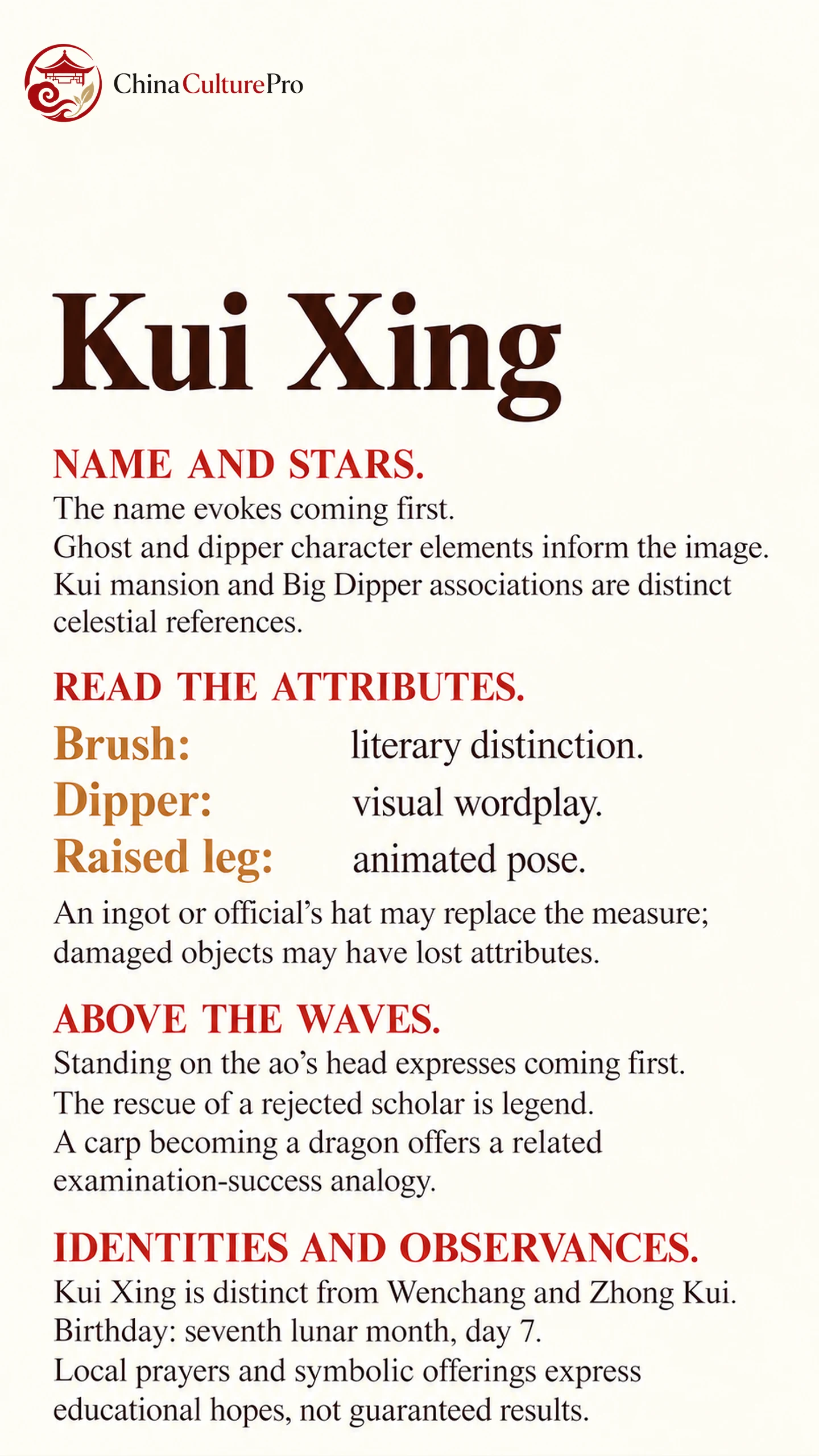
The name appears as Kui Xing, Kuixing or, in older English, Kuei Hsing. 魁 can mean a leader or someone who comes first, connecting the name with distinction in examinations. Its components 鬼, “ghost,” and 斗, “dipper” or measure, also lend themselves to a pictorial interpretation. This explains an artistic convention; it is not a complete historical etymology of the word. [8]
Stellar associations have several layers. The Big Dipper(北斗,Běidǒu)figures prominently in his imagery, while accounts also connect him with the similarly pronounced Kui mansion(奎宿,Kuí xiù), one of the twenty-eight lunar mansions. These two Chinese names and celestial groupings should not be collapsed merely because both become “Kui” in English. [2]
Some English collection labels call him the “Pole Star deity.” Read that as a curatorial designation within the history of the image, rather than assuming every object identifies the modern astronomical star Polaris. The religious figure’s name and pictorial associations are the more reliable starting point here. [1]
Brush, Dipper and Raised Foot: Reading the Image
The familiar figure is deliberately energetic. A raised leg, windblown scarf and emphatic gesture contrast with the composed bearing of a civil official. The following attributes work together; none is an absolute requirement in every surviving object. [5]
| Attribute | Cara memahaminya |
|---|---|
| Writing brush | Evokes literary achievement and the legendary selection of successful candidates. [8] |
| Dipper or measuring vessel | Connects with the 斗 component of 魁. One circa-1650 vase shows a bushel measure. [4] |
| One leg raised behind the body | Gives the figure its familiar dynamic stance. Which leg is raised differs between works. [5] |
| Fierce face and unusual coloring | Red hair and a blue face occur in painted examples. Unpainted metal or porcelain need not reproduce those colors. [1][5] |
The Ao and the Meaning of Coming First
The marine creature is often called an ao(鳌,áo). Its appearance can be fish-like or dragon-like rather than a zoologically precise species. The phrase du zhan ao tou(独占鳌头,dú zhàn áo tóu), “to stand alone on the ao’s head,” expresses coming first. A scholar’s ambition is therefore built into the deity’s footing. [2]
A related but distinct motif shows a carp becoming a dragon after passing the Dragon Gate. On a vase dated around 1650, this transformation parallels a candidate’s change of status through successful examinations. It should not be used to identify every marine support as exactly the same creature or story. [4]
A popular legend explains the ao through a rejected scholar: despite his learning, his appearance leads to humiliation; after he enters the water in despair, a wondrous creature rescues him and he becomes a celestial patron. This is a legend about recognition and injustice, not a documented biography with a secure date or emperor. [6]
Kui Xing, Wenchang and Zhong Kui
Wenchang Dijun commonly has the calm dress and bearing of a civil official. Kui Xing can accompany him, as in a seventeenth-century porcelain group where the smaller figure holds a book for Wenchang. The arrangement shows cooperation, not identity. [7]
Do not confuse Kui Xing with Zhong Kui(钟馗,Zhōng Kuí), the demon-quelling figure. Their names contain different Chinese characters, and a fierce expression alone cannot identify either. Kui Xing’s writing implements, raised leg and examination setting are more useful clues. [9]
Variation also occurs within Kui Xing imagery. An image documented at Guanghan shows him carrying an official’s hat rather than the usual measure. A sixteenth- or seventeenth-century metal figure holds an ingot, linking success with official income. These substitutions reinforce the examination theme rather than creating a new deity. [1][3]
Birthday Worship and Examination Communities
The seventh day of the seventh lunar month, also Qixi(七夕,Qīxī), is observed as Kui Xing’s birthday in documented traditions. This gives the date a scholarly religious association alongside its better-known romantic stories. It is not a fixed Gregorian date. [8]
Xinzhuang Wenchang Shrine provides a concrete example of related worship: Wenchang occupies the main hall and Kui Xing a side hall. Its cultural record describes longan, hazelnuts and peanuts as auspicious offerings associated with examination honors. These are local symbolic associations, not a universal shopping list for every shrine. [6]
Modern practice can include presenting copies of examination documents or making prayers about study and careers. Such customs belong to the social life of religion in China. They show the continuing importance of educational hopes without establishing that an offering determines a score. [2]
FAQs About Kui Xing
Is Kui Xing the Same as Wenchang?
No. They share literary and examination associations, but can appear as separate figures in the same artwork or shrine. [7]
Why Does Kui Xing Look Like a Demon?
The familiar fierce form participates in visual wordplay on the 鬼, or “ghost,” component of 魁. It does not make him a malevolent deity. [8]
Does Kui Xing Always Hold a Dipper?
No. Recorded images also show an ingot or an official’s hat. Some surviving objects have lost their original implements: a late-nineteenth-century Vietnamese sculpture, for example, is now missing its brush and other attributes. [1][3][5]
When Is Kui Xing’s Birthday?
The seventh day of the seventh lunar month is the commonly documented observance in the sources discussed here, coinciding with Qixi. [8]
Sumber
[1] The Metropolitan Museum of Art. Polestar Deity Kui Xing, sixteenth–seventeenth century
[2] Taiwan Historica. Dictionary of Taiwanese Folk Objects: examination offerings
[3] Chengdu Museum. Qixi worship of Kui Xing and differences from Wenchang
[4] The Metropolitan Museum of Art. Vase with the Pole Star deity, circa 1650, L.2017.53.2
[5] Musée de Grenoble. Kui Xing, late-nineteenth-century Vietnamese sculpture, MG 2010-0-14
[6] National Cultural Memory Bank, contribution by Cai Xiujia. Kui Dou Xing Jun at Xinzhuang Wenchang Shrine
[7] British Museum. Wenchang and Kui Xing porcelain group, 1980,0728.54
[8] Songshan Fengtian Temple. Kui Xing: visual wordplay and lunar birthday
[9] Staatliche Museen zu Berlin, Museum für Asiatische Kunst. Ghostbuster: Zhong Kui, the Demon Queller