


Quick Answer: What Is Water Margin?
Water Margin(水浒传,Shuǐhǔ Zhuàn) is a classical Chinese novel about people who gather in a marshland stronghold after falling out with officials and other local powers. The action is set in the late Northern Song, and the novel took shape much later through literary and print traditions. It is commonly attributed to Shi Nai’an(施耐庵,Shī Nài’ān). Early editors reshaped it into markedly different versions, and the versions differ in how much of the band’s story they tell. [1]
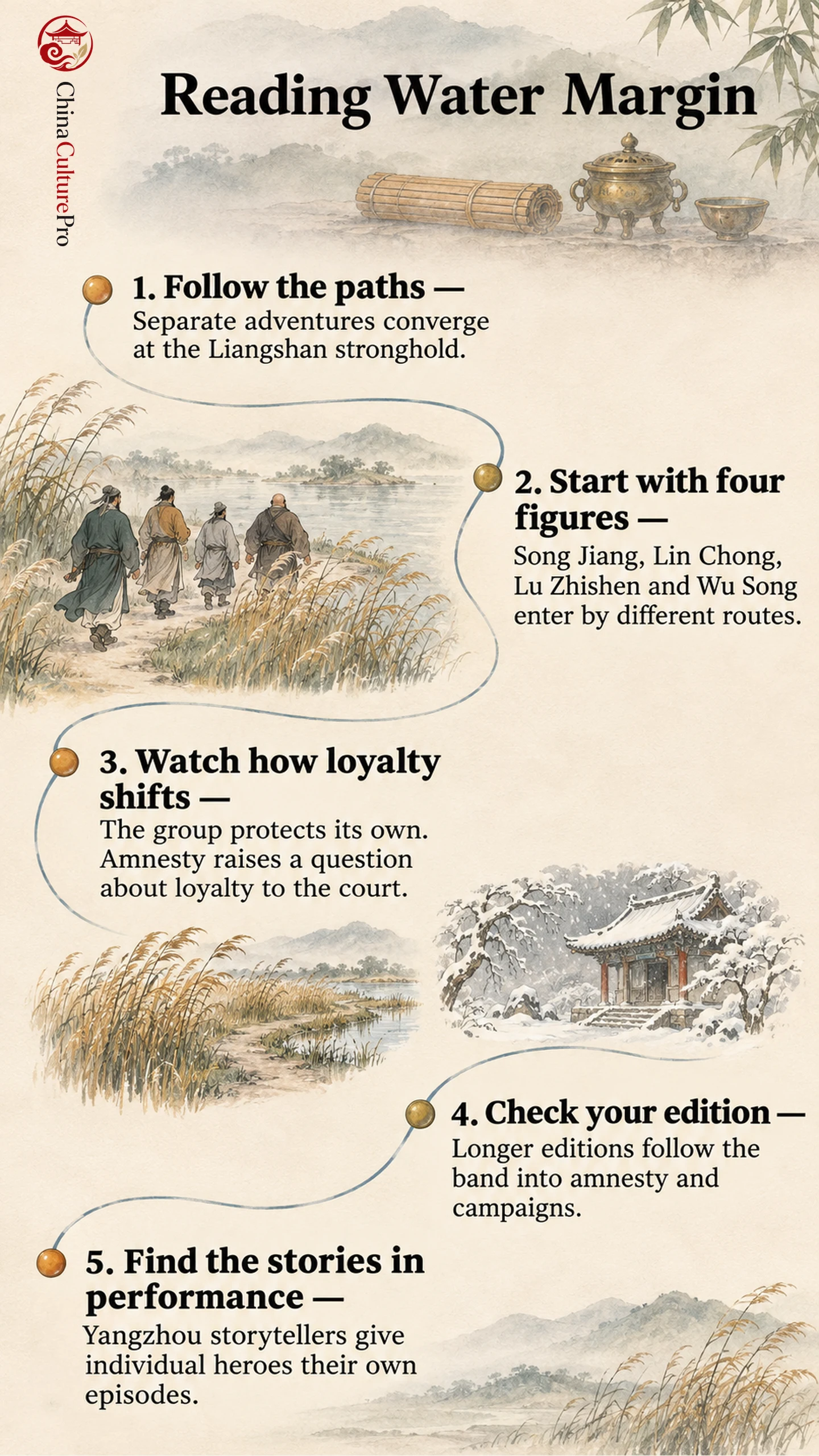
A snowstorm drives a former arms instructor into a roadside temple. From inside, he learns why a building he was meant to guard is burning. This moment offers a way into Water Margin. Its outlaws arrive at the marsh through separate adventures, and each arrival changes what the group can do.
From Separate Adventures to Liangshan
Early in the novel, attention passes from one person to another. A traveler meets a new character, and soon the book is following that character along a different road. Some are fugitives from corrupt officials. Others have already made choices that leave them exposed to punishment. Following these transfers is easier than memorizing a roster before you start. [2]
The stories gradually come together at Liangshan(梁山,Liángshān), a stronghold protected by marshes. In the familiar roster, 108 figures are eventually ranked there. Their meeting creates a new center of authority within the novel’s imagined Song dynasty setting. The number and the ranking belong to the literary story. [2]
Four Characters to Follow
Begin with four people who give you different ways into the story. The early episodes reveal how far their situations and motives differ, even when the novel places them under the same banner. [2]
| Four Water Margin Characters | Role in the novel | What to follow |
|---|---|---|
| Song Jiang(宋江,Sòng Jiāng) | A clerk who rises to lead the outlaws | The pull of official recognition and his obligations to companions |
| Lin Chong(林冲,Lín Chōng) | A military instructor persecuted by powerful men | The successive pressures that close off his old life |
| Lu Zhishen(鲁智深,Lǔ Zhìshēn) | A former officer who becomes a monk | His willingness to intervene when he sees someone threatened |
| Wu Song(武松,Wǔ Sōng) | The traveler famous for killing a tiger | The difference between public acclaim and later acts of revenge |
Lin Chong’s snowbound episode is a good first close reading. He goes to a temple after his shelter gives way in the snow. From there he overhears the men behind the fire at the depot he is guarding. The same night that exposes the plot also closes off his attempt to live within the terms of his punishment. The storm sends him to the one place where he can hear the men without being seen. [3]
What Loyalty Means at the Marsh
The band offers shelter, recognition and allies. Its members give loyalty to one another and speak in the language of righteousness. The stories put those claims under pressure by showing the cost of individual actions. A rescue can look just to the person who needs it, while a reprisal can widen the harm. Watch how often the story changes the person through whose predicament you see events. [2]
Imperial amnesty makes the problem especially clear in the longer editions. Song Jiang seeks recognition from the court, even though abuses by its officials helped create the band. Accepting service gives the outlaws a new public standing and asks them to use their force on the court’s behalf. Who gets to define loyalty once the group returns to imperial service? [2]
How the Editions Change the Ending
The 100- and 120-chapter forms carry the story beyond the assembly to amnesty and military campaigns. The 120-chapter form adds campaigns against Tian Hu and Wang Qing, extending the period in which the band serves the court. In the familiar 120-chapter contents, the ranking at the stronghold is chapter 71. Treat any chapter number you see online as edition-specific. [2]
Jin Shengtan’s seventeenth-century 70-chapter edition gives the assembly a different ending and omits the later amnesty and campaign arc. This changes the shape of the book a reader encounters. The gathering that sets up a new political problem in a longer text becomes the culmination in Jin’s edition. [4]
The English title can give you an initial clue about the edition. Pearl S. Buck’s All Men Are Brothers draws on the Jin edition, while Sidney Shapiro’s Outlaws of the Marsh presents the 100-chapter version. Use the translator’s name and the contents page together to choose a book or match a passage with someone reading a different edition. [5]
From Printed Novel to Public Performance
The adventures can be told on their own, which helps explain their place in Chinese storytelling. The national heritage profile of Yangzhou performer Wang Litang describes a family repertoire built around figures including Wu Song and Song Jiang. A spoken version can linger on a voice, a gesture or a minor figure that the reader passes quickly on the page. [6]
The Puning heritage description of Yingge dance includes the enactment of Water Margin stories among the accounts of the tradition’s origins. The dancers use coordinated stick work, percussion and group formations to evoke martial energy. Read the novel alongside the other Four Great Classical Novels to see how differently stories can travel between the page and performance. [7]
FAQs About Water Margin
Who wrote Water Margin?
The novel is traditionally attributed to Shi Nai’an. Its composition and transmission involved several layers, including the work of editors whose versions can differ substantially.
Are Water Margin and Outlaws of the Marsh the same novel?
Yes. Outlaws of the Marsh is Sidney Shapiro’s English title for his translation of the 100-chapter Water Margin.
Do all editions tell what happens after the outlaws assemble?
The longer editions continue into amnesty and campaigns. Jin Shengtan’s 70-chapter version ends around the gathering and ranking.
Sumber
[1] Scott W. Gregory, Cornell University Press. Bandits in Print
[2] Chinese Wikisource. Water Margin, 120-Chapter Text
[3] Chinese Wikisource. Water Margin, Chapter Ten of the 100-Chapter Text
[4] Frontiers of Literary Studies in China. Jin Shengtan’s 70-Chapter Edition
[5] Hong Kong Polytechnic University. Thesis on English Translations of Shuihu Zhuan
[6] China Intangible Cultural Heritage. Wang Litang and Yangzhou Pinghua
[7] China Intangible Cultural Heritage. Puning Yingge