


Quick Answer: What Is The Art of War?
*The Art of War*(孙子兵法,Sūnzǐ Bīngfǎ) is an early Chinese military text traditionally attributed to Sun Tzu(孙子,Sūnzǐ). Its thirteen chapters discuss how a state and its commanders assess conflict, weigh costs and respond to changing conditions. The book’s short formulations are easier to understand within those chapters.
The received text has a long transmission history. Early manuscript finds document its circulation alongside a distinct work associated with another strategist. Modern readers often apply its ideas beyond war. The original questions concern rulers, armies, campaigns and the costs of conflict.
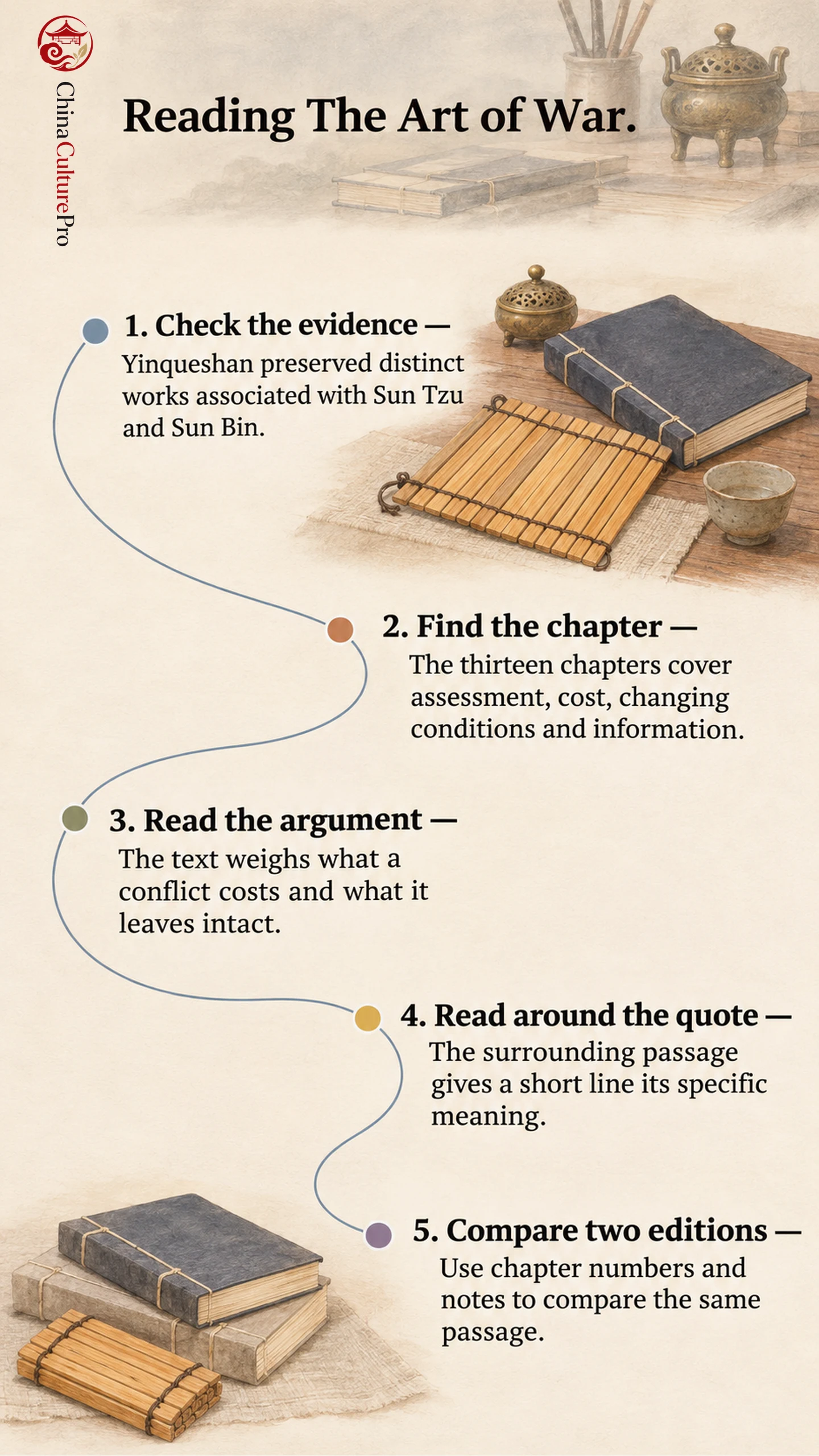
A maxim can sound like a rule for every situation when it appears on its own. In *The Art of War*, the surrounding passage can change its force. A line about winning, for instance, belongs beside questions about what a campaign costs and what it leaves intact.
Sun Tzu, Sun Bin and the Manuscript Evidence
The title Sun Tzu means Master Sun. Tradition identifies the author with Sun Wu(孙武,Sūn Wǔ), a strategist associated with the state of Wu. Scholars debate how the work took shape. Victor Mair argues for compilation during the Warring States period. A traditional author’s biography and the history of a text’s formation are separate questions. [1]
In 1972, excavations at Western Han tombs at Yinqueshan in Shandong uncovered bamboo manuscript material from works associated with Sun Tzu and Sun Bin(孙膑,Sūn Bìn). The two works were distinct by the time the copies entered the tomb. The find gives a point in the history of transmission. Dating the original composition requires other evidence. [2]
How the Thirteen Chapters Are Organized
The received text consists of thirteen compact chapters. They move from initial assessment and campaign costs to different conditions, movements and the use of information. Chapter headings can differ in English translations. The numbered sequence helps you compare the same part of the text. [3]
| Chapter | Main subject | A question to take into the reading |
|---|---|---|
| 1, Assessment | Conditions that shape an initial decision | Which conditions does the text ask a ruler or commander to compare? |
| 2, Waging War | Expense and the burden of a prolonged campaign | How do costs affect the value of continuing? |
| 3, Attack by Stratagem | Preserving what can be taken intact and preferring success without battle | What does the chapter treat as a better outcome than destruction? |
| 13, Use of Spies | Foreknowledge and information in war | Why does the text distinguish information from guesswork? |
These chapters are entry points. Read the surrounding argument if an isolated line seems to offer a simple rule. The text often moves from a broad claim to distinctions among situations. [3]
Planning, Cost and the Limits of Victory
The first chapter lists factors for assessment, including environmental conditions, terrain, command and organization. In the second chapter, prolonged warfare consumes resources and can weaken a state. Read together, the two chapters ask about the ability to sustain a campaign as well as the possibility of winning it. [3]
The third chapter ranks taking an opposing state or force intact above destroying it. The idea of overcoming resistance without battle belongs within that argument. The chapter measures success partly by how much remains intact. The passage is concerned with the condition of what remains after a conflict as well as its immediate outcome. [3]
Reading Famous Lines in Context
The short passages are often quoted on their own. A discussion of knowing oneself and the opponent appears in a chapter that also considers command and different conditions for success. Reading the complete section helps you see what kind of knowledge the author is discussing. [3]
Modern writers can draw analogies with business, sport or negotiation. Those analogies are new uses. Reading the work as part of Chinese literature and the intellectual history of early China gives a way to separate the text’s questions from what later readers make of them.
How to Choose a Translation
Choose a translation with chapter numbers and enough notes to explain recurring terms. Victor Mair’s edition discusses the text’s authorship and recovered manuscripts. Lionel Giles’s translation can be read beside the Chinese on the Chinese Text Project. [4] The side-by-side text lets you check which Chinese term each English phrase is rendering.
Start with chapter one and compare the words each translation uses for the factors under assessment. Then read chapters two and three in sequence. That order helps you see how a claim about victory follows earlier discussion of preparation and cost. [4]
FAQs About The Art of War
Did Sun Tzu definitely write all thirteen chapters?
The traditional attribution is to Master Sun, identified with Sun Wu. The text’s composition and transmission remain subjects of scholarship.
Are Sun Tzu and Sun Bin the same person?
They are distinct figures in tradition. The Yinqueshan find included separate military works associated with their names.
Is The Art of War mainly a business book?
Its subject is warfare and statecraft in early China. Business readings apply selected ideas by analogy.
Sumber
[1] Columbia University Press. The Art of War, Victor Mair Translation
[2] China Culture. Tombs of Han at Yinqueshan
[3] Chinese Wikisource. The Art of War, Received Chinese Text
[4] Chinese Text Project. Laying Plans, Chinese Text and Lionel Giles Translation