

Quick Answer: What Is To Live About?
To Live (活着, Huózhe) is a novel by Yu Hua (余华, Yú Huá) about Xu Fugui (徐福贵, Xú Fúguì), a landowner’s son who gambles away his family’s fortune. Years later, as a farmer, he tells a visiting collector of folk songs how his family lived through war, hardship and loss.[1]
- The novel: First appeared in Panen in 1992. An expanded Chinese book edition followed in 1993.[4][5]
- The film: Zhang Yimou (张艺谋, Zhāng Yìmóu) directed the 1994 adaptation, which adds shadow puppetry and changes the way the story is told.[6][7]
- English reading: Look for Michael Berry’s translation, published by Anchor in 2003.[3]
The guide uses the opening scene and the family’s early reversals. It leaves the details of the later losses and the endings of both versions for readers and viewers.
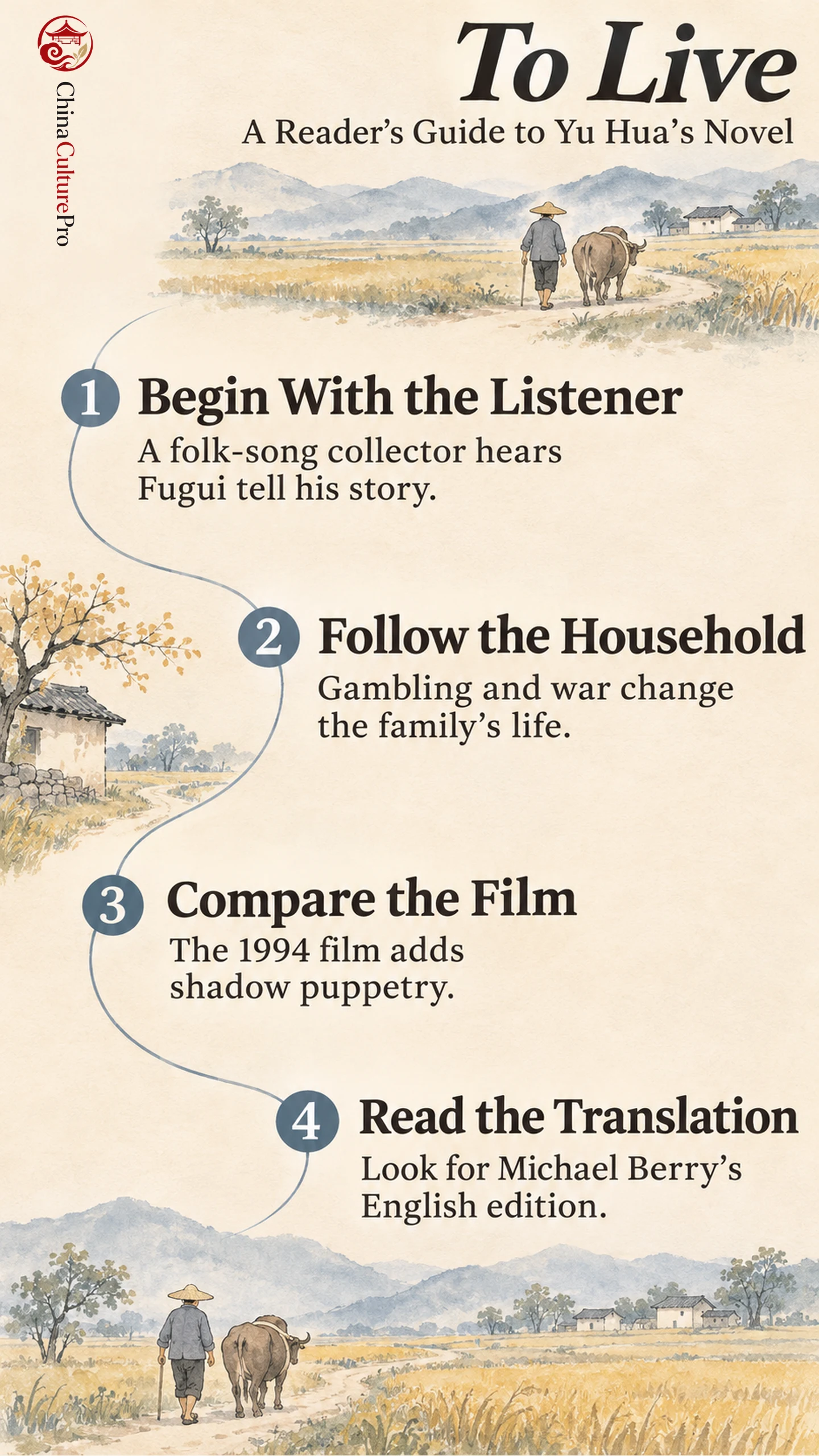
Before Fugui tells the story of his life, someone stops long enough to listen. That encounter matters to the way you read the novel. A man you meet at work in a field can introduce you to the reckless person he used to be, with decades of experience between the two.
Why the Novel Starts With Fugui and His Ox
A young collector of folk songs meets Fugui while traveling through the countryside. He finds the older man at work with an ox. This frame sets up the long account of Fugui’s life that follows, with Fugui doing the telling in his own voice.[1]
The old man and the ox share a name.[6] When the book moves into the past, the reader already knows they will meet again in the frame’s present. That changes the suspense. You already know what one day near the end of his life looks like. The story that follows tells you how he got there and what he thinks of the changes.
Pay attention to the change in authority when the collector steps aside. The collector can report what an encounter looked like. Fugui can tell what it was like to lose the home and land that once defined his position. Listen for what Fugui can admit about his younger self and what it takes him longer to understand about his wife.
How History Enters the Xu Household
Jiazhen (家珍, Jiāzhēn), Fugui’s wife, lives through the loss of the family’s property and the work of raising children afterward. Fengxia (凤霞, Fèngxiá) and Youqing (有庆, Yǒuqìng) grow up in a household whose possibilities change with Fugui’s decisions and with events beyond their control.[1]
The Chinese Civil War reaches Fugui in a direct way. He is taken into the Nationalist army and separated from his family. The story makes the conflict a household question. With Fugui gone, the others have to keep the family going without knowing when he will return.[2]
Later episodes take place amid the Great Leap Forward and the Cultural Revolution.[6]
Historical context helps explain why work, food and institutions are under pressure. To see what the novel does with that context, follow what one family member is able to do for another in a particular scene.
Another family saga, White Deer Plain, can help readers compare scales. Yu Hua gives one man a life to tell. Chen Zhongshi follows competing households and their ties to a village.
What Zhang Yimou Changes in the Film
Zhang Yimou’s 1994 film stars Ge You as Fugui and Gong Li as Jiazhen. It shared the Jury’s Grand Prix at Cannes, where Ge You won the Best Actor award. Yu Hua is among the credited screenwriters.[7][8]
The film drops the traveling listener who introduces Fugui in the book and gives Fugui a trade as a shadow puppeteer. The puppets let him perform for different audiences as the political setting changes.[6] To follow the craft outside the story, see Chinese shadow puppetry.
The opening sequences offer a direct comparison. The book starts with the older man and lets a listener discover who he was. The film puts the younger Fugui in front of you and asks you to watch the gambling losses change the household as they happen.
The film also rearranges individual losses and the final scene, so a remembered film detail may belong to a different point or outcome in the novel.[6]
Where to Start With the Book
The English paperback of To Live from Anchor is dated 2003 and has ISBN 9781400031863. Search with Michael Berry’s name to distinguish the book from film editions or other works with the same short title.[2][3]
Read the frame before looking up a plot summary. Once the young man begins to listen, you can follow how Fugui understands his family at different ages. That reading path leaves room for humor, embarrassment and practical care alongside the book’s losses.
For a different narrative vantage from Yu Hua, compare The Seventh Day, which places its narrator in an afterlife. Readers tracing how vulnerable people are heard in modern Chinese literature can also pair the opening with Lu Xun’s New Year’s Sacrifice, where another narrator’s position shapes the story available to us.
FAQs About To Live by Yu Hua
Is To Live based on a true story?
It is fiction. Yu Hua places an invented family in recognizable periods of twentieth-century Chinese history and lets Fugui recount his own experience.[2]
Why do some sources date the novel to 1992 and others to 1993?
The Chinese periodical version appeared in 1992. The expanded standalone book came out in 1993.[4][5]
Can you read the book after watching the film?
Yes. Start with the meeting between Fugui and the folk-song collector. That framing encounter is specific to the novel and changes how the family’s history reaches you.[1]
Sumber
[1] National Endowment for the Arts. To Live, Big Read Guide
[2] Penguin Random House. To Live, Anchor Paperback
[3] Michael Berry. To Live, Translation Record
[4] Yu Hua, China Writers Association. Talking About To Live at Tsinghua
[5] Jiang Jiyong, China Writers Association. How Three Versions of To Live Took Shape
[6] Association for Asian Studies. To Live: Novel and Film
[7] Festival de Cannes. Huozhe, 1994 Competition
[8] Film Movement. To Live, 1994 Film