

Quick Answer: What Is The Travels of Lao Can?
The Travels of Lao Can (老残游记, Lǎo Cán Yóujì) is a late Qing novel by Liu E (刘鹗, Liú È) about a traveling doctor known as Lao Can (老残, Lǎo Cán). His travels through Shandong bring him into contact with storytellers, townspeople and officials. The book puts careful observation of places and people alongside criticism of officials whose reputations hide the cost of their methods.[1][4][5][6]
- The traveler: Lao Can’s personal name is Tie Ying (铁英, Tiě Yīng). He earns his living by treating patients as he travels.[4]
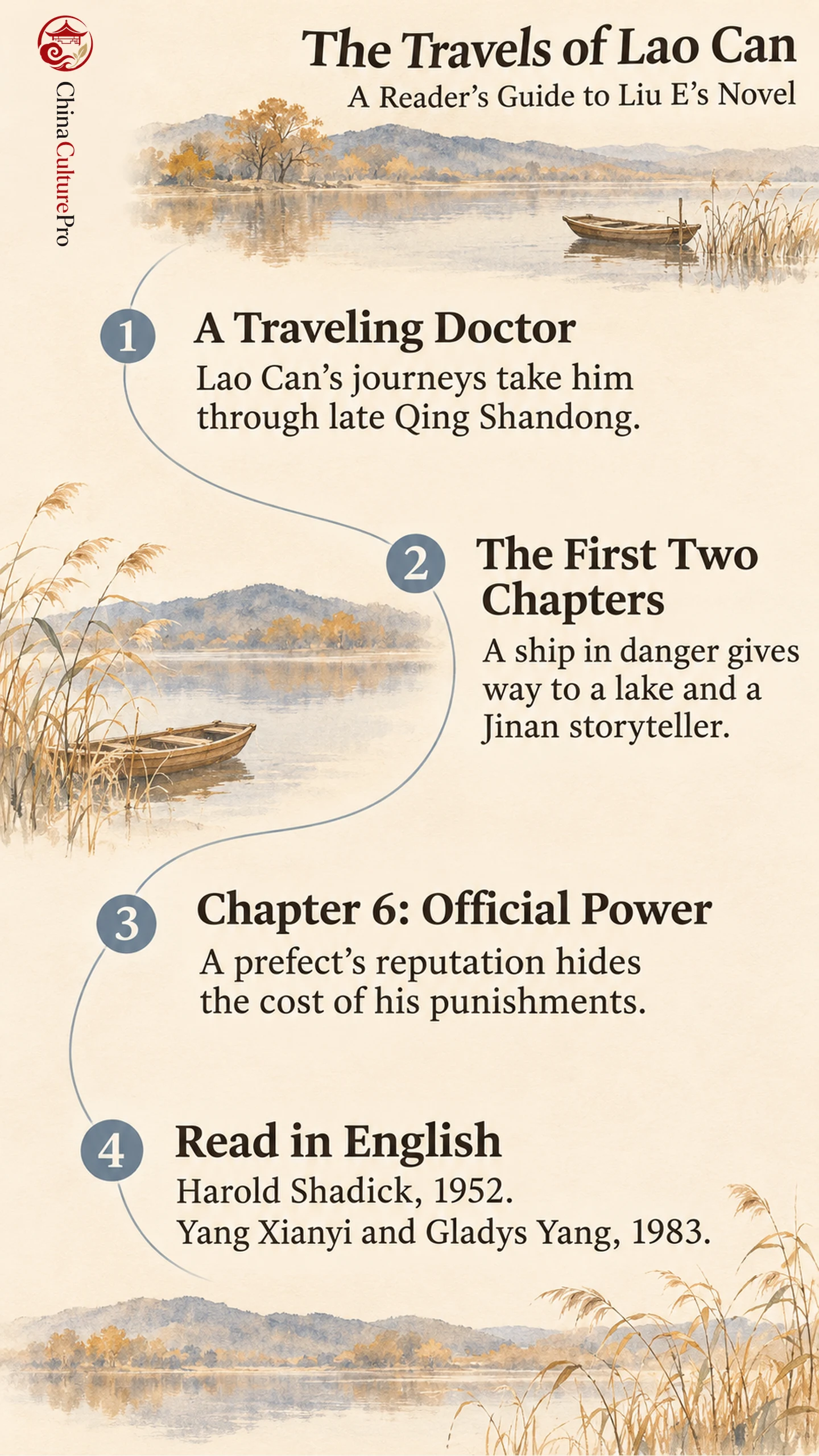
- Two early scenes: A ship is in trouble off the coast. In Jinan (济南, Jǐnán), Lao Can visits Daming Lake (大明湖, Dàmíng Hú) and hears a celebrated storyteller.[4][5]
- The main text: The novel began appearing in print in 1903. Its main sequence contains twenty chapters, and some editions include a continuation.[1][3][9]
- Reading in English: Look for Harold Shadick’s The Travels of Lao Ts’an or the translation by Yang Xianyi and Gladys Yang.[2][7][8]
This guide describes the early chapters and one example of the book’s satire. It leaves the later cases and their outcomes for the novel.
In one chapter, a crowd falls quiet when a storyteller raises her eyes. In another, the empty cages outside an official building seem to say that nothing bad is happening there. In both scenes, the book asks you to notice something before anyone tells you what it means.[5][6]
The traveler offers a way to connect observations like these. He comes into a place, hears what people say about it and sometimes learns to see it differently by the time he leaves.
Who Is Lao Can, and Why Does He Travel?
Tie Ying takes up a traveling medical practice after failing to find a place in several conventional occupations. He carries a string of bells to announce his practice and takes payment from the people who hire him.[4] That position can bring him into a household as a guest without requiring him to hold office.
Liu E also practiced medicine. His other interests included music and the collection of early inscriptions.[2] Knowing this can help explain why the novel gives such close attention to what can be heard, seen and examined. Tie Ying remains a fictional character whose observations belong to a crafted narrative.
As you read, pay attention to what Lao Can learns from people who have no reason to impress an official. A stranger can learn a great deal from an innkeeper or a person sitting next to him at a performance. Those voices give the book room to examine the late Qing from different social positions.
Three Chapters for a First Reading
1. The Ship in Trouble
Lao Can and two friends see a damaged vessel off Penglai. They offer navigation instruments. Some of the people aboard treat those instruments as evidence of a foreign plot, although the ship is already in trouble.[4]
Read into the beginning of chapter two, which reveals the encounter as a dream.[5] It works as an image of failed government. The scene turns on a practical question. Can the people running the ship judge a navigational tool by what it does, when a crowd treats its origin as proof of disloyalty?
2. The Lake and the Storyteller
Lao Can hires a boat on Daming Lake and sees Thousand Buddha Mountain reflected in the water. He then hears people in the city talking about a storytelling performance. At the venue, Wang Xiaoyu (王小玉, Wáng Xiǎoyù), known as Bai Niu (白妞, Bái Niū), holds the attention of a large audience.[5]
When her voice rises in stages, Liu compares the effect to climbing Mount Tai and repeatedly finding another height above the one you have reached.[5] The image makes a change in pitch legible to a reader. It also carries the observation of a landscape into a chapter about a performance.
6. A Prefect’s Reputation
Lao Can has heard about the harsh use of standing cages under the prefect Yuxian (玉贤, Yùxián). The cages are empty when he sees them. He learns that punishments have paused because the official has received recognition and the office is celebrating.[6]
That reason changes the meaning of the sight. An empty cage could suggest restraint. Here it marks a brief interruption in a practice the official can resume. Track what Lao Can sees directly and what he learns from his acquaintance. That conversation gives him a reason to question the administration’s praise.
What the Novel Means by Good Government
Yuxian’s chapter raises the question of how a superior can judge work done far away. An official can get credit for a campaign against banditry while ordinary people live with the fear of being treated as bandits. Lao Can turns his anger into a poem and starts a letter, warming his ink and brush as they freeze in the cold.[6]
The slow work of writing gives the reader time to notice the difficulty of turning local knowledge into something an authority will read. It also keeps the story’s criticism tied to the individual trying to do that work. The Scholars offers a complementary reading about the status granted by official recognition. The Seven Heroes and Five Gallants gives the investigator a different relationship to the power of a court.
Which Chinese or English Edition Should You Read?
The first installments appeared in 1903. A Taiwan National Central Library record describes the twenty-chapter main novel and cites 1906 for publication.[1][3] Use the main sequence if you want to follow the reading path above. The same catalogue distinguishes the initial collection and later material in the contents.[1]
For English, Cornell University Press published Harold Shadick’s translation in 1952 under The Travels of Lao Ts’an. The 1983 Chinese Literature edition uses The Travels of Lao Can and credits Yang Xianyi and Gladys Yang.[2][7][8] The spelling in the title can help you find the version you want.
This is a good example of why it helps to check translators’ names when choosing Chinese classic books. For a first reading of this work within Chinese literature, follow the three scenes above and notice what each asks you to find out about a place.
FAQs About The Travels of Lao Can
Is The Travels of Lao Can a real travel diary?
It is a novel. Liu E gives a fictional doctor a journey that brings together observed places, invented encounters and a dream.[1][4][5]
How many chapters are in the main novel?
There are twenty chapters in the main sequence. Editions may include a separately marked continuation or other material.[1][9]
Is Lao Ts’an the same person as Lao Can?
Yes. Lao Ts’an is the spelling used in the title of Harold Shadick’s English translation. Other editions use the pinyin spelling Lao Can.[2][7][8]
Sumber
[1] Taiwan National Central Library. Lao Can Youji, Laureate Books Edition
[2] Chinese University of Hong Kong Research Centre for Translation. Liu E
[3] Merit Times. How The Travels of Lao Can Was Written
[4] Wikisource. The Travels of Lao Can, Chapter One
[5] Wikisource. The Travels of Lao Can, Chapter Two
[6] Wikisource. The Travels of Lao Can, Chapter Six
[7] WorldCat. The Travels of Lao Ts’an, Cornell Edition
[8] WorldCat. The Travels of Lao Can, Chinese Literature Edition
[9] Wikisource. The Travels of Lao Can, Contents