


Quick Answer: What Makes the Classical Gardens of Suzhou Distinctive?
The classical gardens of Suzhou are urban landscapes built on the scale of residences and retreats. Ponds, rocks, plants and buildings evoke scenery within the city. Literary names and paintings connect views in the gardens to stories and works of art. Nine Suzhou gardens make up a UNESCO World Heritage property. [1][2][3]
- Each garden has its own layout. One uses a large pond to spread out the view, while another leads the eye along a bank just outside the walls. [4][5]
- Gardens had different kinds of patrons. Some were private residences, while the Lion Grove Garden (狮子林, Shīzǐ Lín) began with a Buddhist community. [1][6]
- Buildings and names guide the experience. A covered walk frames a scene, and a name can point readers toward a poem or earlier story. [7][8][9]
Compare the garden’s historical setting with the first view you encounter.
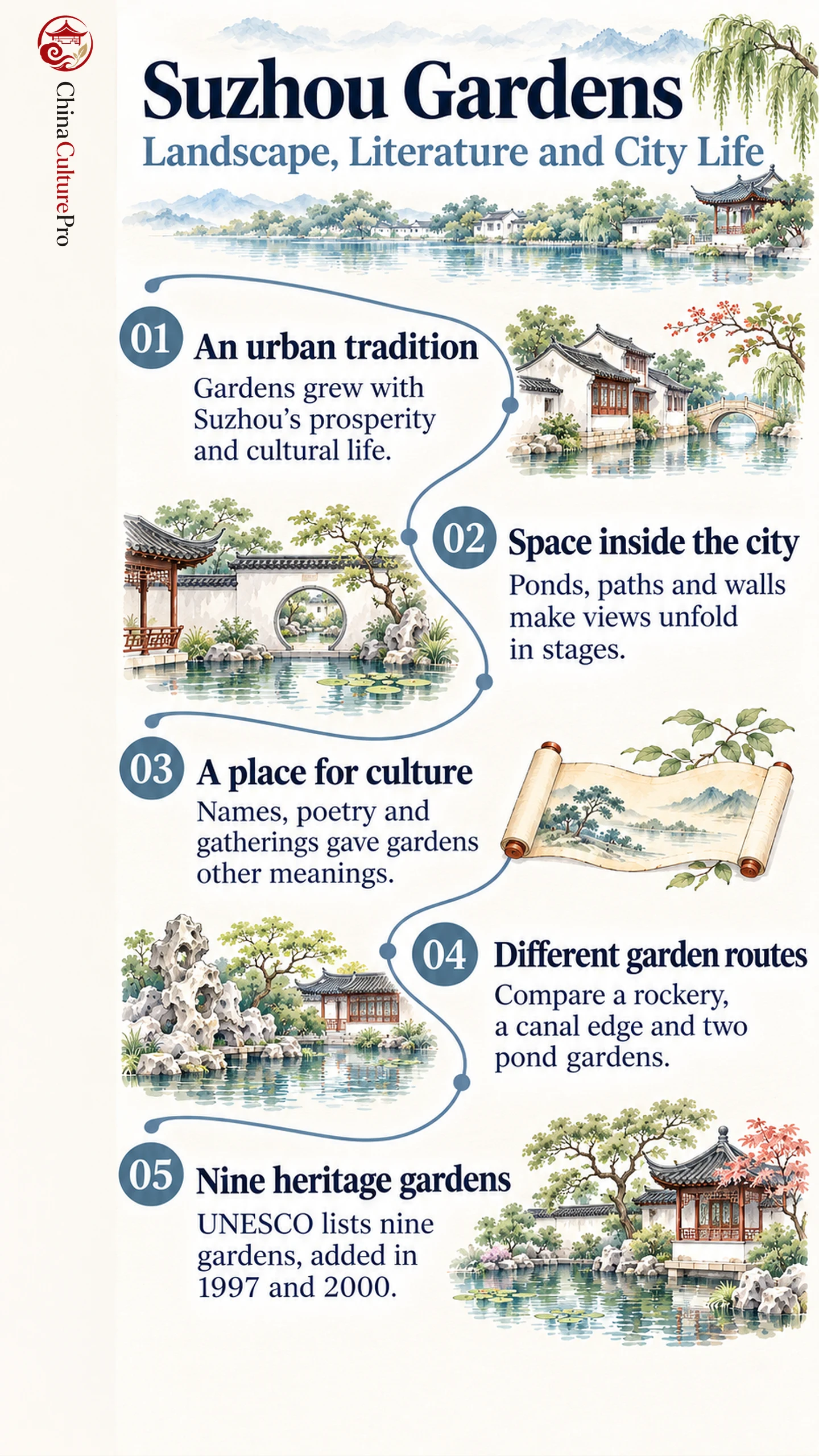
At some Suzhou gardens the water only comes into sight after you enter. At Canglang Pavilion (沧浪亭, Cānglàng Tíng) the bank outside the garden already belongs to the scene. Differences like that become clearer when you consider where each garden began and how its owners used it.
How Garden Making Took Root in Suzhou
Suzhou’s prosperity, access to water and active cultural life sustained a range of Chinese gardens. Cultivated retreats were celebrated in literature long before the sites you can recognize today took their present form. In later periods, wealthy private owners could use gardens to combine a residence with scenery and spaces to receive guests. [1][2][3]
The poet Su Shunqin acquired the site associated with Canglang Pavilion in 1045 and built a pavilion beside water. The garden underwent later changes, including a move of the pavilion to higher ground in the Qing dynasty. Its early origin and current layout tell different parts of the story. [9]
Lion Grove began in 1342 in a Buddhist setting. Disciples established a place for the monk Tianru, and poets and painters became part of its early cultural life. The grounds subsequently changed hands. The Suzhou garden bureau records an extensive private restoration that began after a purchase in 1917. The contrast between imperial and scholar gardens is useful for understanding scale and patronage, and Lion Grove adds a religious founding context to that picture. [1][6]
A Landscape Within the City
Suzhou gardens are particularly good places to study how Chinese garden design makes a view feel larger than the space available. A pond separates banks without blocking the view. A rockery interrupts a line of sight or gives a short path an uphill turn. A covered route links several viewpoints, each with its own foreground. [1][4][10][7]
The Humble Administrator’s Garden (拙政园, Zhuōzhèng Yuán) uses a large water-centered middle section. In the compact Master of the Nets Garden (网师园, Wǎngshī Yuán), buildings and banks feel closer together around the central pond. Compare how much of the opposite bank you can see from a single stop. [4][10]
At Canglang Pavilion, water outside the garden and a roofed gallery along the edge take part in the composition. Here paths and windows can bring attention to scenes on both sides of the boundary. The relationship between the outer water and the inner grounds helps explain how borrowed scenery can extend the apparent reach of a garden. [7][9][5]
Reading, Painting and Names
The garden was a social space as well as a place for retreat. People could gather to look at paintings, write, talk or appreciate seasonal scenery. The same group might have moved between a room for gathering and a pavilion that opened toward a pond. A scholar’s study gives a more intimate counterpart to the outdoor and waterside settings. [2][8][11]
Garden names and couplets can tell readers how earlier owners saw a place. Su Shunqin named his pavilion for an old song about washing in the waters of the Canglang. A phrase with a literary history thus became the name of a place where people encountered actual water. The name remained legible through changes to the buildings and the garden. [9][5]
Paintings could turn a garden into a place people knew without visiting it. Suzhou’s garden bureau records that poets and painters made works about Lion Grove from its early history. A painting can emphasize a recognizable rockery or pavilion while reworking the distance and viewpoint for a viewer looking at paper. [1][6]
Four Suzhou Gardens to Compare
| Garden | Latar sejarah | Feature to look for |
|---|---|---|
| Canglang Pavilion | Northern Song poet’s garden with later rebuilding | Water outside the walls and a gallery along the edge |
| Lion Grove Garden | Yuan Buddhist founding and later private ownership | Paths among tall groups of lake rocks |
| Humble Administrator’s Garden | Early Ming private garden with later changes | The broad pond-centered landscape in the middle section |
| Master of the Nets Garden | Residence garden with an earlier site history and Qing reworking | A compact central pond closely framed by buildings |
Lion Grove’s rocks form a terrain you can look into and move through. A smaller stone such as one of the scholars’ rocks once displayed indoors asks for attention at a different scale. At the two pond-centered gardens, notice how much water is visible from one place and which features break up the view. [2][4][10][6]
What the UNESCO Listing Covers
The property called Classical Gardens of Suzhou includes nine components. The original listing in 1997 covered four sites, and an extension in 2000 added five. The four examples above show some of the variety within that group. The other components are the Lingering Garden, the Mountain Villa with Embracing Beauty, the Garden of Cultivation, the Couple’s Garden Retreat, and the Retreat & Reflection Garden. The listing brings together architecture, rock formations, planting, calligraphy and other surviving evidence of garden life. [1][3]
UNESCO describes gardens that reflect several centuries of work. This is visible in the history of Canglang Pavilion, where the surviving garden took shape through repeated rebuilding, and at Lion Grove, where later owners kept and reworked elements of a much earlier landscape. A founding date tells you when a garden’s recorded history began. Its present buildings, paths and rocks can reflect several later periods. [1][9][6]
FAQs About Suzhou Gardens
How many Suzhou gardens are on the UNESCO World Heritage List?
Nine gardens make up the Classical Gardens of Suzhou property. They were listed in two groups in 1997 and 2000. [1][3]
Which Suzhou garden is known for its rockery?
Lion Grove Garden is especially known for its large groups of lake rocks. They form elevated shapes and interior passages, making the rockery part of the route through the garden. [6]
Were all Suzhou gardens made for scholars?
Suzhou garden patrons included literati, officials and wealthy owners. Lion Grove adds a different origin: disciples founded it in a Buddhist setting, and later private owners reworked it. [1][2][6]
Sumber
[1] UNESCO World Heritage Centre. Classical Gardens of Suzhou
[2] The Metropolitan Museum of Art. Chinese Gardens and Collectors’ Rocks
[3] Suzhou Bureau of Gardens and Landscaping. Overview of Suzhou Gardens
[4] Suzhou Bureau of Gardens and Landscaping. The Humble Administrator’s Garden
[5] Suzhou Bureau of Gardens and Landscaping. The Inscription at Canglang Pavilion
[6] Suzhou Bureau of Gardens and Landscaping. Lion Grove Garden
[7] Suzhou Bureau of Gardens and Landscaping. Architecture in Garden Design
[8] The Metropolitan Museum of Art. Taman Tiongkok
[9] Suzhou Bureau of Gardens and Landscaping. Canglang Pavilion
[10] Suzhou Bureau of Gardens and Landscaping. Master of the Nets Garden
[11] The Metropolitan Museum of Art. The Astor Chinese Garden Court