

Quick Answer: How Do Names and Couplets Work in Chinese Gardens?
A plaque (匾额, biǎn’é) can name a building, view or garden. An architectural couplet (楹联, yínglián) pairs two lines, often placed on the sides of a doorway or on columns. The writing can direct attention to a feature nearby or invoke an older work of literature. [1][2][3][4]
- Placement is part of the reading. A name above a doorway can tell you what to look for on the other side. [5][3]
- The two lines can make different details feel connected. At Suzhou’s Lingering Garden, a recorded couplet brings together rocks and the autumn scent of osmanthus. [6][7]
- Calligraphy belongs to the setting. The size, script and material can affect when you notice the words and how closely you need to look. [1][8][3]
Read the words, then look at what the building puts in front of you.

A plaque above a doorway is easy to notice and easy to walk past. Stop beneath it and look in the same direction as the path. The words may point you toward a sound, a plant or a view that takes another few steps to find.
Tell a Plaque From a Couplet
A horizontal plaque above an opening often carries the name of a hall or pavilion. The name might identify the place through a plant, a view or a literary allusion. A plaque can also carry a short phrase about the character of the place. It is usually read as one inscription, even if other writing appears nearby. [1][2][3][4]
A couplet has two lines that work together. In a garden setting, the lines can flank a doorway or appear on separate columns. Parallel structure can let a feature in one line answer a different feature in the other. A phrase about what you see might be paired with one about what you smell. [2][7][4]
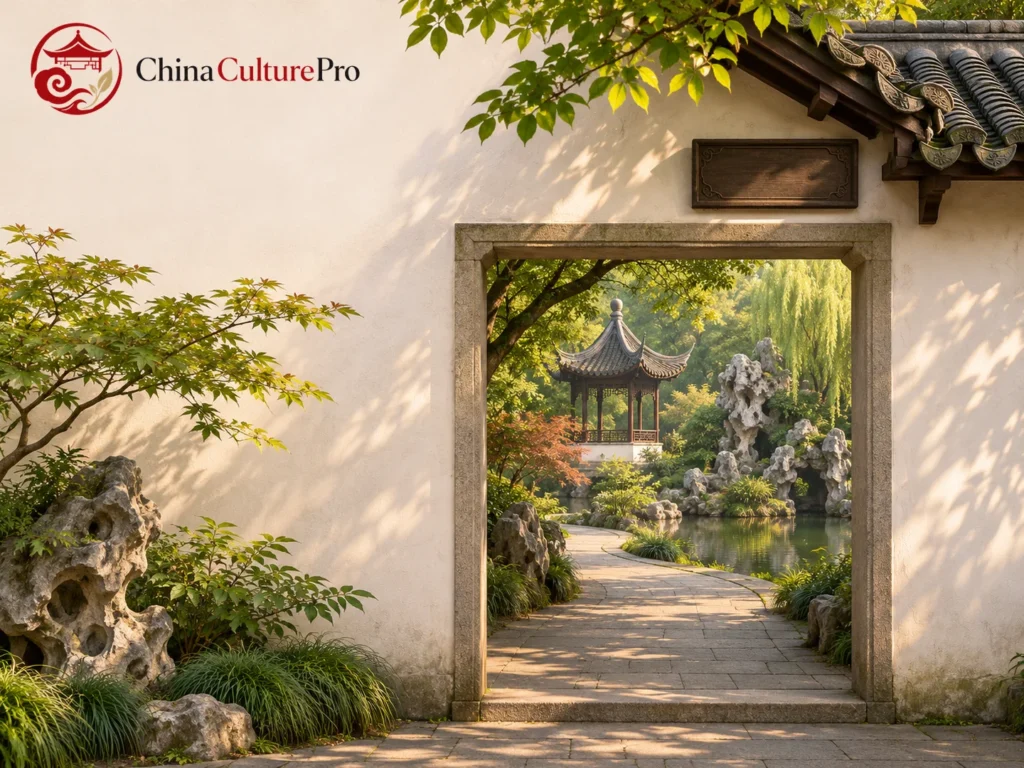
In Chinese garden design, the building gives those words a position. A name above the entrance can come into view on the approach. Two vertical boards may make sense together only when you stand far enough back to take in both. [1][2][3]
How a Name Changes a View
Suzhou’s garden bureau describes an inscription above a moon gate leading into a small waterside garden. The phrase suggests cloud or mist kept behind the threshold. From outside, the writing prepares you for an inner garden where buildings seem to sit close to the water. Its reference is visible in the layout even on a day without mist. [5]
At the Met’s Astor Court, the main entrance carries an inscription the museum translates as “In Search of Quietude.” A circular opening lines up with a rectangular one beyond it. From the entrance, the visitor looks through a shaded vestibule toward a brighter court. The short phrase can turn this physical passage into a moment of leaving the space outside behind. [3]
A Couplet About Rocks and Osmanthus
At the Lingering Garden, a pavilion takes its name from the scent of osmanthus. Suzhou’s local gazetteers office describes trees around it. A visitor account reproduced by the garden bureau attributes a couplet for the setting to Zheng Wenyuan. Its lines pair a visual feature and a fragrance. [6][7]
- 奇石尽含千古秀。 The unusual rocks hold beauty from ages past.
- 桂花香动万山秋。 The scent of osmanthus stirs autumn through the hills.
These English lines are a free rendering. In the original, unusual rocks in the first line are paired with fragrant blossoms in the second. The rocks suggest a much longer span of time than autumn. In just two lines, a visitor can picture the stable form of the stones and the brief season in which the flowers are fragrant. [7]
At many Suzhou gardens, writing can draw attention to parts of a scene that change at different speeds. The pavilion and stones can still be there after the flowers fade. The name and lines keep garden plants and their season present in the language. [1][6][7]
Why Calligraphy Is Part of the Garden
The script, material and placement are visible even to someone who cannot read the inscription. The size of a character, the material behind it and the contrast with a wall or roof can affect how it stands out. In Astor Court, the Met notes that the entrance inscription uses seal script, while characters for some other plaques were designed from examples of Wen Zhengming’s calligraphy. [3]
The Huntington’s Garden of Flowing Fragrance shows how contemporary artists can work with the same traditions. Its inscriptions were commissioned from artists in several places and draw on earlier literature. A 2007 handscroll by Wan-go H. C. Weng shows the garden’s name in clerical script on paper. The same name can work as an architectural identifier and as the subject of a calligraphic composition. That offers a way to compare writing in the garden with the close attention it might receive in a scholar’s study. [1][2][8]
Read the Words and the Place Together
Notice where the writing sits. At an entrance, a plaque may orient you before you move. Two lines beside a pavilion can invite you to stop and compare the imagery with the scene. Look through nearby openings or follow the approach from a few steps back. Like paths and windows, writing can make the moment and direction of looking part of a garden’s design. [2][3][4]
A translation may preserve the image but change the rhythm. Another may keep the rhythm at the cost of explaining less about a literary allusion. A garden’s name can be clearer when you compare a short translation with the place, plants or route it describes. [2][6][7][4]
FAQs About Chinese Garden Names and Couplets
What is the difference between a garden plaque and a couplet?
A plaque can carry a name or a short inscription. A couplet consists of two related lines, often presented separately on either side of a doorway or pavilion. [1][2][3][4]
Do garden names always describe what you can see?
Some describe nearby scenery or plants. Others recall a literary work, express an ideal, or refer to something seasonal such as osmanthus fragrance. [2][6][4]
Why do translations of the same inscription differ?
A translator can give priority to images, rhythm, the relationship between two lines, or an earlier work the inscription refers to. Those choices affect how the English reads. [2][7][4]
Sumber
[1] The Huntington. Chinese Garden
[2] Phillip E. Bloom, The Huntington. Reading the Chinese Garden
[3] The Metropolitan Museum of Art. A Chinese Garden Court
[4] The Huntington. Chinese Garden: Classroom Resources
[5] Suzhou Bureau of Gardens and Landscaping. Inscriptions on Moon Gates
[6] Suzhou Local Gazetteers Office. Stories Behind Suzhou Gardens
[7] Suzhou Bureau of Gardens and Landscaping. Suzhou Visitor Accounts: Lingering Garden
[8] The Huntington. A Garden of Words