

Quick Answer: What Is Chinese Penjing?
Chinese penjing (盆景, pénjǐng) is the art of creating a scene in a container. A work can suggest a mature tree, mountains above a valley, or a shoreline with plants and figures. Artists use the size, position and shape of each element to make the scene feel larger than the tray. [1][2][3][4]
- The main subject can vary. A tree or group of trees can carry the design, or stones and water can organize the whole scene. [2][3]
- Regional traditions shape trees in different ways. Lingnan artists use repeated pruning and regrowth, while Yangzhou is known for tied branch forms and layered foliage. [5][6][7]
- A living display keeps changing. Growth and seasonal leaf changes can alter how much of the tree’s shape you see. [1]
Find the main subject, then look at what makes it read as a landscape.
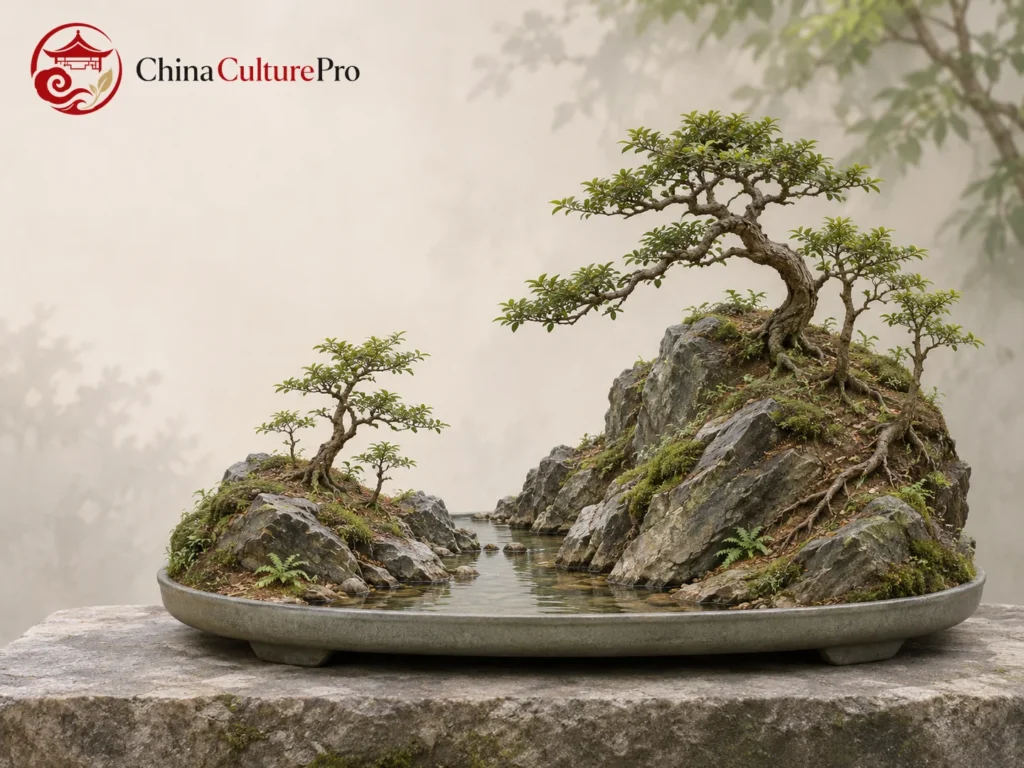
A shallow tray can hold a grove, a stretch of shoreline or a single tree with roots exposed. Its size is only the first thing you notice. The height of a stone and the space around a tree can make the scene feel much larger.
Three Ways to Compose a Penjing
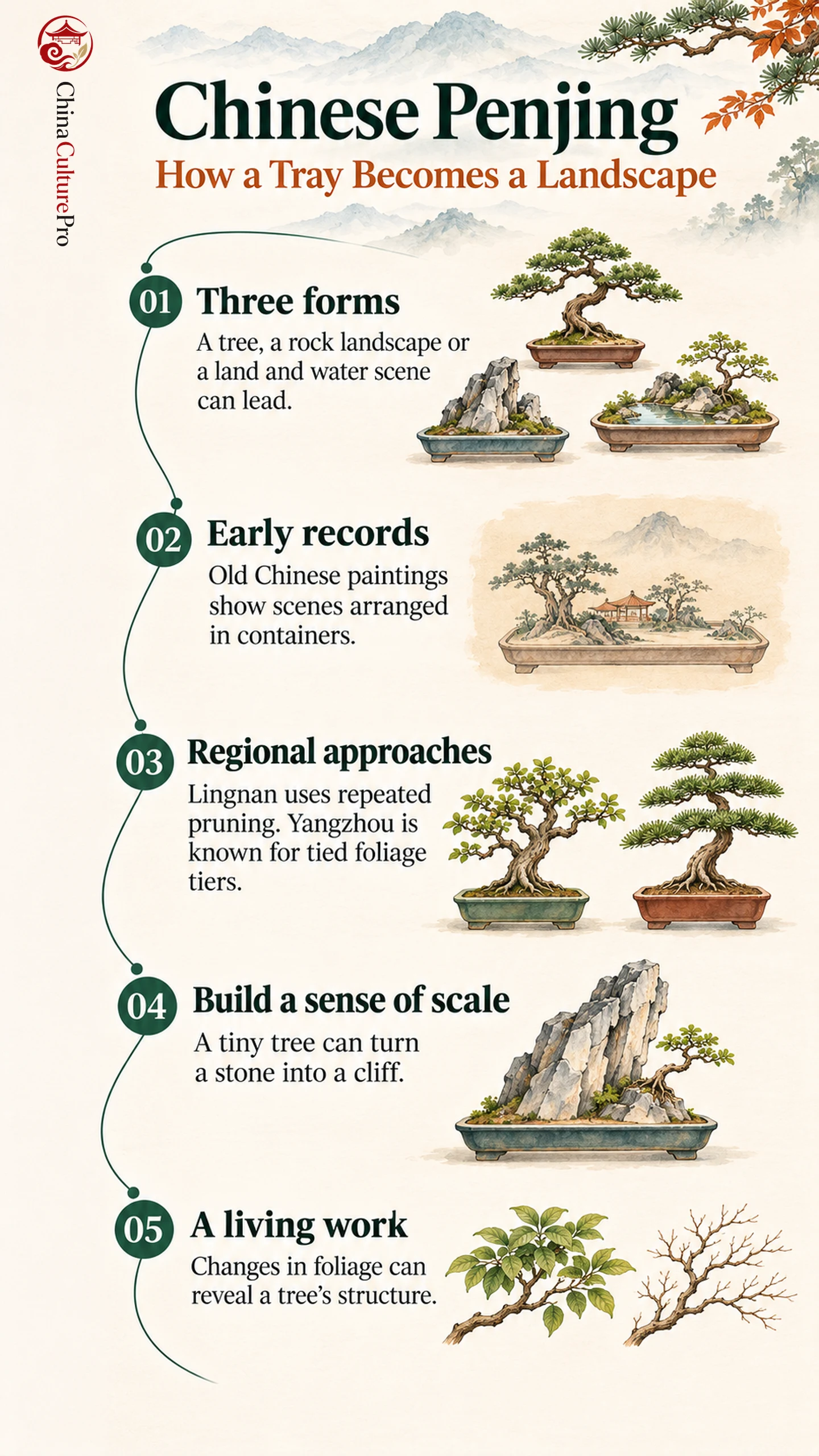
The artist Zhao Qingquan describes three kinds of penjing. A work can share elements with another kind, so the simplest way to use the grouping is to see which element organizes the composition. [3][4]
- Tree penjing (树木盆景, shùmù pénjǐng) centers on one or more trees. A slanting trunk, exposed roots or a group of differently sized trees can convey the character of a growing place.
- Landscape penjing (山水盆景, shānshuǐ pénjǐng) uses stone as the main element. A jagged outcrop can become a peak or a set of islands. A small planting can make those rock forms appear larger.
- Water-and-land penjing (水旱盆景, shuǐhàn pénjǐng) gives shape to the relationship between land and water. Plants, soil, rocks and sometimes small figures make a shore or a passage across water easier to imagine.
The relationship between penjing and bonsai is closest in tree-centered works. A tree can be a minor detail in a rock scene. Its small size then gives the viewer a clue about how high the artist wants the cliff to seem. [1][2][3]
What the History Can Tell Us
The Huntington points to Eastern Han tomb paintings of potted plants on stands as early visual evidence. The paintings document an early interest in potted arrangements. The route from those scenes to the later named art is harder to trace. [2][3]
Penjing shares an interest in condensed landscapes with Chinese gardens. In a tray, a few stones can suggest a ridge. In the Suzhou gardens, groups of rocks and ponds can produce a related effect at a scale that people walk through. The change of scale makes for different ways of looking. [2][3][4][8]
Later regional practices are easier to describe in detail. The collection named for Hong Kong connoisseur Yee-sun Wu at the U.S. National Arboretum records his association with the Lingnan approach. China’s national intangible cultural heritage inventory documents the Yangzhou tradition as a practice with its own techniques and transmission. [9][5]
How Lingnan and Yangzhou Shape Trees
In Lingnan, one characteristic method lets a new shoot grow after a cut and later prunes it again to encourage more branching. Guangzhou’s landscaping bureau connects this method with a warm, humid climate and a long growing season. At The Huntington, Che Zhao Sheng lets a branch reach the desired thickness before cutting it back to encourage growth in another direction. Successive cuts can give the branch a changing line and finer growth toward its tip. [4][7]
Yangzhou is known for tying and trimming branches into clearly separated layers. Heritage descriptions compare the thin layers of foliage to clouds. The effect comes from the shape of individual branches and how they are placed in relation to one another. A viewer can follow the open spaces between the layers as well as the foliage itself. [5][6]
These examples give two ways to think about training. In one, successive cuts and new growth help set the direction. In the other, tying helps organize the outline and arrange foliage into layers. Artists can use more than one method in a work. The school names point to histories of practice and do not specify the only technique a tree can show. [1][6][7]
The Pot, the Stones and the Empty Space
A container sets the limits of a scene. When a rock rises close to one edge and leaves space on the other, the opening can suggest air around a peak, an open bank or room for water. A low rim helps keep attention on what happens inside and above it. A second rock can make the first appear farther away if it is smaller and partly hidden. [2][3][4]
Mounted scholars’ rocks also suggest landscape through their ridges and hollows. In a tray the artist can add a small tree, use a reflection or lead the eye between several stones. This creates a set of near and far relationships, much as Chinese garden design can place a foreground rock against a more distant bank. [2][3][4][8][10]
Looking at a Penjing Through the Seasons
With a tree-centered piece, look at the connection between the trunk and the soil. Follow the direction of the main branches and see whether gaps make their movement easier to read. Foliage may join branches into masses, or expose the branch pattern when a deciduous tree loses its leaves. A living work needs care as it grows and its appearance changes. [1][2][4]
Examples by Che Zhao Sheng at The Huntington show how different plants can direct the eye. In one olive, a gap in the trunk becomes part of the silhouette. A Taiwan ficus shows a different emphasis, with roots visible above the soil. Seen up close, the two works ask you to notice different parts of the tree. [4]
FAQs About Chinese Penjing
Does penjing always use living trees?
Tree penjing centers on living trees. A landscape penjing may be led by stone, with small plants as supporting details. [2][3]
What is the difference between rock penjing and water-and-land penjing?
A rock landscape uses stone to suggest major forms such as mountains or islands. A water-and-land scene draws attention to how land and water meet, with plants or small figures as possible additions. [3][4]
Does penjing stay the same after it is displayed?
A living tree keeps growing and can change through the seasons. Artists care for and train the plant to maintain or develop the composition over time. [1][2]
Sumber
[1] U.S. National Arboretum. National Bonsai & Penjing Museum
[2] The Huntington. The Art of Penjing
[3] National Bonsai Foundation. Penjing Defined by Master Zhao Qingquan
[4] The Huntington. Penjing
[5] China Intangible Cultural Heritage Network. Yangzhou Penjing Techniques
[6] China Intangible Cultural Heritage Network. Five Chinese Penjing Traditions
[7] Guangzhou Municipal Forestry and Landscaping Bureau. Lingnan Penjing
[8] UNESCO World Heritage Centre. Classical Gardens of Suzhou
[9] National Bonsai Foundation. National Bonsai & Penjing Museum Collections
[10] Suzhou Bureau of Gardens and Landscaping. Architecture in Garden Design