

Quick Answer: What Was the Sixteen Kingdoms Period?
The Sixteen Kingdoms (十六国, Shíliù Guó) period ran from 304 to 439 CE. It saw successive and overlapping regimes rule parts of northern and western China, with one of the traditional sixteen based in Sichuan. Northern Wei (北魏, Běi Wèi) ended the period by conquering the last major northern rival. [1][2][3][5]
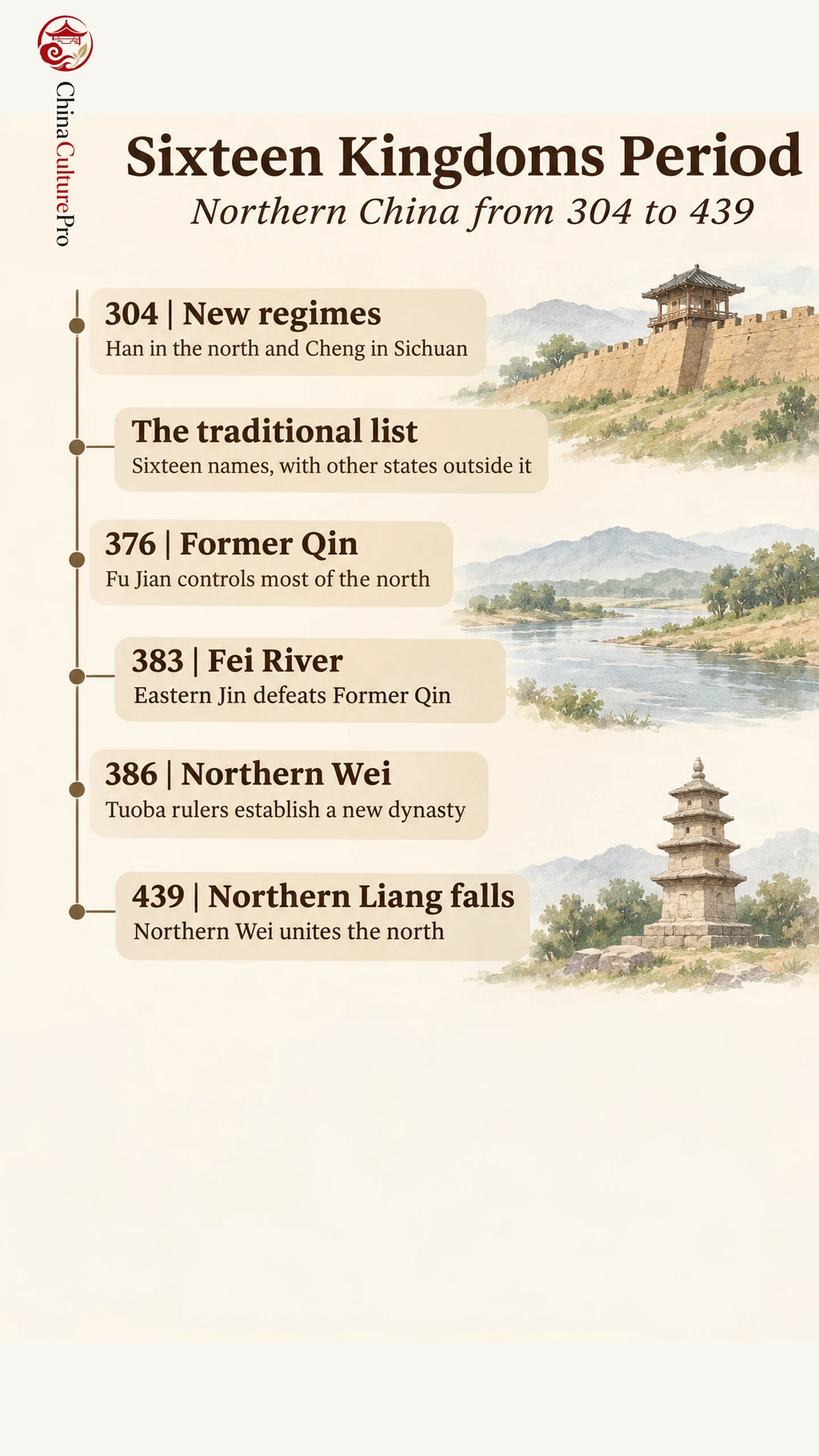
- 304: New regimes emerged as the Jin court lost control.
- 383: A defeat at the Fei River broke the momentum of an earlier attempt at consolidation.
- 439: Northern Wei completed its conquest of the north. [1][2][3][4][5]
The sixteen are a conventional list. The regimes on it rose and fell at different times, alongside other states. [1][2]
An early ruler named his state Han. A later regime from the same political line called itself Zhao. Elsewhere, rival courts used the names Qin, Yan and Liang more than once. The familiar list makes these names easier to follow when read alongside the chronology.
Why the Period Began in 304
The Western Jin (西晋, Xī Jìn) had reunited China in 280. Its court was weakened by succession struggles and civil war. In 304, Liu Yuan established a state called Han in the north. In the southwest, Li Xiong proclaimed himself king at Chengdu in Sichuan. Historians call the latter political line Cheng-Han (成汉, Chéng Hàn) because the regime later took the name Han. [1][2][3]
The two foundations mark the beginning of the period even though the Western Jin survived into the following decade. After it fell, the Eastern Jin (东晋, Dōng Jìn) ruled in the south from Jiankang, present-day Nanjing. The northern regimes coexisted with the southern Jin court and competed for land, followers and claims to legitimate rule. [1][2][3]
Which States Are Counted in the Sixteen Kingdoms?
The traditional list is associated with the Northern Wei historian Cui Hong and his Spring and Autumn Annals of the Sixteen Kingdoms. Here are the names grouped by their conventional English labels. Shared names do not imply that the regimes were ruled by one family or held the same territory. [1][2]
| Kelompok | Regimes in the traditional list |
|---|---|
| Two Zhaos | Han–Former Zhao and Later Zhao. [2] |
| Three Qins | Former Qin (前秦, Qián Qín), Later Qin and Western Qin. [2] |
| Four Yans | Former Yan, Later Yan, Northern Yan and Southern Yan. [2] |
| Five Liangs | Former Liang, Later Liang, Northern Liang (北凉, Běi Liáng), Southern Liang and Western Liang. [2] |
| Two other regimes | Cheng-Han and Xia. [2] |
Regimes such as Ran Wei and Western Yan existed but are outside the traditional list. Historian Charles Holcombe counts as many as twenty-two significant states in the north over the period, depending on how independent rule is defined. [1][2]
How Former Qin United and Lost the North
Former Qin came closest to reuniting the north before Northern Wei. Under Fu Jian (苻坚, Fú Jiān), it expanded from Chang’an, took Former Yan in the east and later absorbed Former Liang in the northwest. By 376 Fu Jian’s campaigns had brought most of the north under his command. He then led an invasion against the Eastern Jin. [1][2][4]
The Eastern Jin defeated Former Qin at the Fei River in 383. Defeat made it harder for Fu Jian to hold recent conquests. In the years that followed, commanders who had served him claimed territory and established regimes of their own. Later Yan and Later Qin emerged in the ensuing fragmentation. [1][2][4]
How Northern Wei Ended the Period
The Tuoba rulers established Northern Wei in 386 and expanded over several decades. Under Emperor Taiwu the dynasty took Northern Liang in 439. The Book of Wei records the campaign against Northern Liang’s ruler, Juqu Mujian, at Guzang, present-day Wuwei in Gansu. That victory is conventionally used to mark the end of the Sixteen Kingdoms. [1][3][4][5]
Northern Wei united the north while a different dynasty, Liu Song, ruled the south. The change was from competing northern states to one dominant northern dynasty. The political division between north and south persisted. For the people of Northern Liang, conquest could mean relocation. The National Museum of China notes that many artisans were moved to the Northern Wei capital at Pingcheng. [1][3][5]
What the Surviving Sources Reveal
Cui Hong’s original work did not survive intact. The versions available now include later reconstructions assembled from surviving quotations and other histories. The roster is still useful for identifying the conventional sixteen. It should be read as a historical selection and compared with accounts such as the Book of Wei, itself written from a dynastic perspective. [1][2][5]
Objects help recover parts of the period that a roster leaves out. A small Northern Liang stone pagoda preserved at the National Museum of China carries Buddhist figures and an inscription. The museum places it within a group of works found in the Hexi Corridor and Turfan region. The inscription and images go together. The museum identifies figures of past and present Buddhas alongside bodhisattvas associated with the future, evidence of religious practice that the military annals record in far less detail. [6]
FAQs About the Sixteen Kingdoms Period
Did all sixteen kingdoms exist at once?
No. Some existed together, while others succeeded one another. The traditional list covers more than a century and excludes several states. [1][2]
Was Cheng-Han in northern China?
Cheng-Han was centered in Sichuan in the southwest. Its inclusion is one reason the label is broader than a literal list of northern states. [1][2]
Is this the same period as the Northern and Southern Dynasties?
The labels partly overlap in time. Northern Wei was founded before the Sixteen Kingdoms period ended, and Liu Song began ruling in the south in 420. The 439 date refers to Northern Wei’s conquest of Northern Liang. [1][3][5]
Sumber
[1] Charles Holcombe. The Sixteen Kingdoms
[2] Cui Hong, attributed, later surviving versions. Spring and Autumn Annals of the Sixteen Kingdoms
[3] Albert E. Dien and Keith N. Knapp, eds.. The Cambridge History of China: The Six Dynasties, chronology
[4] Jennifer Holmgren. Annals of Tai: Early T’o-pa History According to the First Chapter of the Wei-shu
[5] Wei Shou and other compilers. Book of Wei, Annals of Emperor Taiwu, Part 1
[6] National Museum of China. Stone Pagoda Commissioned by Bai Shuangqie