

Quick Answer: How Did Treaty Ports Shape Cultural Exchange?
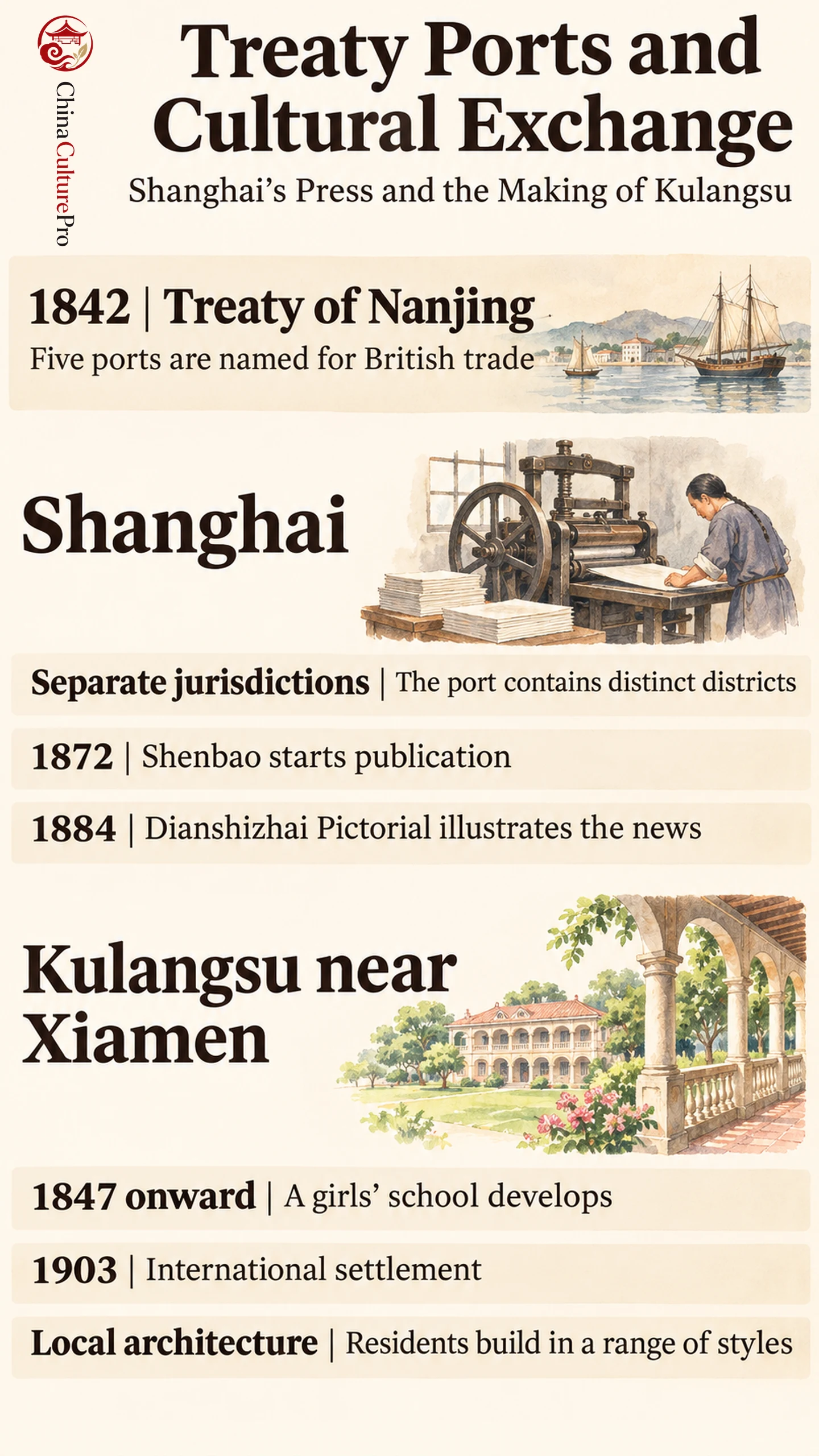
China’s treaty ports (通商口岸, Tōngshāng Kǒu’àn) were cities opened to foreign trade and residence under treaties. The Treaty of Nanjing (南京条约, Nánjīng Tiáoyuē) named the first five in 1842 after Britain defeated the Qing. Chinese merchants, artists and families built enterprises and institutions within a system that gave foreign nationals special rights. [1][2][3][4][5][7]
- Rules: Treaty rights opened ports, while specific arrangements governed some neighborhoods.
- Publishing: Shanghai’s illustrated press brought local and foreign subjects to Chinese readers.
- Urban life: Schools and buildings on an island off Xiamen show another form of exchange. [1][3][4][5][6]
Shanghai and Xiamen were both treaty ports, but they developed different institutions and built environments. [2][3][4][5][6]
An illustrated paper in Shanghai and a girls’ school off Xiamen both grew out of contacts made possible by the new port system. The treaty that opened the ports did not prescribe how either institution would develop.
How the Treaty Port System Worked
Under Article II of the 1842 treaty, the Qing government agreed that British merchants could reside and trade in Guangzhou, Xiamen, Fuzhou, Ningbo and Shanghai. Later treaties extended the network. Opening a city for treaty trade differed from setting aside a district administered under a separate arrangement. The treaty did not require every port to create the same kind of foreign-administered district. The resulting jurisdictions varied between ports and within cities. [1][2][3][7]
Shanghai’s International Settlement took shape after the British and American settlements merged in 1863. The French Concession remained separate. Foreign consular jurisdictions applied to nationals of powers with extraterritorial rights. Chinese residents were not covered by the foreign consular courts in the same way. In the International Settlement, the Mixed Court heard cases involving Chinese residents, with foreign assessors taking part where foreign interests were involved. [2][3]
How Shanghai’s Illustrated Press Reached Chinese Readers
The British publisher Ernest Major founded the Chinese-language newspaper Shenbao (申报, Shēnbào) in 1872. In 1884 he launched the Dianshizhai Pictorial (点石斋画报, Diǎnshízhāi Huàbào), which used lithography. It drew on models such as the Illustrated London News, but depended on Chinese artists, writers and readers. The publication also drew on a Chinese tradition of printing images alongside text. Artists and editors chose the subjects, wrote captions and worked for readers who could follow a story in both words and pictures. [4]
In its second issue, the pictorial reported on horse races attended by Chinese as well as foreign spectators. The report shows what editors thought worth explaining to readers. It can be read alongside articles on local events, inventions and ordinary life. MIT’s digitized issue preserves the drawing with its caption. Reading both helps distinguish a report about the races from the way the paper staged the scene for readers. [4]
What Schools and Buildings Reveal About Kulangsu
Xiamen began operating as a treaty port in 1843. The island of Kulangsu (鼓浪屿, Gǔlàngyǔ), also called Gulangyu, became an international settlement in 1903. Its buildings were shaped by Chinese residents, people returning from overseas and foreign residents. The island has houses in southern Fujian styles alongside Western Classical Revival buildings and houses with broad verandas. Later construction also produced a local style known as Amoy Deco, which drew on early twentieth-century modernism and Art Deco. [2][5]
The school later known as Yude illustrates an institutional change. Its origins lay in a girls’ school opened by the American Reformed Mission in Xiamen in 1847. After a fire in 1880, the school moved to Tianwei on Kulangsu. It took the name Yude in 1921 after expanding to a four-year middle school. The school’s move came before the island’s 1903 settlement. This chronology shows why a building’s history cannot be inferred from the date of the settlement alone. [5][6]
What Cultural Exchange Changed and What the Records Show
The treaty explains why British merchants could live and trade in the first five ports. Shanghai’s pictorial shows how Chinese producers interpreted what was happening around them. Kulangsu’s buildings and school records show the institutions residents developed locally. The sources answer different questions. The newspaper shows what producers thought readers might want to see. A building can show which forms residents or patrons chose, while additional records help identify who used it. [1][4][5][6][7]
Treaty ports gave different groups access to publishing technology, schooling and trade networks. Their opportunities still depended on legal privileges, money and institutional control. The evidence of exchange is visible in what residents produced, while the treaty and court records help explain the unequal conditions under which they worked. [2][3][4][5][7]
FAQs About Treaty Ports and Cultural Exchange
What were the first five treaty ports?
The 1842 Treaty of Nanjing named Guangzhou, Xiamen, Fuzhou, Ningbo and Shanghai. The treaty uses older spellings such as Canton and Amoy. [1]
Were treaty ports the same as foreign concessions?
A treaty port was open to trade under a treaty. A concession or international settlement was a particular district with its own arrangements. Those arrangements did not necessarily extend across the entire city. [2][3][5]
Did all treaty ports develop like Shanghai?
No. Shanghai supported a large commercial press and several foreign-administered districts. Kulangsu was an island settlement with its own mix of institutions and architecture. The port rules created contacts, but local circumstances shaped their results. [2][3][4][5]
Sumber
[1] The World and Japan Database. Treaty of Nanking, 1842
[2] Robert Nield. China’s Foreign Places: The Foreign Presence in China in the Treaty Port Era
[3] Wanshu Cong and Frédéric Mégret. International Shanghai, 1863–1931: Imperialism and Private Authority in the Global City
[4] MIT Visualizing Cultures. The First Six Issues of the Dianshizhai Pictorial
[5] UNESCO World Heritage Centre. Kulangsu, a Historic International Settlement
[6] Kulangsu heritage interpretation. Former American Reformed Mission Girls’ Middle School
[7] British Museum. China’s Hidden Century: Treaty Ports