

Quick Answer: Who Was Pu Xinyu?
Pu Xinyu (溥心畬, Pǔ Xīnyú; 1896–1963), also known as Pu Ru (溥儒, Pǔ Rú), was a painter, calligrapher and poet associated with literati painting (文人画, wénrén huà).[2]
- Gaya: He drew on classical landscape models while working across several painting subjects.[2]
- Works: Museum examples include meticulous landscapes and a red-ink figure painting.[3][5]
- Legacy: He taught in Taiwan from 1949 to 1963.[2]
Read his painted forms together with the writing: both contribute to the work’s meaning.
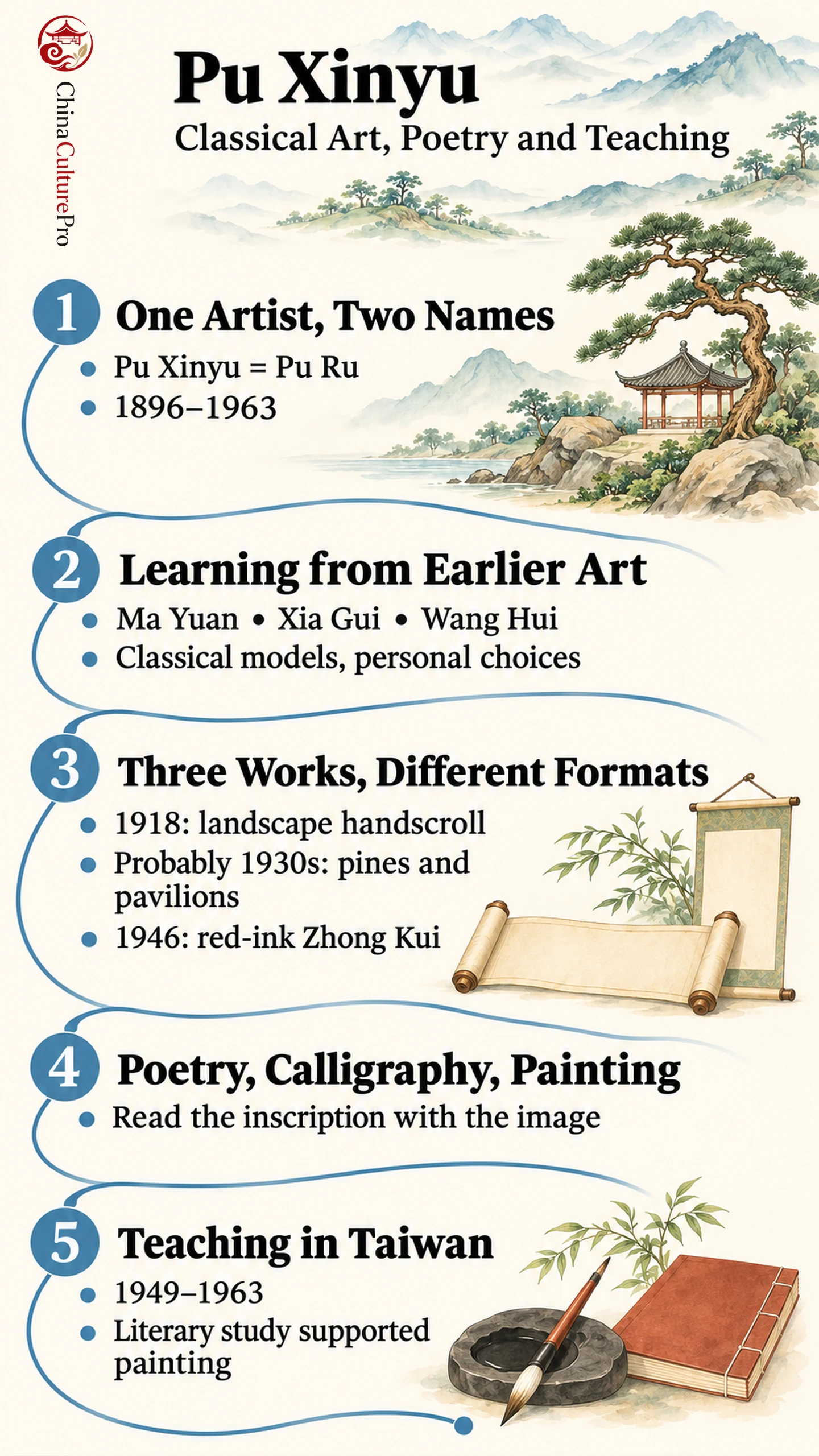
A Pu Xinyu landscape can appear much older than its twentieth-century date. Its mountains and buildings refer to earlier painters, while the inscription carries his own literary voice. Comparing different formats helps reveal the choices behind that classical appearance.
Pu Xinyu and Pu Ru: One Artist, Two Names
Pu Ru was his personal name; Xinyu was his style name. Museum catalogues may also use older romanizations such as Pu Hsin-yu or P’u Ju. These labels identify the same artist.[1]
A grandson of Prince Gong, he belonged to the Qing imperial family.[5] Classical education and access to older paintings gave him a wide range of models to study.[3]
Classical Models and a Literary Approach to Painting
Among his models were Ma Yuan, Xia Gui and later Zhe School (浙派, Zhèpài) painters.[1] His study of their works connected a twentieth-century practice with much earlier pictorial languages.
His range also included meticulous painting (工笔, gōngbǐ). An early handscroll refers to Wang Hui, with careful brushwork and color recalling earlier blue-and-green landscapes.[3] This offers a useful comparison with broader approaches to meticulous and freehand painting.
The connection to literati painting concerns more than subject matter: writing and pictorial form belong to the same cultivated practice. In the hanging landscape below, the painted scene and Pu’s own poem occupy one surface.[4]
Three Museum Works to Compare
These works demonstrate different formats and subjects. Measurements refer to the painted sheet or image rather than the complete mount.
| Work | Date and format | Museum reference |
|---|---|---|
| Mountainous Landscape with Buildings and Waterfalls | 1918; handscroll, ink and color on paper | Ashmolean Museum; 10 × 238.6 cm.[3] |
| Landscape with Pavilions and Pines | Probably 1930s, on stylistic grounds; hanging scroll, ink and color on paper | Los Angeles County Museum of Art; image 87.31 × 43.82 cm.[4] |
| Zhong Kui (钟馗, Zhōng Kuí) | 1946; single sheet, red ink on paper | National Palace Museum, Taipei; image 64.6 × 33.9 cm.[5] |
The 1918 handscroll’s long, low format unfolds horizontally. Compare that extended viewing experience with the upward movement of the hanging landscape.
In Landscape with Pavilions and Pines, two men converse on a bridge beneath pines, while a steep mountain rises behind them. Angular rocks and buildings recall the tradition of Li Tang; Pu’s poem appears at the upper left.[4] Begin with the small figures, then follow the climb through the landscape toward the writing.
Zhong Kui introduces a different register. The red-ink figure and forceful turning lines connect with the seasonal imagery of the Dragon Boat Festival.[5]
Teaching and Artistic Legacy in Taiwan
Pu moved to Taiwan in 1949 and taught at the institution now known as National Taiwan Normal University until 1963. His wider artistic circle included a long friendship with Zhang Daqian, whom he met in 1926.[2]
He encouraged students to develop poetry and calligraphy as foundations for painting.[1] The inscription and seals belong to that wider practice.
His importance lies in carrying a literary approach to painting into twentieth-century teaching and practice. Classical references remained resources for new work.
FAQs About Pu Xinyu
Are Pu Xinyu and Pu Ru the same person?
Yes. Xinyu was the style name of the artist named Pu Ru.[1]
Did Pu Xinyu paint only landscapes?
No. The 1946 Zhong Kui provides a documented example of his figure painting.[5]
How does poetry contribute to his paintings?
An inscription can add a literary setting to the image. Landscape with Pavilions and Pines includes a poem by the artist.[4]
Sumber
[1] National Palace Museum. The Last Stroke of Literati Painting: Pu Hsin-yu
[2] National Taiwan Normal University. Pu Xinyu: Artist and Teacher
[3] Ashmolean Museum. Mountainous Landscape with Buildings and Waterfalls
[4] Los Angeles County Museum of Art. Landscape with Pavillions and Pines
[5] National Palace Museum. Zhong Kui