


Quick Answer
Naxi ancient music (纳西古乐, Nàxī gǔyuè) is a broad label used for several traditions associated with Lijiang in Yunnan. Baisha Xiyue (白沙细乐, Báishā xìyuè) and Dongjing music (洞经音乐, Dòngjīng yīnyuè) have distinct histories. Huangjing music (皇经音乐, Huángjīng yīnyuè) appears as a historical category described in local accounts as lost.[1][2][3]
- Baisha Xiyue: A suite with instrumental, vocal and dance elements and a documented association with mourning.[1]
- Dongjing: Music taken up by Naxi musicians from Han traditions and practiced in Lijiang associations.[2]
- Performance labels: A modern concert or account may use the broader name for more than one repertoire.[2][3]
For a specific performance, the title of the piece and the ensemble tell you more than the umbrella term.[2][3]
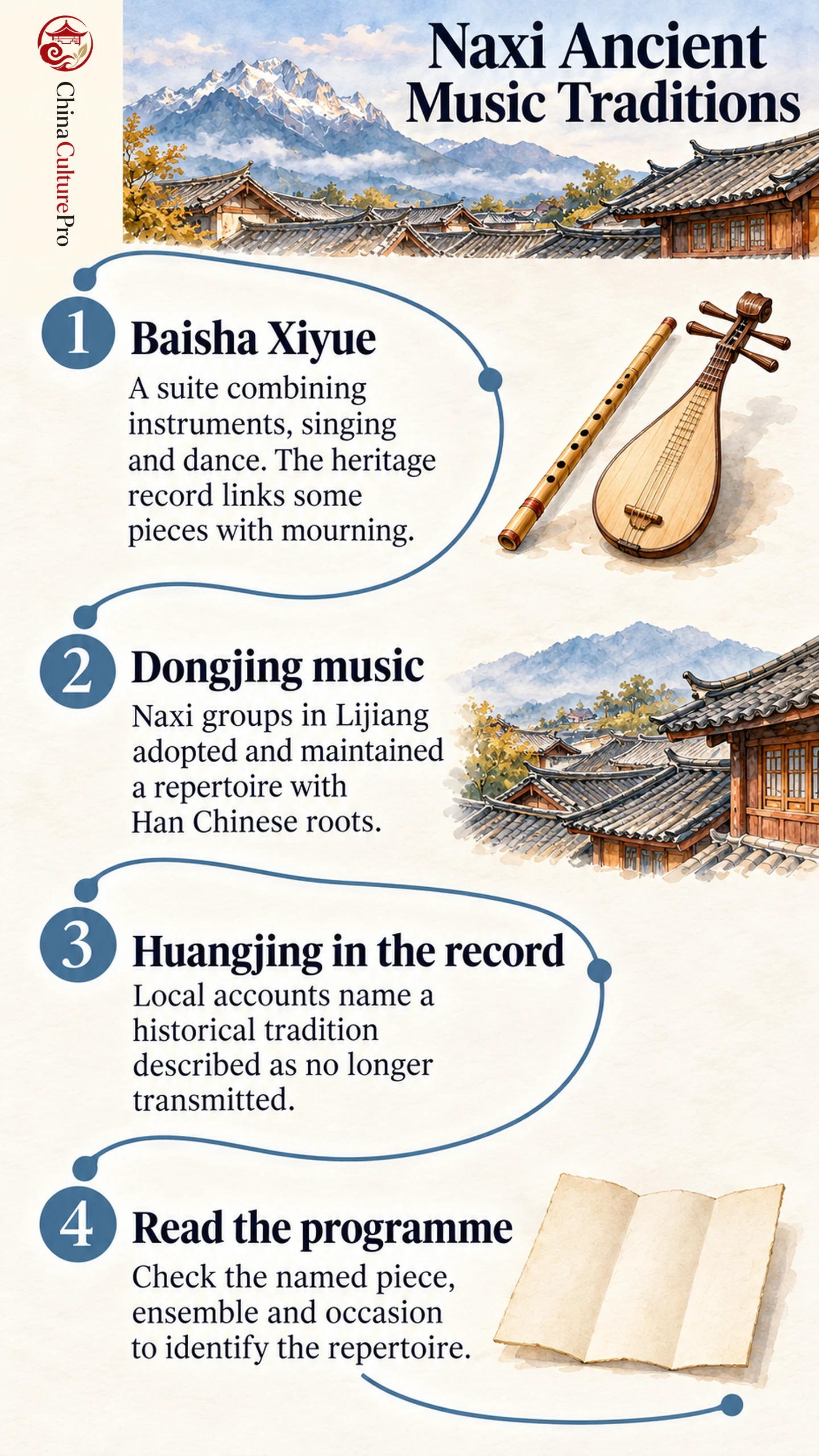
Two performances billed as “Naxi ancient music” can start from different musical histories. One may draw on a suite linked with mourning. Another may use music cultivated by local associations. Those distinctions matter when connecting the music of Lijiang with the wider traditions of Yunnan culture.
Baisha Xiyue and Its Links to Mourning
The Chinese national inventory describes Baisha Xiyue in Lijiang’s Old Town district and Yulong Naxi Autonomous County. It combines instruments, singing and dance. The record associates a number of its dances with funeral occasions and describes music that expresses separation or grief. A stage excerpt may give the listener an impression of the melody while leaving the original occasion outside the performance.[1]
The inventory says ten tunes were traditionally remembered and lists eight it records as surviving. They include “Beautiful White Clouds” and “The Princess Weeps,” two translated tune names that help identify what a performer is playing. Among the instruments in the register are flutes, a zither and a small lute. The title of a tune and the sounds used in that rendition are more specific than a general claim that the performance comes from a single ancient period.[1]
Dongjing Music and Lijiang Associations
Ethnomusicologist Helen Rees describes Dongjing as a repertoire adopted from Han Chinese practice by Naxi inhabitants of Lijiang County. The music became part of the lives of local groups. Its history in Lijiang therefore includes both circulation from elsewhere and the ways local players learned and continued it.[2]
A listener comparing a Dongjing excerpt with Baisha Xiyue should begin with the recorded name, group and occasion. Both can be presented in Lijiang. The ensembles may draw on different repertoires even when they perform in the same town. Rees’s account focuses on the social networks that sustained Dongjing in the twentieth century as well as its music.[2]
What the Huangjing Name Tells Us
Chinese accounts grouping Lijiang’s older music commonly mention Huangjing alongside Baisha Xiyue and Dongjing. The account cited here describes Huangjing as no longer transmitted. Its place in a historical classification helps explain why a guidebook can name three categories while a programme features music drawn from fewer traditions.[3]
An account of past music can describe a category without supplying a playable version of every piece. Treat a Huangjing reference as a lead about local musical history and ask what evidence the author uses. A programme that names a piece or its source gives a firmer starting point for identifying a modern performance.[3]
How Stage and Community Settings Differ
The national Baisha record describes support for teaching in Changshui village, including work by the representative bearer He Linyi. The local example shows that preservation depends on people who know the repertoire and can pass it on. A performance in a concert setting and one connected with an earlier occasion can draw on related music while reaching different audiences.[1]
A stage programme can introduce a listener to a named piece and its ensemble. The heritage record can explain its link to a community practice. There is a similar need for context when viewing the Baisha murals. The wall paintings and the music tell different stories about Baisha’s past.
FAQs About Naxi Ancient Music Traditions
Is All Naxi Ancient Music From the Yuan Dynasty?
The Baisha Xiyue inventory reports more than one origin account, including a connection with the Yuan, and says the origins are uncertain. Dongjing has a separate history of adoption in Lijiang.[1][2]
Is Naxi Ancient Music the Same as Dongba Chanting?
Dongba chanting (东巴诵经, Dōngbā sòngjīng) concerns the vocal use of ritual texts. The broad label discussed here covers documented music repertories such as Baisha Xiyue and Dongjing. For the manuscripts and their ritual context, see the guide to Dongba writing for more detail.[1][2][4]
Sumber
[1] China Intangible Cultural Heritage Network. National inventory entry for Naxi Baisha Xiyue
[2] Helen Rees, Oxford University Press. Echoes of History: Naxi Music in Modern China
[3] China Ethnic and Religious Network. Naxi ancient music and its named traditions
[4] Leiden University Libraries. Documenting oral readings of Naxi Dongba manuscripts