


Quick Answer: What Are Hui Hua’er Traditions?
Hua’er (花儿, Huā’ér) is a folk song tradition shared by Hui (回族, Huízú) and other communities in northwestern China. A singer can use a familiar tune and make up lines within a recognized verse pattern. Both informal singing and organized song gatherings are documented.[1]
- The term ling (令, lìng) can name a tune in the repertoire.[1][2]
- Songmingyan (松鸣岩, Sōngmíngyán) in Gansu is one gathering place.[2][4]
- The UNESCO inscription covers Hua’er as a shared tradition.[1]
The Hui connection is part of a wider regional practice within Chinese intangible cultural heritage.
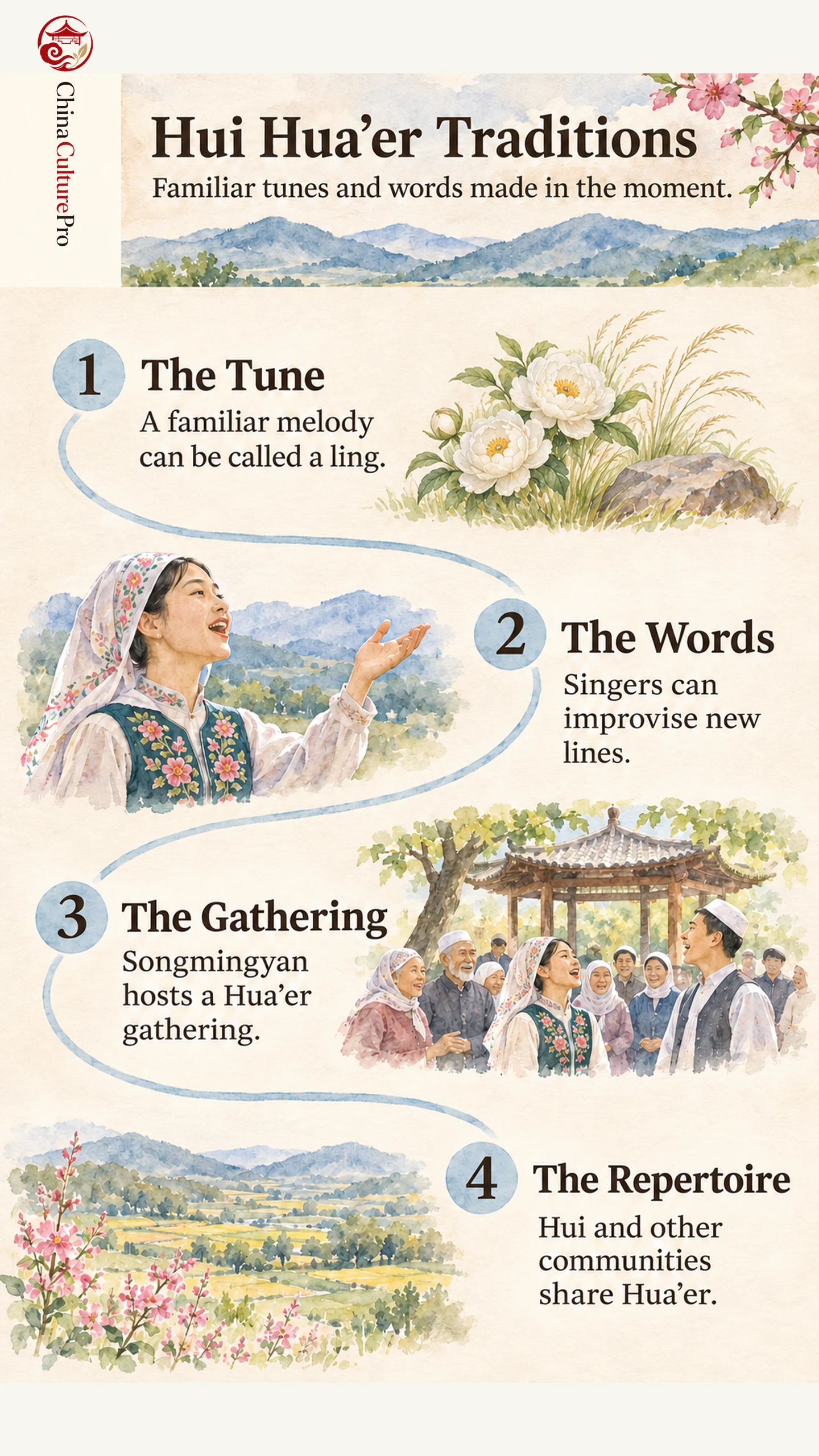
Listen for the parts of a song that are familiar to the audience. Then pay attention to what the singer does with the words. That distinction helps explain why different people can sing within the same tradition.
What Stays Fixed and What Changes
Tune names can refer to flowers, places or communities. The melody gives a singer a familiar form for a verse. Within that form, new lines can express affection, the demands of fieldwork or changes in the singer’s community.[1][2] In Kazakh aitys, another oral performance tradition, the improvised verse takes the form of a contest between performers.
What a Song Gathering Adds
At Songmingyan in Hezheng County, Linxia Hui Autonomous Prefecture, the local gathering is associated with Hezhou Hua’er. The account describes a high, far-carrying vocal style and established melodies. A documented event in June 2019 drew singers to this mountain setting.[2][4]
A Shared Repertoire Across Communities
One heritage profile names the Dongxiang singer Ma Shenglin as a practitioner of Ningxia Hui mountain Hua’er. He learned from his father and other singers and became known for improvisation. His example helps place the genre within the exchanges that also shape Hui cultural life.[3] Hui Sini calligraphy offers a separate example of exchange in visual art.
FAQs About Hui Hua’er Traditions
Are the words always set in advance?
Singers can improvise lyrics within established patterns.[1]
Is Hua’er sung only at festivals?
It can be sung informally during travel or work as well as at organized events.[1]
What did UNESCO recognize?
The 2009 inscription recognizes Hua’er, a shared folk song tradition, as intangible cultural heritage.[1]
Sumber
[1] UNESCO. Hua’er
[2] Linxia Prefecture Bureau of Culture. Songmingyan Hua’er gathering
[3] China Intangible Cultural Heritage Digital Museum. Ma Shenglin
[4] Xinhua. Hua’er performance in Hezheng