


Quick Answer: What Is Dongba Writing?
Dongba writing (东巴文,Dōngbāwén) is a writing tradition used to record the Naxi language (纳西语,Nàxīyǔ), especially in ritual manuscripts from southwestern China. Many signs resemble people, animals or objects, but reading a manuscript involves more than recognizing pictures. Written signs work together with learned oral knowledge: a page can prompt a reader to supply words or passages not fully written out. The script, the spoken language and the specialists who use it are related but distinct.[1][2]
A page can show people, animals and objects arranged in compact groups. The pictures attract the eye, but their relationship to spoken words is the more revealing question. This guide explains how the manuscripts work, how other writing systems relate to them, and why their readers matter within Naxi culture.
The Ritual Book and Its Reader
Dongba ritual specialists (东巴,dōngbā) have used manuscripts for ceremonies such as funerals and blessings. Handmade paper, often assembled into booklets, provides the physical surface for texts connected with creation narratives, spirits, ancestors and other ritual subjects. The books are part of a performance setting; they are not simply illustrated stories intended for any reader to decode independently.[1]
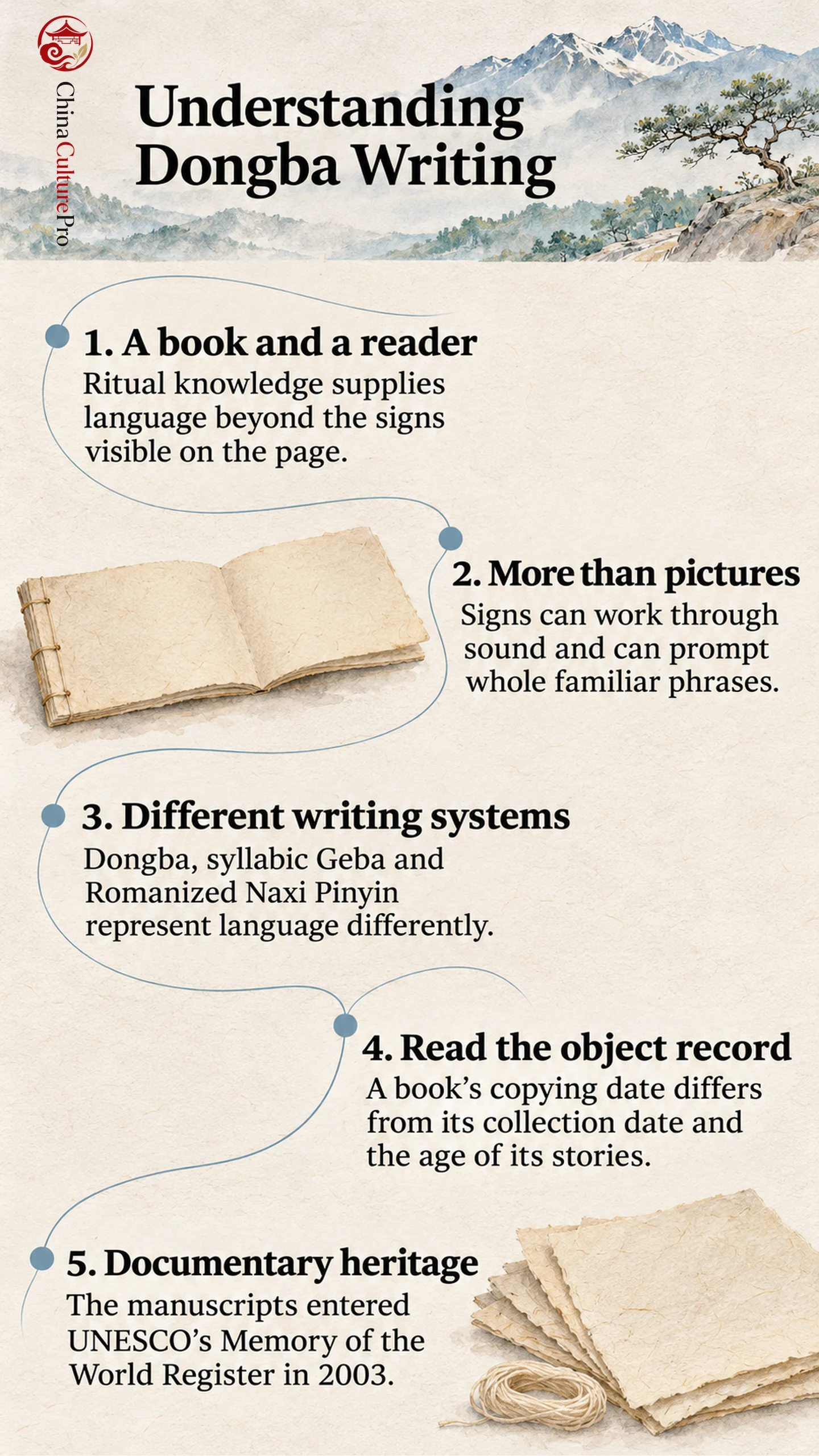
The reader brings knowledge of the narrative and its spoken delivery to the page, supplying language beyond the visible signs. Preserving the physical book and passing on that expertise are complementary tasks.
The relationship is visible in a manuscript opening discussed by Leiden’s collection specialists. Images of stars, earth, sun and moon prompt a more developed spoken passage, including grammatical words not shown individually. The written scene and the full recitation occupy different amounts of space; the reader connects them.[3]
How Pictures, Words and Sound Work Together
Picture-like signs can function through sound or cue a phrase beyond the object they resemble. Their appearance is therefore only part of how they work.[2]
A scholarly analysis of manuscript MEB 481-4 identifies an especially revealing interruption. The scribe briefly comments on a painful hand using a more fully phonetic, syllable-by-syllable sequence, then returns to the ritual text’s oral mode. The same manuscript therefore brings together different relationships between signs and speech.[2]
A picture-to-English substitution chart therefore cannot reliably translate an unfamiliar ritual page. Interpreting the signs requires attention to their sound values, textual setting and the reader’s knowledge.
Dongba, Geba and Naxi Pinyin Compared
Naxi has been written using more than one system. The following distinction concerns how the systems represent language; it does not imply that every speaker uses all of them or that one system has simply replaced the others.
| Sistem | Main character or sound relationship | Konteks yang perlu diperhatikan |
|---|---|---|
| Dongba writing | Picture-like and other signs, including phonetic uses. | Ritual pages often rely on knowledge beyond the visible text.[2] |
| Geba (哥巴文,Gēbāwén) | A syllabic system representing sounds. | It occurs in religious texts and can appear among Dongba signs.[4] |
| Naxi Pinyin (纳西拼音,Nàxī Pīnyīn) | A Romanized system for representing Naxi speech. | Its spelling and tone conventions belong to Naxi, rather than Mandarin pronunciation.[2] |
A collection report published in October 2026 provides a concrete reminder that manuscripts need not use one script exclusively. Among the Harvard-Yenching holdings, some books use Dongba alone, some combine Dongba and Geba, and a small number are written in Geba. An individual catalogue record can identify which scripts a particular book contains.[5]
Manuscript Dates and Collection Context
A traditional text can survive in a comparatively recent physical copy. The same 2026 collection report dates most of the Harvard-Yenching manuscripts to the late Qing and early Republican periods. That describes the surviving books, not necessarily the first composition of every narrative they contain.[5]
Copyists also leave traces of their work. A Leiden manuscript, Or. 26.029, contains a note explaining that its writer borrowed another specialist’s book to make a copy. A later note comments on the difficulty of producing good writing during nights spent copying. Such passages reveal books circulating between people, alongside the ritual content they transmit.[3]
Collection dates answer another question. Manuscripts acquired by the Library of Congress from Joseph Rock arrived in several groups during the 1920s and 1930s. An acquisition date records the object’s entry into a collection; it should not automatically be read as its writing date or the origin date of the script.[1]
Documentary Heritage and Learning Today
“Ancient Naxi Dongba Literature Manuscripts” entered UNESCO’s Memory of the World Register in 2003, following a submission by China. This is recognition of documentary heritage. It is different from inscription on an intangible-cultural-heritage list or recognition of a World Heritage site. The record highlights both the importance of the manuscripts and the vulnerability of their handmade paper.[6]
Digital learning offers one route into the tradition. In May 2023, UNESCO announced support for an introductory online course developed with universities in France, Switzerland and China. It was presented in English, French, Chinese and German. This 2023 announcement records the initiative; it does not establish the course’s current enrolment dates.[7]
Modern writing uses are another subject of research. A study of revitalization examines ways of adapting Dongba for contemporary vernacular purposes alongside its established ritual role. Learning individual signs, reading a modern inscription and interpreting a traditional ritual manuscript are therefore different tasks. A beginner gains more by identifying the task and using an annotated reading than by assuming that a picture-like appearance makes every text immediately transparent.[8]
FAQs About Dongba Writing
Is Dongba a language or a script?
Dongba writing is a script tradition used for Naxi. The script’s name is also connected with ritual specialists and their cultural practices.
Can you read a text by guessing the pictures?
Not reliably. A sign can work through sound, represent a larger phrase or depend on knowledge not fully written on the page.
Is Dongba the same as Chinese characters?
No. It is a distinct writing tradition associated with Naxi, with its own conventions and ritual uses.
Was Dongba writing listed as UNESCO intangible heritage in 2003?
No. The 2003 inscription concerns the manuscripts on the Memory of the World Register, which recognizes documentary heritage.
Sumber
[1] Library of Congress. About the Naxi Manuscript Collection
[2] Duncan Poupard. Between the Oral and the Literary: The Case of the Naxi Dongba Texts
[3] Leiden University Libraries. Words as pictures: Southwest Chinese Naxi manuscripts
[4] Sun Bojun. The theoretical significance of ancient Chinese ethnic writings
[5] Li Xiaoliang, Harvard-Yenching Institute. Dongba manuscripts, October 21, 2026
[6] UNESCO. Ancient Naxi Dongba Literature Manuscripts
[7] UNESCO. Support for an introductory Dongba-script MOOC
[8] Duncan Poupard. Revitalising Naxi dongba as a pictographic vernacular script