

Quick Answer: How Do Mandarin and Taiwanese Hokkien Differ?
Mandarin(華語,Huáyǔ)and Taiwanese Hokkien(臺灣台語,Táiwān Táiyǔ)are different spoken varieties of Chinese. Taiwanese Hokkien is also called Taigi, Hoklo or Holo.[1] It is not simply Mandarin pronounced with a Taiwan accent, and knowing Mandarin does not automatically make its speech intelligible.[2]
- Sounds: Their tone systems, syllable endings and phrase-level pronunciation differ.
- Words: Shared characters coexist with different readings and everyday vocabulary.
- Learning: Choose materials for the intended spoken language, then check their writing and romanization conventions.
Taiwan Mandarin means Mandarin as used in Taiwan. Taiwanese Hokkien is a separate learning target.
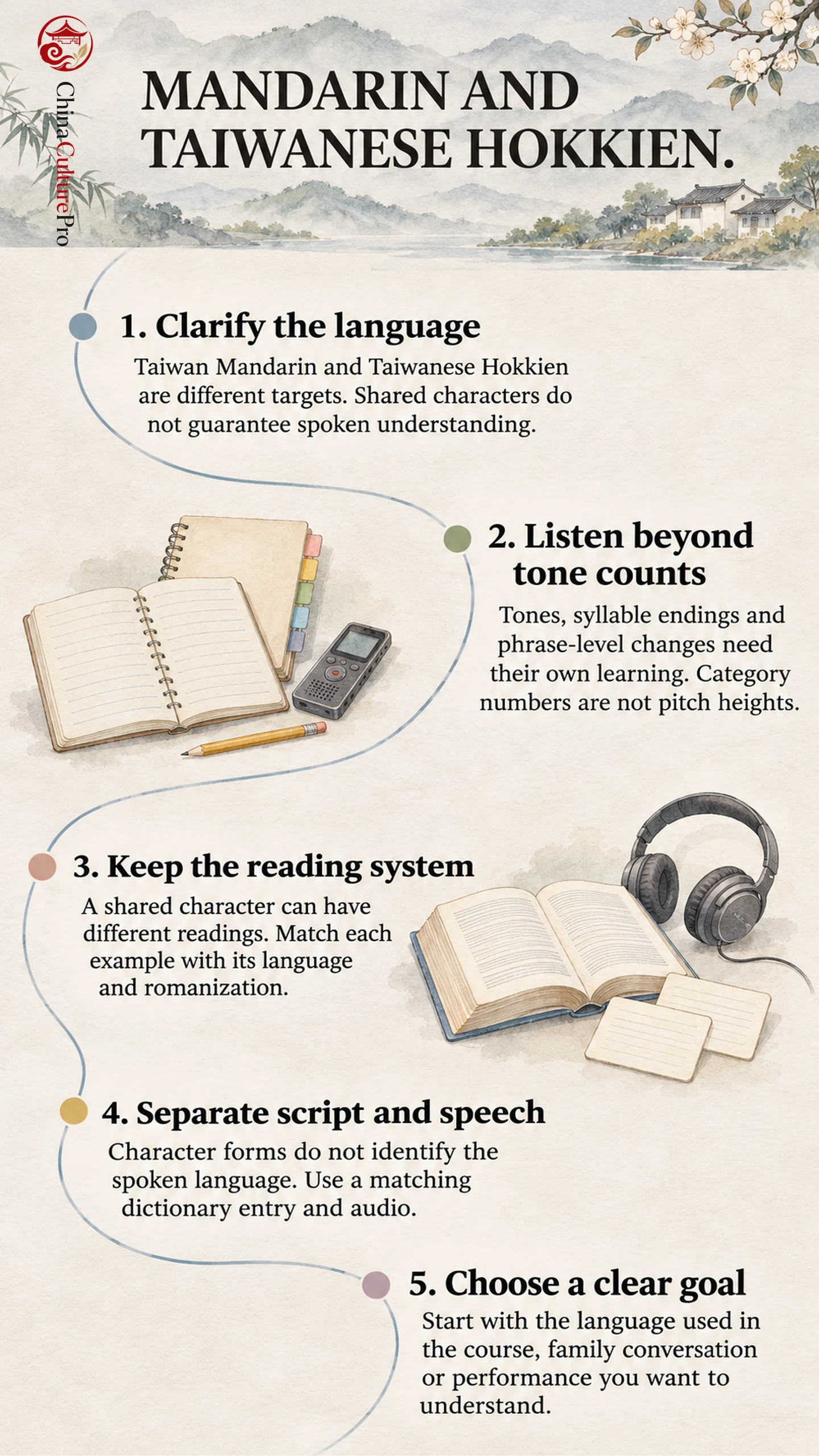
A Taiwan language course may teach Mandarin, while a song or family conversation uses Taiwanese Hokkien. The label “Taiwanese” alone can leave an English-speaking learner unsure which language is meant. This comparison separates the names, then follows sounds, words and writing to explain what changes when you switch between them.
Two Languages, Not Two Mandarin Accents
Taiwanese Hokkien belongs to Southern Min(閩南語,Mǐnnányǔ), whose related varieties are associated with southern Fujian, Taiwan and Southeast Asian Hokkien-speaking communities. Mandarin belongs to a different Chinese language group. The lack of automatic mutual intelligibility is a spoken-language issue; recognizing shared written material is a separate ability.[2][3]
There are grammatical similarities as well as differences. Both Mandarin and Taiwan Southern Min allow a basic subject–verb–object order, topics placed prominently in a sentence, and sentence-final particles. Those similarities do not supply a word-for-word conversion rule: the systems of aspect, questions and other constructions need their own study.[3]
“Dialect” is sometimes used broadly for Chinese varieties. That label should not lead you to expect the relationship between two regional Mandarin accents. Ask which spoken system a resource actually teaches. The overview of Chinese languages and dialects provides the larger classification context without turning shared cultural connections into a promise of effortless comprehension.
Sound Systems: Tones, Stops and Phrase-Level Changes
Standard Mandarin is commonly taught with four lexical tones and a neutral-tone realization. Neutral tone is a reduced realization in connected speech, rather than another fixed pitch contour to rank beside the four citation tones.[4] The usual Taiwanese Hokkien teaching framework has seven common tone categories, conventionally numbered 1, 2, 3, 4, 5, 7 and 8. These historical category numbers are not measures of pitch height, nor do they correspond directly to Mandarin’s numbered tones.[5]
Taiwanese Hokkien also has syllable-final stops represented by -p, -t, -k and -h, with -h representing a glottal ending in the romanization. These are not features you can supply by reading a word as Mandarin. Actual stop realization varies: a study across five Taiwan Min dialect regions documented several outcomes, including closure, changes near a vowel’s end and coda deletion.[2][5]
The dictionary writes citation tones, while phrase pronunciation can change through tone sandhi. Boundaries and context create exceptions; a phrase recording may differ systematically from the headword spelling.[6]
Three Everyday Words Compared
The Mandarin column uses Hanyu Pinyin(漢語拼音,Hànyǔ Pīnyīn). The Taiwanese Hokkien column uses Tâi-lô(臺羅,Táiluó), the romanization used in the Taiwanese dictionary. The Mandarin readings in Chinese-name parentheses elsewhere in this article label the terms; they are not instructions for pronouncing Hokkien.[6][7]
| Makna dasar | Mandarin, with pinyin | Taiwanese Hokkien, with Tâi-lô |
|---|---|---|
| You | 你 — nǐ | 你 — lí |
| Eat | 吃 — chī | 食 — tsia̍h |
| Cooked rice | 飯 — fàn | 飯 — pn̄g |
These selected dictionary readings show two different relationships. 你 and 飯 can share a written form across the columns but have different readings; the everyday verb “eat” is represented here by different characters. The table gives isolated-word readings, not a ready-made sentence pronunciation.[6][7]
The “you” entry also records local alternatives to lí. Keep the locality with the recording.[6]
Characters, Romanization and Reading Context
Traditional characters do not identify a spoken language on their own. A Mandarin text and a text representing Taiwanese Hokkien can both use them, while selecting different words or readings. Dictionary spelling choices can reflect meaning or sound rather than a simple Mandarin-to-Hokkien character substitution.[6]
Romanization offers direct access to pronunciation, but the system must be named. Tâi-lô and Mandarin pinyin use Latin letters for different sound systems. Zhuyin(注音,Zhùyīn)is designed for Mandarin teaching; a comparison chart in a Hokkien reference is an aid, rather than a claim that the sound inventories coincide.[5] The guide to simplified and traditional Chinese explains the separate question of character forms.
For Hokkien study, combine the character entry with its romanization and audio. Learning resources support searches through a Hokkien form, a romanized sound or a corresponding Mandarin meaning. A Mandarin definition helps you find an entry; it does not mean the Hokkien headword is pronounced in Mandarin.[8] The pinyin guide is useful when reading the Mandarin column, but its spelling rules should not be transferred to Tâi-lô.
Choosing a Learning Goal in a Multilingual Taiwan
Taiwan’s linguistic life includes Mandarin, Taiwanese Hokkien, Hakka, Indigenous languages and Taiwan Sign Language. Language development efforts address this wider setting. Ask which language a person uses in the situation you are discussing.[9]
Choose Mandarin materials when your immediate goal is a Mandarin course, Mandarin conversation or reading a Mandarin text. Choose Taiwanese Hokkien materials when you want to understand a particular Hokkien-speaking relative, performance or conversation. A learner who already knows Mandarin can use Mandarin glosses while studying Hokkien, but still needs its sounds, words and constructions.
For a family project, ask which language and local variety the family actually uses. For a song, find the language of the lyrics and a matching recording before choosing a pronunciation guide. Save the character spelling, romanization system and phrase audio together. If speakers use both languages, treat their language choice as contextual information rather than evidence that the two systems are interchangeable.
FAQs About Mandarin vs Taiwanese Hokkien
Is Taiwanese Hokkien the same as Taiwan Mandarin?
No. Taiwan Mandarin is Mandarin as used in Taiwan; Taiwanese Hokkien belongs to Southern Min.
Can Mandarin speakers automatically understand Taiwanese Hokkien?
No. Bilingual experience or separate learning may support comprehension, but Mandarin alone does not guarantee it.
Do traditional characters tell you which language is being spoken?
No. Character form, word choice and spoken reading are separate questions.
Which language should I learn first?
Choose the language used in the course, relationship or material you want to understand. A general label such as “Taiwanese” needs clarification.
Sumber
[1] Taiwan Ministry of Education. Taiwanese Taigi language proficiency testing announcement
[2] Ho-hsien Pan. Glottalization of Taiwan Min Checked Tones
[3] Miao Ling Hsieh. Taiwanese Hokkien/Southern Min: chapter abstract
[4] Beijing Language and Culture University. Modern Chinese: tones and sound changes
[5] Taiwan Ministry of Education. Taiwanese Taigi Romanization Scheme
[6] Taiwan Ministry of Education. Dictionary of Frequently Used Taiwanese Taigi
[7] Taiwan Ministry of Education. Revised Mandarin Chinese Dictionary
[8] Taiwan Ministry of Education. Learning Taiwanese Taigi Romanization
[9] Executive Yuan. National Languages Development Plan