


Quick Answer: How Do Shanghainese and Mandarin Differ?
Shanghainese(上海話,Shànghǎihuà)is a variety of Wu(吳語,Wúyǔ), not simply Mandarin spoken with a Shanghai accent. Here, “Mandarin” means the standard language, Putonghua(普通話,Pǔtōnghuà).[1]
- Sounds: The two have different consonant, vowel and tonal systems.
- Everyday language: Familiar characters can represent different local words, including common pronouns.
- Learning: Reading a Mandarin gloss does not supply the Shanghainese pronunciation of an expression.
Both belong to the wider Chinese linguistic world, but that relationship does not make them interchangeable. This guide focuses on urban Shanghainese; its name does not erase variation across the larger Shanghai municipality.
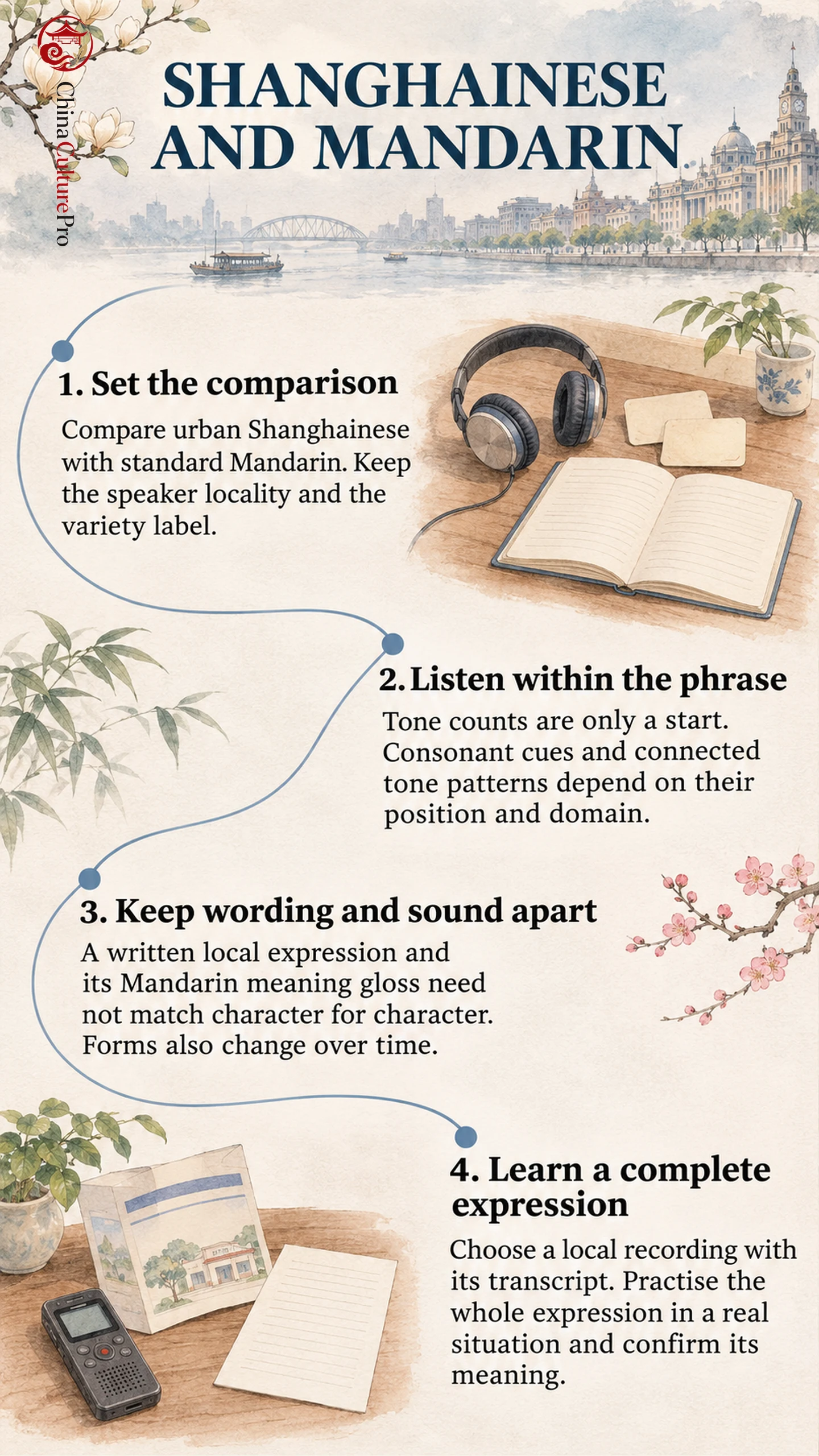
Knowing how to read a Shanghai shop sign does not mean you can follow the conversation beside it. Mandarin literacy, local pronunciation and colloquial vocabulary solve different parts of that task. Comparing them carefully helps explain both the familiar written forms and the unexpected sounds a learner may encounter.
A Wu Variety and a Standard Language
The standard Mandarin comparison needs a clear target. Putonghua uses Beijing pronunciation as its phonetic standard, northern speech as its dialectal base and exemplary modern vernacular writing for its grammar. It is a standardized language, rather than a label for every regional Mandarin variety.[2]
Shanghainese also needs a geographical boundary. Chen and Gussenhoven’s phonetic description concerns the modern urban variety associated with Shanghai’s older city-centre districts. It distinguishes that variety from suburban forms and notes the importance of migration and contact in its development.[1] Keep the locality with the recording. The pinyin in this article’s introductory labels gives Mandarin readings of the names, not Shanghainese pronunciations.
Do not assume that a person who understands standard Mandarin automatically understands an unfamiliar Shanghainese conversation. Equally, when a local speaker answers in Mandarin, that demonstrates the speaker’s ability to use Mandarin, not that the two sound systems are identical. Exposure and bilingual experience matter to that encounter.
The broader guide to Chinese languages and dialects explains how regional classification differs from a shared national standard.
Compare Sound Systems, Not Just Tone Counts
For standard Beijing speech, Lee and Zee illustrate four full citation tones and discuss neutral-tone syllables. Their stop system includes contrasts between unaspirated and aspirated consonants. Those are sounds distinguished partly by the burst of breath, not by treating the Latin letters b and p as English pronunciation instructions.[3]
Chen and Gussenhoven describe five lexical tone contours, including short checked syllables with a glottal closure. Analyses of underlying contrasts can yield a different count.[1] “Four versus five” is therefore an introduction to the comparison, not a complete account of either system.
The traditional Shanghainese voiced series also needs care. In Chen and Wang’s perception experiments, pitch strongly cued the stop distinction in initial position, while closure was important in medial position in two-syllable words. Listening for a consistently English-like b, d or g would miss that positional difference.[4]
Tone sandhi(連讀變調,liándú biàndiào)changes tone patterns when syllables combine. An exploratory 2024 study of three young female speakers found left-dominant patterns in its two-syllable nominal material; its verbal material showed effects interpreted as tonal coarticulation instead. That small study does not make the first syllable the controller of every sentence.[5]
For listening practice, compare a word said alone with the same word in a short recorded expression. Save the whole expression and its boundaries. A list of isolated syllables cannot show every change that occurs when a speaker joins them together. The Chinese tones guide provides the basic terminology.
Small Words, Written Forms and Historical Change
Pronouns give a concrete reason that familiar writing does not make the speech identical. These selected written forms illustrate the contrast; they are not a complete pronoun inventory or a pronunciation key.[6]
| Makna | Shanghainese written example | Mandarin equivalent |
|---|---|---|
| You | 侬 | 你 |
| He | 伊 | 他 |
| We | 阿拉 | 我们 |
The first two pairs show different character choices, not just a new accent on the Mandarin word. The third also has a history. In his own historical discussion, Zhou Zhenhe examines a late nineteenth-century Shanghainese newspaper that used 我伲 for “we,” rather than 阿拉. He links the later urban prominence of 阿拉 to Ningbo migration. The prominent modern form was not the only historical choice.[6]
Zhou also records changing word order: older 满快了 gave ground to 快满了, both describing something nearly full. The position of 快, meaning “soon” or “nearly” here, changes. Local grammar also changes through contact and social history.[6]
Keep a transcript and a Mandarin meaning gloss in separate columns when studying. The gloss tells you what the local expression means; it does not tell you to pronounce every character with its Mandarin reading. The same distinction applies when an informal video uses standard-written subtitles beneath local speech.
Learning and Using Both in Shanghai
Language use has a social setting as well as a sound system. A 2026 study by Simin Zhang and Muzhi Zhou, using the 2017 Shanghai Urban Neighborhood Survey, found a positive relationship between migrants’ Shanghainese proficiency and their self-identification as Shanghainese. The relationship varied with age. This is evidence about the surveyed migrants and identity, not a rule for deciding who counts as a local person.[7]
Local learning also has documented contemporary examples. An October 2026 report from Hongkou described a Shanghainese community course attended by residents, families and international students. Its activities included pronunciation explanation and group reading of children’s rhymes.[8] The report documents that event; check a current notice for enrolment.
For a learner, choose materials that identify the local variety and provide a recording with its transcript. Begin with complete expressions suited to a situation you actually encounter. Ask which word is used locally, then listen to the whole utterance rather than substituting local sounds into a Mandarin sentence.
Mandarin and Shanghainese can serve different goals in the same learning project. Use Mandarin to build the standard-language skills you need, while giving local expressions their own vocabulary and listening practice. When following a conversation, confirm the meaning instead of inferring it from a few recognized characters.
For the role of writing, the Chinese characters guide separates shared written forms from the many readings associated with them.
FAQs About Shanghainese vs Mandarin
Is Shanghainese just Mandarin with a local accent?
No. It is a Wu variety with its own sound system and colloquial language, rather than accented standard Mandarin.
Can a Mandarin speaker automatically understand Shanghainese?
Do not assume so. Familiar words, previous exposure and a bilingual speaker’s Mandarin replies are different from understanding unfamiliar local speech.
Do Shanghainese and Mandarin use different characters?
They share Chinese characters, but colloquial wording and readings can differ. The pronoun examples show that a transcript need not match a Mandarin gloss character for character.
Does every Shanghainese sentence follow its first syllable’s tone?
No. Tone patterns depend on the domain and construction. A rule for selected words cannot simply be extended to every sentence.
Sumber
[1] Yiya Chen and Carlos Gussenhoven. Shanghai Chinese
[2] Ministry of Education. 中国语言文字概况
[3] Wai-Sum Lee and Eric Zee. Standard Chinese (Beijing)
[4] Zhongmin Chen and Yizhi Wang. Roles of F0 and closure in the voiced-voiceless distinction for initial stops in Wu dialects
[5] Yu Chen, Nathalie Vallée, Thi-Thuy-Hien Tran and Silvain Gerber. Sandhi tonal en shanghaïen : une étude acoustique des contours dissyllabiques chez des locuteurs jeunes
[6] Zhou Zhenhe. “我伲”比“阿拉”更正宗, in 周振鹤:上海比老比不过人家,比新则一骑绝尘
[7] Simin Zhang and Muzhi Zhou. Local dialect proficiency and migrants’ identity integration: A case of Shanghai
[8] Hongkou District Government. “沪说新语”上海话传承计划首期公益活动热闹开讲