

Quick Answer: What Is the Li Surname?
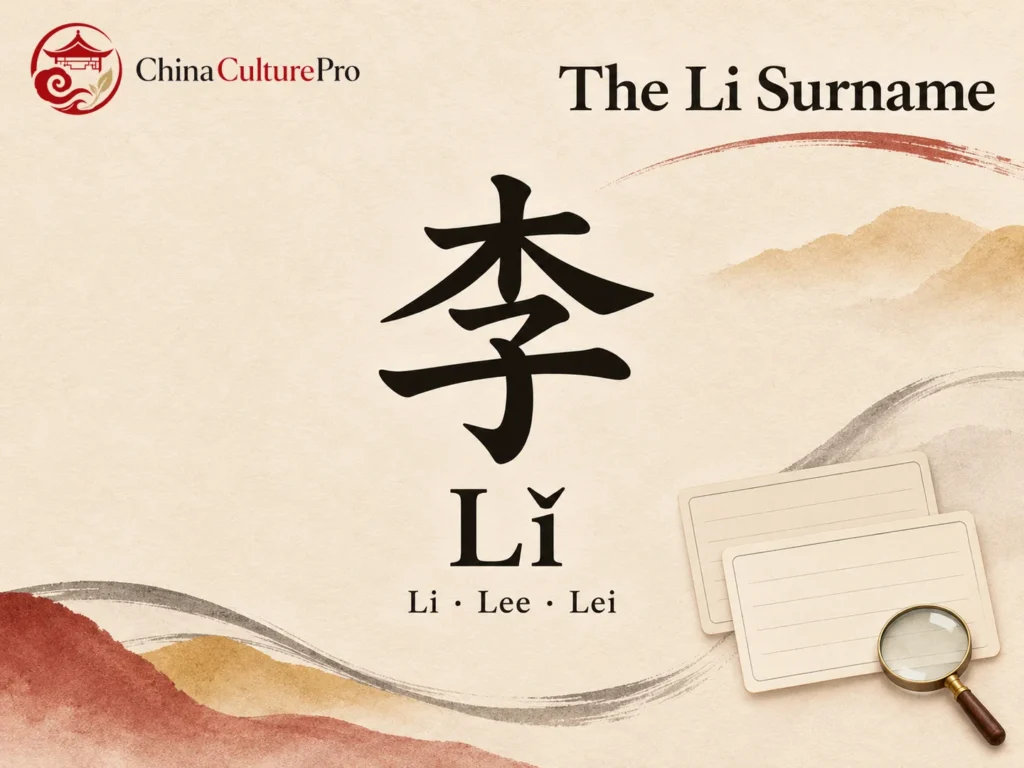
The Li surname(李,lǐ)has a third-tone Mandarin reading. Its character also names the plum tree. Li, Lee and Lei are attested spellings for 李.[1][6][7][8]
- Writing: 李 is unchanged between simplified and traditional Chinese.
- Traditional origins: One account explains a change from an earlier, similarly pronounced surname.[2]
- Historical prominence: It was an imperial surname, and historical records also document grants of the name.[3][4]
- Record matching: Preserve the person’s Chinese character and established spelling.
Neither the word “plum” nor a royal association proves the history of every Li family.

Li can be a dynasty’s ruling surname, a poet’s name or an older record’s Lee. Understanding it requires three separate questions: what the character means, which origin account a family preserves, and how particular people recorded their names.
The Character 李: Meaning and Pronunciation
李 is pronounced lǐ in Mandarin and also denotes the plum tree. “Plum” is a word meaning, not a translation normally substituted for a person’s inherited surname.[1]
The letters Li can represent other surnames. The Lí surname(黎,lí)has a second tone, while the Lì surname(厉/厲,lì)has a fourth tone. Their characters and histories are distinct from 李. An English-only record cannot resolve that distinction by itself.[9][10]
2019 mainland rank: 2nd.[11]
Traditional Origins: From 理 to 李
One transmitted account traces the family to Gao Yao(皋陶,gāoyáo)and a hereditary judicial office. It connects that office with the earlier Li name(理,lǐ). In the story, a later official is killed, and his wife escapes with their son; tree fruit sustains them, and the family changes 理 to 李. This is an origin narrative preserved in surname literature, rather than a verified founding event for all present-day bearers.[2]
The same compilation connects the line with Laozi(老子,lǎozǐ), identified there as Li Er(李耳,lǐ ěr). This records a traditional affiliation rather than establishing a modern family’s descent from the philosopher.[2]
Tang Imperial Use and Historic Li Lineages
Li was the ruling surname of the Tang dynasty(唐朝,tángcháo), conventionally dated 618–907. Its founder was Li Yuan(李渊/李淵,lǐ yuān).[4][5]
A specific grant shows another route into the name. The Old Book of Tang records Xu Shiji(徐世勣,xú shìjì), originally bearing the Xu surname(徐,xú), receiving Li as an imperial surname. A documented change of surname differs from descent by birth within the imperial family.[3]
Historical surname literature also distinguishes major Li branches under labels such as Longxi(陇西/隴西,lǒngxī)and Zhao commandery(赵郡/趙郡,zhào jùn). A label in a family record is a research clue; linking a present household to that historical branch still requires connected generations.[2]
Li, Lee and Lei in Personal Records
The same written surname can appear under different established English forms. These examples demonstrate recorded usage, without making the spellings universal substitutes.
| Bentuk | Named example | Documentary context |
|---|---|---|
| Li | Li Bai(李白,lǐ bái) | The Metropolitan Museum of Art identifies Li Bai as a Tang poet in a collection record.[6] |
| Lee | Bruce Lee(李小龙/李小龍,lǐ xiǎolóng) | The Hong Kong Heritage Museum pairs his English name with 李小龍.[7] |
| Lei | Lei Wai Nong(李伟农/李偉農,lǐ wěinóng) | A University of Macau bilingual caption records this form alongside his Chinese name.[8] |
How to Compare Li Family Records
- Check whether the original surname is 李, 黎, 厉/厲 or another character.
- Keep the recorded English form, adding Li, Lee or Lei as separate search alternatives where relevant.
- Compare given names, relatives, dates and hometowns before combining entries.
- Trace each generation before assigning a family to a named historical branch or imperial line.
FAQs About the Li Surname
Are Li and Lee the Same Surname?
They can both represent 李, as the examples above show. The spelling Lee alone does not establish that character or identify one family.[6][7]
Is Li Always Written 李?
No. 黎 and 厉/厲 are among the other Chinese surnames that can appear as Li without tone marks.[9][10]
Does the Li Surname Prove Royal Descent?
No. Imperial use and grants of the surname are documented, but a present-day claim to a particular royal branch requires its own family records.[3][4]
Sumber
[1] Ministry of Education. Revised Mandarin Chinese Dictionary: 李
[2] Deng Mingshi. Gu Jin Xing Shi Shu Bian Zheng, Volume 21
[3] Old Book of Tang. Chapter 67: Xu Shiji and the Grant of the Li Surname
[4] Old Book of Tang. Chapter 1: Emperor Gaozu
[5] Metropolitan Museum of Art. Tang Dynasty (618–907)
[6] Metropolitan Museum of Art. Landscape and Couplet of Chinese Verse: Li Bai Collection Note
[7] Hong Kong Heritage Museum. A Man Beyond the Ordinary: Bruce Lee
[8] University of Macau. China Tourism Education Alliance: Bilingual Photograph Caption, 2022
[9] Ministry of Education. Revised Mandarin Chinese Dictionary: 黎
[10] Ministry of Education. Revised Mandarin Chinese Dictionary: 厲
[11] Ministry of Public Security, reproduced by Cemingzi. 2019 National Names Report