


Quick Answer: What Does the Bai Surname Mean?
Bai(白,Bái)is a Chinese surname pronounced with a rising second tone in Mandarin. The character also means “white” in ordinary vocabulary, but that dictionary meaning does not by itself explain how a particular family acquired the name.[1]
- Character: 白 is the form used in both simplified and traditional Chinese.
- Origins: Transmitted accounts connect different lines with ancient Qin and Chu figures.
- Spellings: Bai, Pai and Pak can be associated with 白 in different records.
Begin with the Chinese character, then identify the family and document. A shared spelling or an ancient origin story is not a complete genealogy.
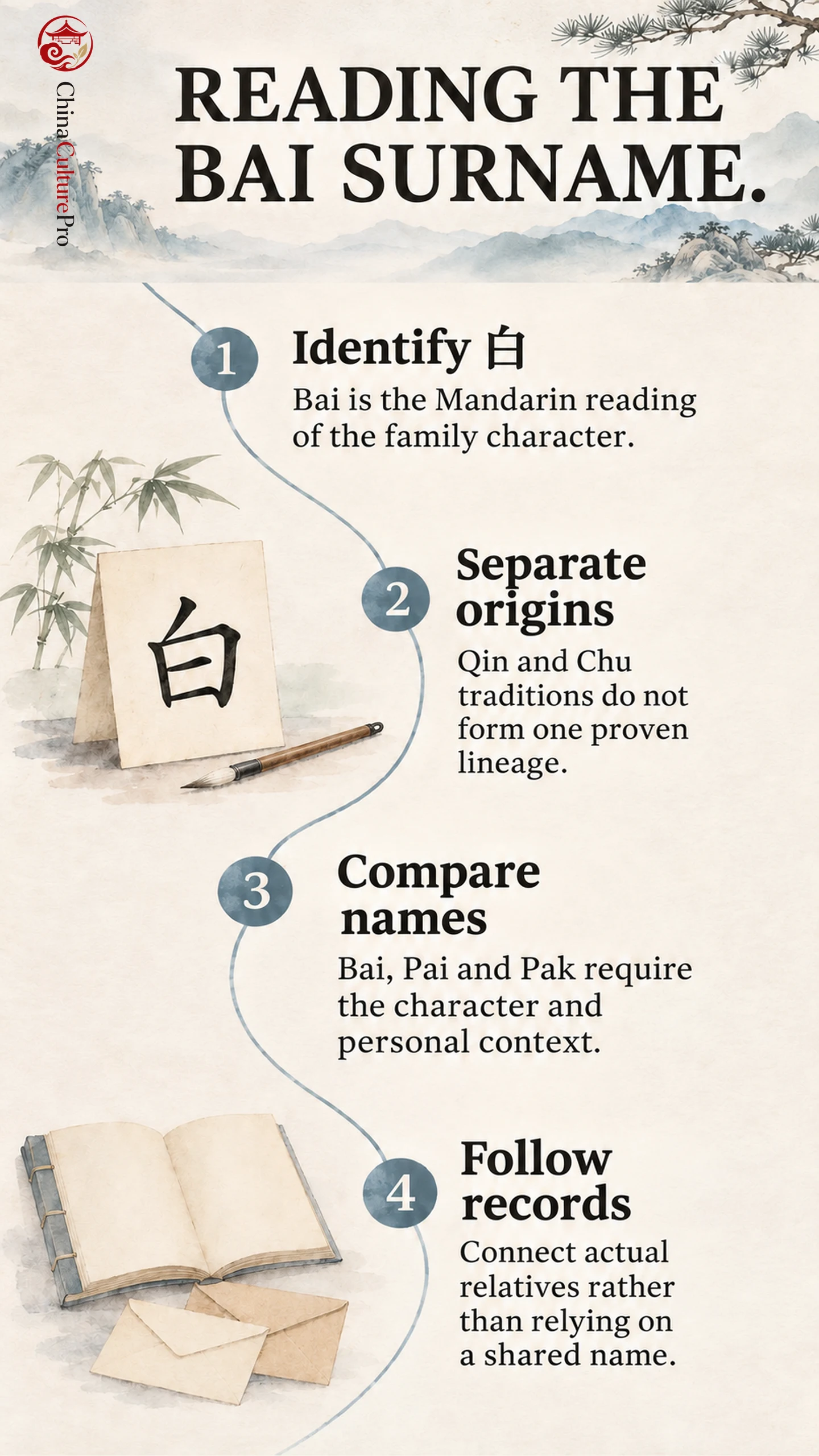
The same family character can appear under different spellings on a book cover, a family document or a modern name list. Bai offers a clear example. This guide connects its written form with Chinese surname traditions, named origin accounts and the limits of what a name alone can establish.
The Character 白 and Its Place in a Name
白 has five strokes. In Mandarin, Bái carries a second tone; ordinary Roman-letter names usually omit that tone mark. The character is unchanged between the standard simplified and traditional forms.[1]
The Tang poet Bai Juyi(白居易,Bái Jūyì)provides a familiar example: Bai is the surname and Juyi the given name. Treating the full name as three unrelated labels would lose that structure. A short introduction to Bai Juyi also shows how the surname appears in literary history.
The common meaning “white” is useful for recognizing the character. It should not become a claim about a bearer’s appearance, personality or ancestors’ occupation. A word can function as an inherited family name without serving as a literal description of the person who carries it.
Qin and Chu Accounts: Reading Origin Traditions Carefully
Two figures recur in transmitted discussions: Bai Yibing(白乙丙,Bái Yǐbǐng), associated with Qin, and Bai Gong Sheng(白公胜,Bái Gōng Shèng), associated with Chu. One account connects the surname with an ancestral name; another connects it with the Chu figure’s title or territorial designation.[2]
These should not be joined into one neat chain. The Song bibliographer Chen Zhensun(陈振孙,Chén Zhènsūn), discussing Bai Juyi’s ancestry, compared different accounts and pointed out chronological problems. In particular, an earlier Qin figure could not straightforwardly be descended from the much later Chu figure.
His discussion also questions whether names listed together establish the parent-child relationships later genealogies assign to them. A record of people serving in the same historical episode is not automatically evidence that they belonged to successive generations of one family.
A Qing bibliographic catalogue likewise criticizes prestigious genealogical connections that were forced together or reversed chronology.[3] The caution is therefore not merely a modern objection imposed on an unquestioned tradition: earlier Chinese scholars themselves examined conflicting claims.
Distinguish a transmitted surname origin from a documented family line. The former may explain a community’s ancestral tradition. Establishing the latter requires records that connect actual generations.
Bai, Pai and Pak in Roman Letters
Different spellings can point to the same written surname, but Roman letters alone do not settle the identification.
| Spelling | Context and identification |
|---|---|
| Bai | Mandarin pinyin form associated here with 白; names usually omit the tone mark. |
| Pai | An established spelling of 白, including in published personal names. |
| Pak | A spelling paired with 白 in a Chinese cultural surname record; check the family’s language and documents. |
Pai Hsien-yung(白先勇,Bái Xiānyǒng)is listed under that English spelling by his publisher.[4] It illustrates why replacing a familiar personal spelling with pinyin can obscure a person’s established published identity. The Pai spelling and the Mandarin reading Bái are different representations of the same family character.
Pak is also explicitly paired with 白 in a cultural surname listing.[5] That does not make every person written Pak a member of a Chinese Bai family. Use the character and the individual record together. The wider guide to regional romanization explains why letter forms can diverge.
From a Shared Surname to a Particular Family
For family genealogy, the productive starting point is a known relative, place and date. Compare the character, given name, spouse or parents, residence and generation links across the available records. A matching surname supplies one clue; matching parents, spouses and locations can connect a particular family.
Keep a family’s origin account separate from the chain actually documented. If a genealogy begins with a famous ancient figure but leaves a large gap before the earliest locally recorded ancestor, that gap remains part of the evidence. The later branch can still have a meaningful history without treating every remote connection as proved.
The surname also does not determine ethnic affiliation. A family name, a person’s identity and the name of an ethnic community are different kinds of information. Read a Bai name within that individual’s history rather than assigning an ethnicity from its spelling. More broadly, Chinese names combine inherited forms with personal and regional histories.
FAQs About Bai Surname
Do Bai and Pai refer to the same surname?
They can. Pai Hsien-yung’s published name uses Pai for 白, read Bái in Mandarin. Confirm the character for a particular person.[4]
Does the meaning white explain every Bai family’s origin?
No. It is the character’s ordinary meaning, not evidence of one universal event that created the surname.[1]
Does the surname prove a person belongs to the Bai ethnic group?
No. A surname alone does not establish an individual’s ethnic affiliation.
Sumber
[1] Ministry of Education, Taiwan. Concise Mandarin Chinese Dictionary: 白
[2] Shidianguji. Old chronology of Bai Juyi: discussion of the Bai lineage
[3] Shidianguji. Siku Quanshu Zongmu: evaluation of Yuanhe Xingzuan
[4] Chinese University of Hong Kong Press. Author entry: Pai Hsien-yung, 白先勇
[5] CHCAculture. Bai and Pak surname entry