


Quick Answer: How Are Chinese Names Structured?
A common Han Chinese name places the family name before the personal name. Understanding that pattern helps, but regional spelling, historical identities and individual preferences also matter.
- Surname (姓, xìng). The inherited family-name element of a name.
- Given name (名, míng). The personal-name element, often written with one or two characters in common Han naming patterns.
- Written characters. These help identify the name and distinguish meanings hidden by a Latin-letter spelling.
- Variation. A generation character, historical courtesy name (字, zì) or additional English name requires its own context.
This guide explains common patterns rather than a rule for every ethnic group or Chinese-speaking community. The pinyin supplied here gives Mandarin readings of the Chinese examples.
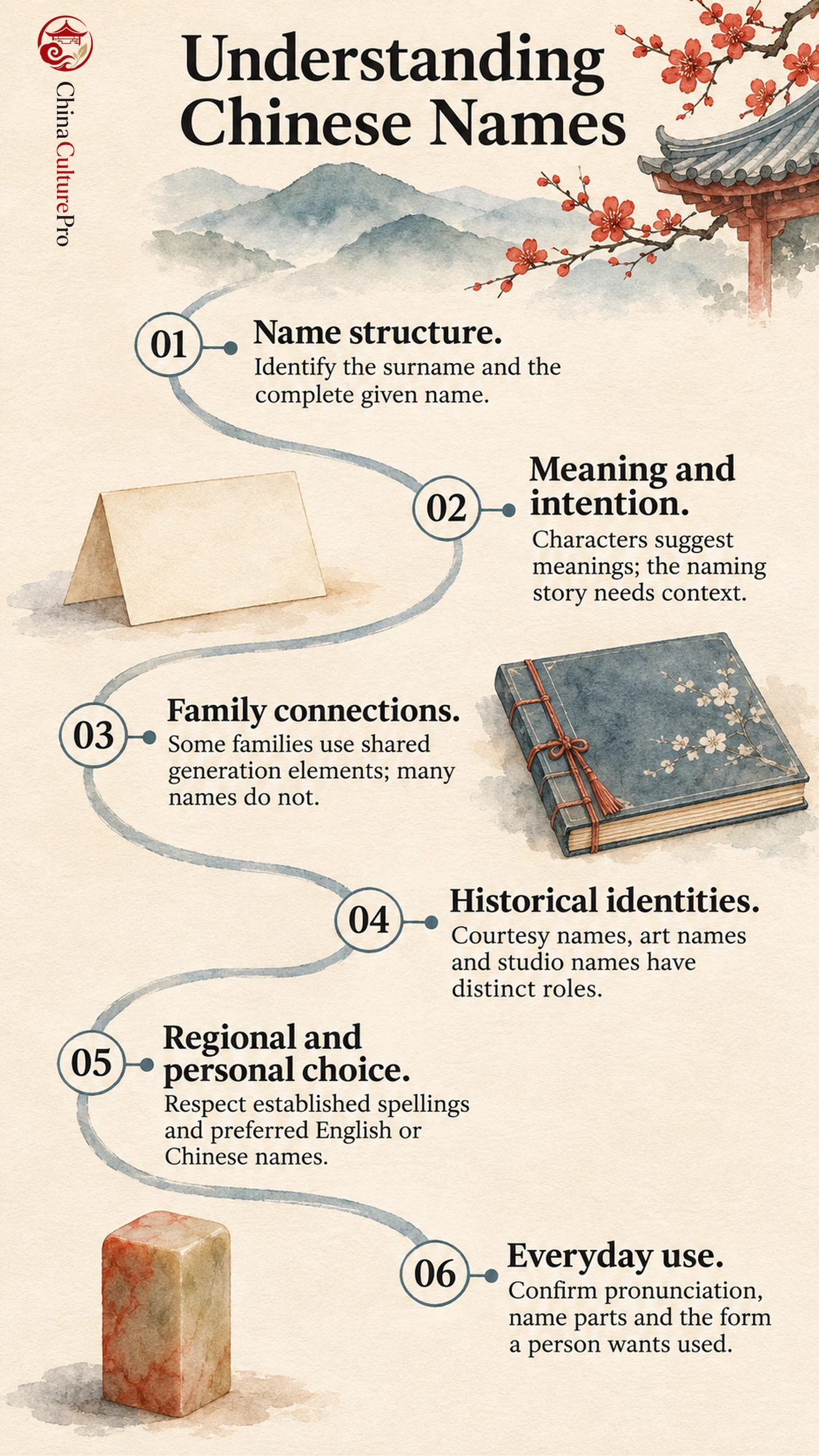
A three-character Chinese name may contain a one-character surname followed by a two-character given name. Treating it as an English-style first, middle and last name would miss that structure. The name’s written form, language context and the person’s own usage are better guides than counting spaces in an English transcription.
The following overview connects the main topics in the Chinese language reference hub. It helps you read a name, understand the kinds of stories attached to it and know when to ask rather than guess.
Surnames, Given Names and Character Count
The surname commonly precedes the given name in Han naming. Ouyang (欧阳, Ōuyáng) is one surname with two characters, not two separate name elements.[1][5]
Wang Xiuying (王秀英, Wáng Xiùyīng) illustrates how three characters form two name elements:[1]
| Unsur | Written form and Mandarin reading | Peran |
|---|---|---|
| Surname | 王, Wáng | Family-name element |
| Given name | 秀英, Xiùyīng | A single given name written with two characters |
In pinyin, the two syllables of Xiuying are joined. They do not become separate first and middle names. For more examples of these structural questions, see compound Chinese surnames and Chinese name order.[1]
Naming traditions among China’s ethnic communities can follow other structures. The wider history of Chinese surnames should therefore be read with attention to the people and period involved.[1]
Meaning, Sound and the Story Behind a Name
Given names can be created from characters carrying desirable associations, family hopes, literary references or aesthetic preferences. This allows considerable creativity, but the reasons for an actual person’s name cannot be reconstructed from a short translation alone.[2]
The written characters are the starting point. A Latin form can conceal different characters and tones, so an English spelling is not enough to determine a name’s meaning. Even after identifying the characters, separate their dictionary senses from the family’s intended explanation.
Some families have also considered auspicious associations, stroke counts or compatibility with birth circumstances. These are documented cultural practices and beliefs, not evidence that a name predicts a child’s future. Nor should one such practice be treated as a requirement followed by every family.[5]
When discussing a name, a useful distinction is “these characters can carry these meanings” versus “this is why the family chose them.” The second statement needs personal testimony or a reliable record. A Chinese dictionary helps with the first task; it cannot supply an undocumented naming story.
Generation Names and Family Connections
Some families use a shared element to indicate membership in a generation or a place within a family hierarchy. It may be part of a two-character given name, rather than a separate middle name. Research on generation naming describes multiple methods, including shared characters and shared character components.[2]
The position of a shared character is not fixed in every naming tradition. The practice is also not universal: a Chinese name need not contain a generation marker. A matching character is a clue to investigate, not proof of a relationship.[2]
For family research, look for the relevant genealogy, a documented generation sequence or an explanation from the family. The guide to Chinese generation names develops those methods; clan names and ancestral identity explains the wider record context. Avoid treating everyone with the same surname as members of one demonstrable recent lineage.
Courtesy Names, Art Names and Other Identities
A courtesy name (字, zì) is a historical name associated with adulthood and social address. An art name (号, hào) is a sobriquet used in literary, artistic or other personal contexts. One person could have several identities.[5]
These categories help when reading biographies, signatures and art records. A name familiar from a painting may differ from the personal name listed in a biographical reference. They should be connected through evidence, rather than counted as unrelated people merely because the wording differs.
Artists’ seals offer a visible example. Paired impressions can give an artist’s proper name and a sobriquet or studio name. A seal can therefore identify different aspects of an artist’s identity; it does not necessarily reproduce a full birth name.[3]
The focused guide to courtesy names and art names covers the historical terminology in more detail. These labels should not be added automatically to every modern person’s name.
Romanization, Regional Usage and English Names
Hong Kong’s Cantonese-based name spellings differ from Mandarin pinyin. For authors, cataloging guidance favors the person’s preferred romanized form when available.[1]
The guides to regional Chinese name spellings and Chinese transliteration systems explain why a familiar spelling may not match a Mandarin chart. A different spelling is not, by itself, a correction to someone’s identity.
English names add another layer. A 2024 study of 357 mainland Chinese students used a 44-item questionnaire to examine English-name choices. Uniqueness, being remembered and expressing identity were important motivations in that sample. The findings show active personal choice; they do not establish that every Chinese person uses or wants an English name.[4]
Ask which name someone wants used in the setting you share. An English name may be convenient for one person, while another prefers their Chinese name. Neither preference should be assumed from nationality or age alone.
Reading and Using Someone’s Name
Before shortening a name, confirm where the surname ends and how the person introduces themselves. If the name is unfamiliar, asking for pronunciation is more useful than inventing an English equivalent. Preserve the spelling they supply when making an introduction or keeping a contact record.
Within families, kinship terms may be used instead of personal names, and nicknames can have an established place in everyday relationships. Their use depends on the relationship and community context. A form heard among relatives is not automatically suitable for a new acquaintance.[5]
See Chinese family terms for kinship vocabulary. If you are selecting a name yourself, how to choose a Chinese name offers the next practical task: checking sound, characters, associations and cultural fit with knowledgeable speakers.
FAQs About Chinese Names
Are Chinese family names always one character?
No. Compound surnames such as Ouyang have two characters. Identify the surname before dividing the remaining name into parts.[1]
Does a two-character given name contain a middle name?
Usually it should be understood as one given-name unit, not automatically divided into an English-style first name and middle name. A shared generation character can be part of that unit.[2][5]
Do Chinese women change their surnames after marriage?
Many mainland Chinese women retain their surnames. Practices vary: ask rather than assuming spouses share one surname.[1]
Can you know a name’s meaning from its pinyin alone?
Not reliably. Confirm the Chinese characters first, then distinguish possible character meanings from the particular story or intention behind the person’s name.
Sumber
[1] IFLA Cataloguing Section. Names of Persons—Chinese Names, 2020
[2] Irena Kałużyńska. Traditional Chinese Generation Names, 2015
[3] Metropolitan Museum of Art. Mastering the Art of Chinese Painting: The Art of Seal Carving
[4] Robert Weekly and Shih-Ching Picucci-Huang. Uniqueness and Agency in English Naming Practices of Mainland Chinese Students, 2024
[5] David K. Jordan. Chinese Personal Names and Titles