

Quick Answer: What Is a Chinese Compound Surname?
A Chinese compound surname (复姓, fùxìng) is one family name written with more than one Chinese character, usually two. Ouyang (欧阳, Ōuyáng) and Sima (司马, Sīmǎ) are examples: both characters belong to the surname.[1]
- Name structure: Two surname characters still form one family-name unit.
- Pinyin: The syllables within that surname are normally joined.
- Regional spellings: Established forms may use different spacing or hyphens.
- Family history: A surname alone does not establish a personal pedigree.
Character count helps describe a name; it cannot by itself tell you where an unfamiliar person’s surname ends.
Splitting a surname after its first character can assign part of the family name to the wrong field. The practical task is to recognize the complete surname before identifying the given name or deciding how to address its bearer. That matters whether you are reading a historical biography, introducing a colleague or checking a registration record.
For the wider system, begin with Chinese names. Here the focus is the surname unit, its historical context and the differences between standard pinyin and established personal spellings.
One Surname Can Contain Two Characters
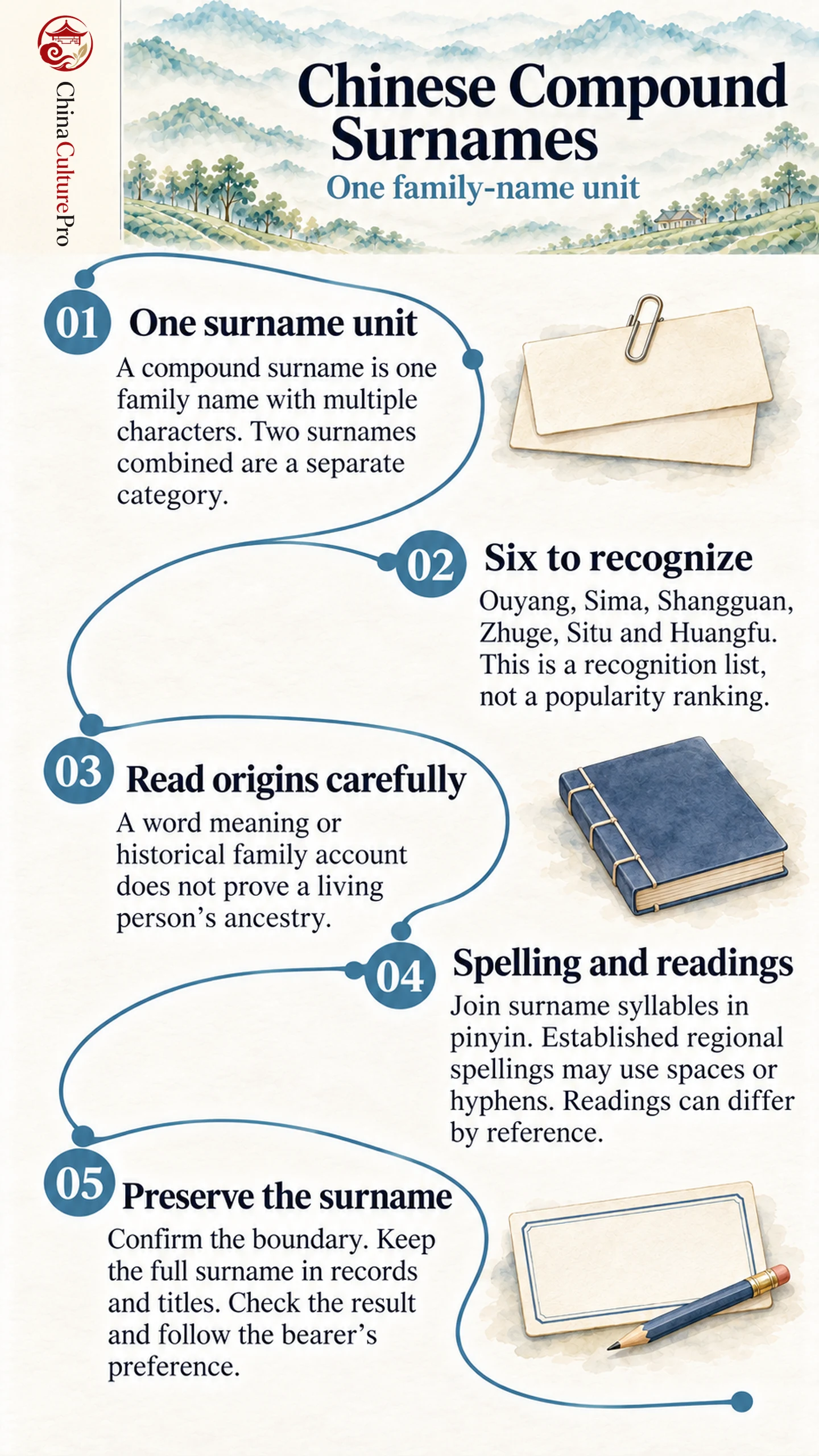
A compound surname is one family name written with more than one Chinese character. The familiar two-character examples do not consist of a surname followed by the first character of a given name.[1]
The 2011 pinyin spelling standard distinguishes this category from a combined surname (双姓, shuāngxìng). A combined surname consists of two surnames placed together as a surname combination. The standard gives separate rules for spelling the two categories; equal character counts do not make their structures identical.[2]
Recognize the actual family-name boundary before counting the remaining characters. A four-character full name might contain a two-character surname and a two-character given name, but length alone does not establish that division. Confirm the name parts instead of applying a rule that every Chinese surname must occupy the first character. See Chinese name order for the broader distinction between name parts and display order.
Six Compound Surnames to Recognize
The following is a short recognition list, not a frequency ranking. Simplified and traditional forms refer to the same surname in each row. The pinyin joins the surname syllables; the pronunciation note identifies a documented reference difference.
| Surname and Mandarin reading | Traditional form | Reading note |
|---|---|---|
| Ouyang (欧阳, Ōuyáng) | 歐陽 | Keep both characters in the surname.[10] |
| Sima (司马, Sīmǎ) | 司馬 | One surname, with the second syllable in the third tone.[4] |
| Shangguan (上官, Shàngguān) | 上官 | One surname, not a separate title plus a given name.[5] |
| Zhuge (诸葛, Zhūgě; Taiwan reference: Zhūgé) | 諸葛 | The mainland spelling standard and Taiwan’s dictionary record different tones for the second syllable.[2][8] |
| Situ (司徒, Sītú) | 司徒 | Keep both syllables together as the family-name unit.[7] |
| Huangfu (皇甫, Huángfǔ) | 皇甫 | The second character is read fǔ in this surname.[6] |
For a related historical reading text, see the Hundred Family Surnames. Its recitation sequence serves a different purpose from a modern population table.
Historical Meanings and Family Origin Accounts
A surname’s characters can also form an ordinary word or an official title. Sima is recorded both as a surname and as the name of historical offices whose functions changed over time.[4] Recognizing that connection does not establish which officeholder, if any, belongs in a particular living person’s ancestry.
Ouyang Xiu (欧阳修, Ōuyáng Xiū) provides a useful example of a historical family account. His genealogy preface connects the surname with an Ouyang territorial title and a place south of a mountain. The same text acknowledges gaps in the recorded generations and describes comparing family genealogies to resolve differences.[9]
Read such a preface as evidence of how a particular writer documented and understood his family’s history. It does not turn a shared modern surname into a documented line of descent from that writer or from an ancient ruler. A word meaning, a traditional origin account and a family’s demonstrable relationships answer different questions. The guide to clan names and ancestral identity develops the record-based side of that distinction.
Pinyin Units and Regional Spellings
In standard pinyin, join the syllables within the compound surname and separate the surname from the given name. Sima Qian (司马迁, Sīmǎ Qiān) divides into Sima and Qian, not Si and Maqian. The surname remains Sima when tone marks are omitted.[3]
This rule describes pinyin spelling. It does not make every established hyphenated or spaced surname an error. Hong Kong naming guidance records forms such as Au-Yeung for Ouyang, Sze Ma for Sima and Szeto for Situ. It also emphasizes the author’s preferred romanized form in cataloging.[3]
Keep the distinction between a pronunciation guide and someone’s actual spelling. A person’s established name can reflect a regional language, an older romanization convention or family usage. Likewise, the Zhuge readings in the table should be understood within their reference traditions, rather than used to announce that another speaker’s name is wrong. See regional Chinese name spellings for the wider context.
Keeping the Whole Surname in Records and Address
- Confirm the surname boundary: Ask the person which characters or letters form the complete surname. Do not infer the boundary from the total number of characters in the full name.
- Keep the confirmed surname together: Enter the complete confirmed surname in the family-name field. Preserve the spelling and spacing used in the relevant record, following the institution’s instructions.
- Check the resulting display: Check that the stored surname and given name remain correctly assigned after submission. If the system splits or truncates the surname, ask the institution how to correct the record.
These steps apply the basic distinction between family and given names; a US school-registration guide similarly emphasizes identifying name parts and confirming information with the person or family.[11] Specific record systems can have their own instructions, so this is a checking method, not a universal form-filling template.
When using a title with a confirmed surname, retain the whole surname: “Professor Ouyang” preserves the family-name unit. For everyday address, also follow the person’s stated preference.
FAQs About Chinese Compound Surnames
Does a compound surname combine the parents’ surnames?
Not necessarily. In the distinction used by the 2011 spelling standard, a compound surname is already one surname, while two surnames placed together form a separate combined-surname category. Two written characters alone do not establish how a family name was formed.[2]
Should Ouyang be written as Ou Yang?
In standard pinyin, Ouyang is one joined surname. When recording a real person’s name, preserve their established spelling and the relevant record’s requirements instead of automatically changing every space or hyphen.[2][3]
Does a compound surname prove noble ancestry?
No. Its length does not document a family’s ancestry or social status. A historical origin tradition may be worth investigating, but a personal lineage claim needs records connecting the relevant generations.
Sumber
[1] Ministry of Education, Taiwan. Concise Mandarin Chinese Dictionary: Compound Surname
[2] Standardization Administration of China. GB/T 28039–2011: Chinese Personal Name Spelling Rules, copy hosted by USTB
[3] IFLA Cataloguing Section. Names of Persons: Chinese Names, 2020
[4] Ministry of Education, Taiwan. Revised Mandarin Chinese Dictionary: Sima
[5] Ministry of Education, Taiwan. Revised Mandarin Chinese Dictionary: Shangguan
[6] Ministry of Education, Taiwan. Revised Mandarin Chinese Dictionary: Huangfu
[7] Ministry of Education, Taiwan. Concise Mandarin Chinese Dictionary: Situ
[8] Ministry of Education, Taiwan. Revised Mandarin Chinese Dictionary: Zhuge
[9] Ouyang Xiu. Preface to the Ouyang Genealogy, stone-text version, via Shidian Guji
[10] Ministry of Education, Taiwan. Revised Mandarin Chinese Dictionary: Ouyang
[11] Institute of Education Sciences. Getting It Right: Reference Guides for Registering Students with Non-English Names