

Quick Answer: What Is Jiangnan Sizhu?
Jiangnan Sizhu(江南丝竹,Jiāngnán sīzhú)is a small-ensemble tradition associated with Shanghai, southern Jiangsu and western Zhejiang in the lower Yangtze region. The name means silk and bamboo, referring to string and wind instrument families.
Several players can follow the same underlying tune while giving it different ornaments, registers and phrasing. The repertory includes a familiar group of eight pieces, as well as other tunes and later arrangements. Musicians play in social gatherings, clubs and concert settings.

A flute may decorate the end of a phrase while a bowed string keeps the tune clear. Both players still know where the melody is going. This give-and-take is central to Jiangnan Sizhu, and you can hear it even when a recording has only a few instruments.
Silk, Bamboo and the Ensemble
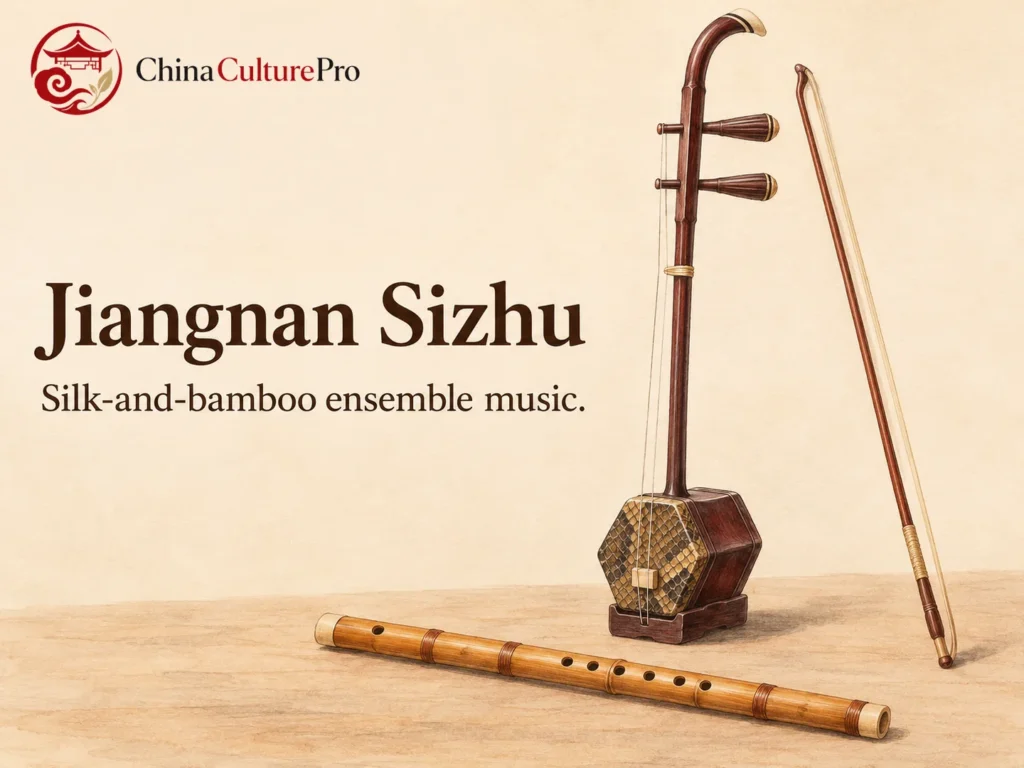
Silk refers to the historical use of silk strings, and bamboo refers to instruments with bamboo tubes. The names identify sound families. The actual materials and lineup can vary. China’s national heritage inventory describes the regional tradition through bowed, plucked and struck strings and several kinds of wind instruments.[1]
The erhu (二胡,èrhú), a bowed fiddle, and the dizi (笛子,dízi), a transverse flute, often lead. Other players may add the plucked pipa (琵琶,pípa)or the struck yangqin (扬琴,yángqín). Small percussion can mark the pulse. The plucked and struck sounds have clear attacks, while a bow or a stream of air can maintain a note between those attacks.[2]
How Musicians Share One Melody
The players can vary the same tune at the same time, a texture called heterophony. One musician might use jiahua(加花,jiāhuā), or melodic ornamentation, adding smaller notes around the main line. Another can play a simpler version so that listeners can still follow the tune. One player can also take the tune higher while another keeps it in a lower register, leaving space between the parts. The group keeps a shared outline while giving the individual parts room to be heard.[1]
The same tune can support different versions. Two related pieces can use a recognizable tune but differ in speed, density and ornament. Listen for the places where the phrase turns or comes to rest, then hear how each performer approaches those points.
The Eight Great Pieces and Recorded Examples
The Eight Great Pieces are a core group in the repertory. The Chinese National Academy of Arts archive identifies several versions with dates, record labels and performers. Catalog dates can refer to a recording, an arrangement or a release. They establish a point in the history of a version.[3]
| Piece | A detail to help identify the version |
|---|---|
| Zhonghua Liuban(中花六板,Zhōnghuā Liùbǎn) | A more ornamented version related to Old Six Beats. The archive identifies an arrangement by Lin Shicheng from 1980. |
| Sanliu(三六,Sānliù) | Three Six. The archive catalogs a Victor disc from about 1916. |
| Xingjie(行街,Xíngjiē) | Street Procession. The archive includes a solo rendition recorded in 1951. |
| Huanle Ge(欢乐歌,Huānlè Gē) | Song of Joy. An archive entry from 1964 credits Lu Chunling and other players. |
| Yunqing(云庆,Yúnqìng) | Cloud Celebration. The archive identifies a Pathé recording from about 1920. |
| Sihe Ruyi(四合如意,Sìhé Rúyì) | Also listed as Sihe. The archive has a Victor record from about 1916. |
| Man Liuban(慢六板,Màn Liùbǎn) | Slow Six Beats. A cataloged version features Lu Chunling and the Shanghai Chinese Orchestra. |
| Man Sanliu(慢三六,Màn Sānliù) | Slow Three Six. A 1963 entry documents a bowed-string rendition. |
The two Six Beats pieces share a source tune. Sanliu and Man Sanliu form another related pair. These connections give listeners a way to compare ornament and pacing across performances.
Clubs, Gatherings and Concert Stages
Small groups have played this music in private and informal public settings, including teahouses. Amateur musicians can use shared repertory as a reason to gather and keep playing together. A concert can present a more formally arranged version of a tune that musicians also play in a social gathering.[4]
The Shanghai entry for Jiangnan Sizhu joined China’s national intangible cultural heritage list in 2006. That record names a specific regional project. The broader phrase “silk and bamboo” also describes ensemble traditions elsewhere. Fujian Nanyin (南音,nányīn)has its own repertory, language and relationship between singers and instrumentalists.
How to Listen to a Sizhu Performance
The ANU Chinese Classical Music Ensemble publishes a studio performance of Yunqing. Follow the main line for a short passage and then listen for the moment a second instrument adds a turn or fills a gap. The group’s own description emphasizes flexible instrumentation and the way players take turns bringing the tune forward.[5]
Then choose one older recording from the archive. The lineup may be different, and a solo version can expose the tune more clearly. Following the phrase across versions helps connect these recordings with the wider repertory of Chinese classical music pieces.
FAQs About Jiangnan Sizhu
Does silk and bamboo describe the materials of every instrument?
The phrase names historical instrument families. Individual instruments can use different materials, and a group may include small percussion.
Is Jiangnan Sizhu the same as Nanyin?
They are different regional traditions. Jiangnan Sizhu centers on instrumental ensemble playing. Nanyin includes distinct vocal and instrumental repertories associated with Minnan communities.
What should a first-time listener focus on?
Follow the shared tune first. Then listen for ornaments, changes of register and moments when one instrument leaves space for another.
Sumber
[1] Museum Digital Warisan Budaya Takbenda Tiongkok. Jiangnan Sizhu
[2] Hong Kong Education Bureau. Listening to Chinese Music, Jiangnan Sizhu
[3] Chinese National Academy of Arts, Arts and Literature Library. Jiangnan Sizhu, Nine Recordings
[4] Grinnell College Musical Instrument Collection. Sizhu Ensemble from China
[5] ANU Chinese Classical Music Ensemble. Jiangnan Sizhu