


Quick Answer: What Is an Erhu?
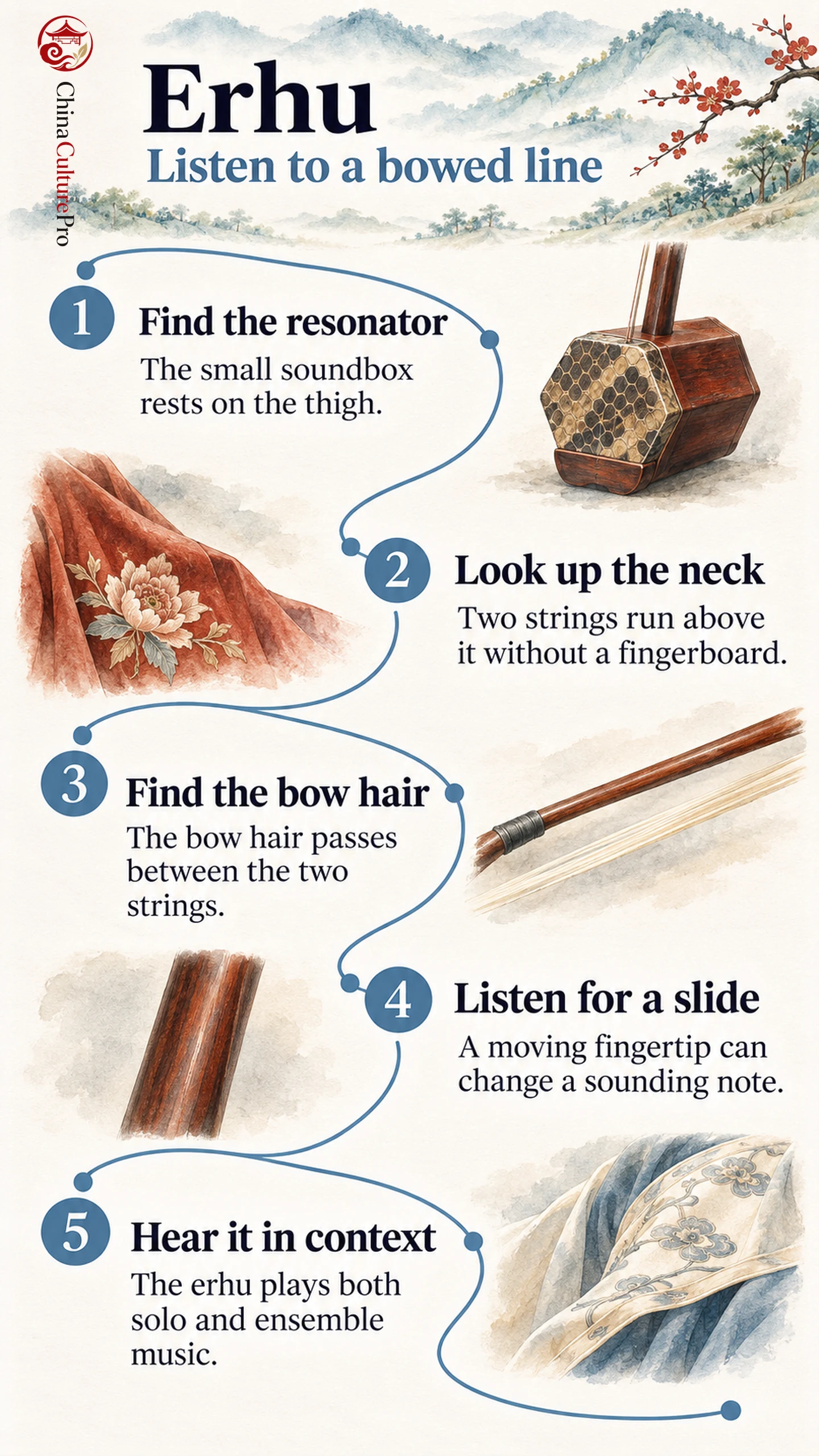
An erhu (二胡, èrhú) is a Chinese two-string bowed fiddle. The player rests its small resonator on the thigh and holds the narrow neck upright.
- Look at the bow: Its hair passes between the two strings, so the player changes pressure to sound one string or the other.
- Look at the neck: The fingers stop the strings in the air above it. There is no fingerboard underneath.
- Listen for the line: The bow can keep a note sounding while the fingers slide or add vibrato.
The erhu can carry a solo melody or take part in an ensemble. Its compact soundbox can use a traditional skin or a newer membrane. [1][2][3][4]
An erhu player can draw a note out, let it waver and slide directly into the next pitch. From a distance the sound may remind you of a voice. Up close, the most distinctive clues are a bow threaded through the strings and fingers moving on a neck with open space behind them. [1][2][4]
How the Erhu Is Built and Held
The erhu is part of the huqin (胡琴, húqín) family of bowed Chinese musical instruments. Its neck rises from a small soundbox. Two tuning pegs hold the strings at the upper end. At the lower end, a bridge conveys the strings’ vibration to a membrane over the front of the resonator. The player supports the instrument on the thigh with the neck vertical. [1][2][4]
An early twentieth-century specimen has a six-sided body, a python-skin face and a carved opening at the back. This is one documented build. Modern orchestra instruments can have modified resonators and synthetic membranes. Look for the soundbox and the threaded bow together. Those features stay visible even when you cannot make out the membrane. [1][3]
How Two Strings Produce a Singing Line
The bow stick sits outside the strings while the hair runs between them. The right hand controls which string the hair contacts, and a continuing stroke supplies energy to the note. The left hand shortens the vibrating length of the string by stopping it with a fingertip. Since there is no fingerboard, the player touches the suspended string rather than pressing it against wood. [1][2][4]
Listen for a slide into a longer note. A fingertip can move along a string while the bow keeps it sounding. You hear the pitch travel instead of jumping straight to the next note. A small repeated motion can make a sustained note pulse in pitch. These changes give a player ways to shape a phrase without starting a fresh bow stroke for each change. [4]
From Solo Repertoire to Orchestra
Two figures in the twentieth-century solo repertoire offer different entry points. Liu Tianhua developed concert pieces for the instrument. Hua Yanjun, known as Abing, left recordings from 1950, including *Reflection of the Moon on the Second Spring*. Start with how he shapes the ends of phrases, where the sound can taper, bend or pause before the next line. [4]
In a Chinese orchestra, several bowed fiddles can share the work of carrying a melody. The erhu sits among related instruments with different ranges and colors. In a mixed ensemble, try following the sustained bowed line before switching your attention to a dizi or a plucked instrument. The guide to Chinese traditional music puts these settings in context. [3][4]
FAQs About Erhu
Is the Erhu the Same as a Violin?
Both are bowed strings. The erhu stands upright on the thigh, has two strings with bow hair running between them and has no fingerboard. [1][2]
Does Every Erhu Use Snakeskin?
Some traditional instruments use python skin. Some modern orchestral models use a synthetic membrane. [1][3]
Where Should I Start Listening?
Abing’s *Reflection of the Moon on the Second Spring* offers a solo example. Listen to how the long notes change while the bow sustains them. [4]
Sumber
[1] Yale Collection of Musical Instruments. Erhu, accession 4503.1973
[2] The Metropolitan Museum of Art. Erhu, Qing dynasty
[3] Hong Kong Chinese Orchestra. Eco-Huqins
[4] Hong Kong Education Bureau. Listening to Chinese Music