
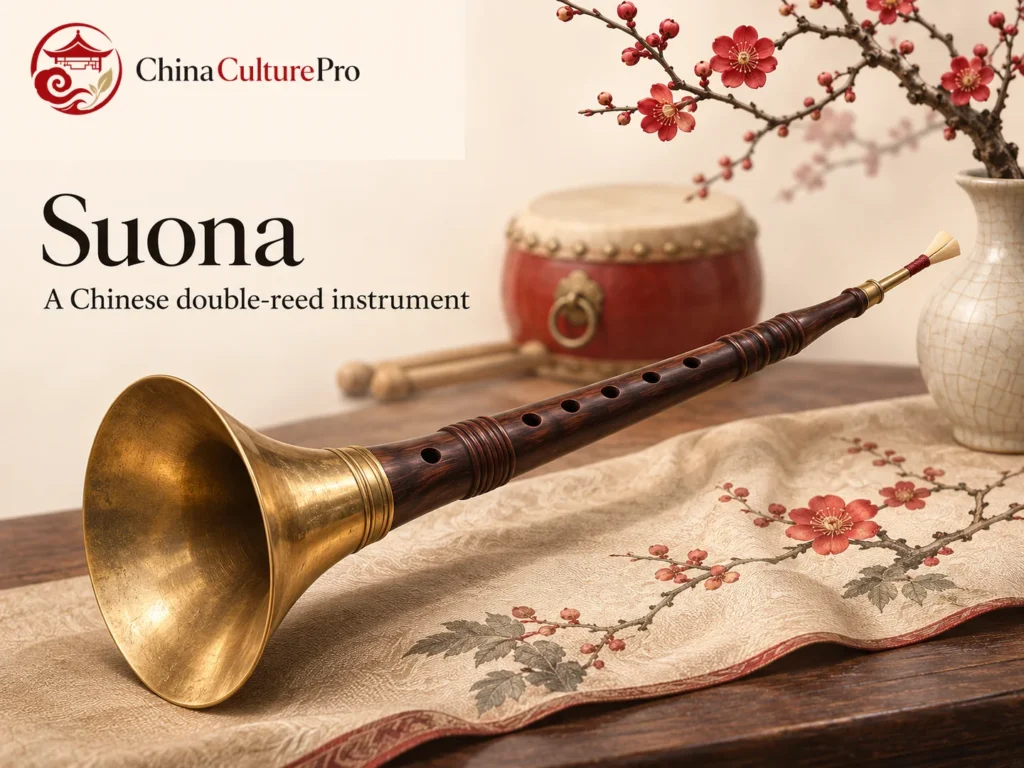

Quick Answer: What Is a Suona?
A suona (唢呐, suǒnà) is a Chinese double-reed wind instrument. A common form has a narrow wooden body that widens toward a flared metal bell. Its penetrating tone carries easily alongside drums and gongs.
- Look at the mouthpiece: Two thin reed blades vibrate when the player blows.
- Look down the body: The fingers cover and uncover holes to change pitch, and the bell flares at the wide end.
- Listen for its role: A suona can lead a procession, carry a solo or join an orchestra.
Ceremonial uses and instrument designs differ among communities and ensembles. [1][2][3][4]
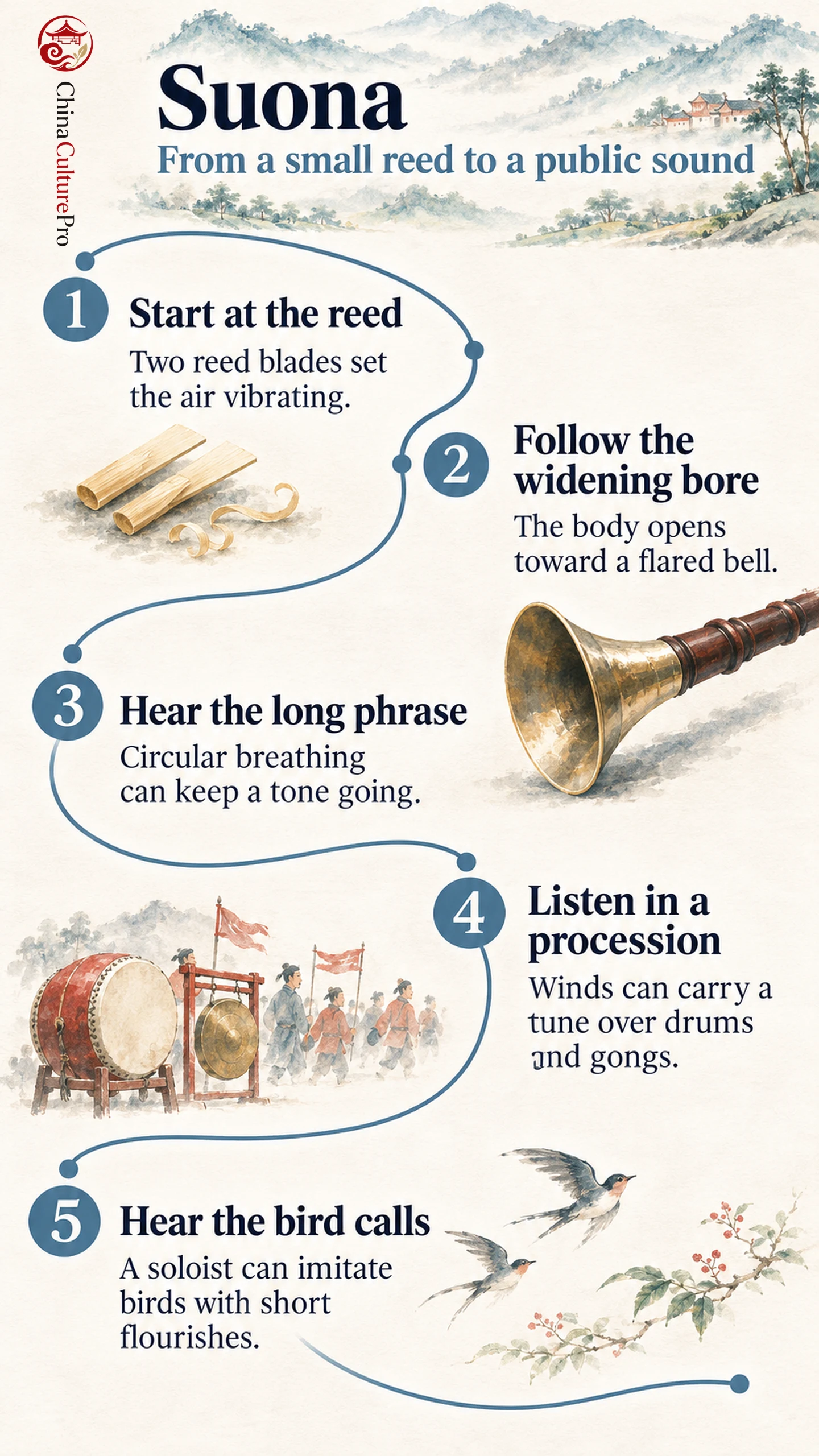
The metal bell is often the first thing you see, but the sound starts at the other end. A tiny double reed drives the tone, giving the suona an edge that can cut through a group of percussion instruments. [1][2]
The Double Reed, Wooden Body and Bell
The player blows into the small reed at the narrow end of the suona. The vibrating blades set the air in the wooden body in motion. The bore widens toward the bell, which helps radiate the sound. A nineteenth-century example made from rosewood and brass measures about 44 centimeters long. That is one specimen rather than a fixed size. Other models can be smaller or use different fittings. [1][2][3]
The suona belongs to the winds in Chinese musical instruments. A dizi player blows across an edge to start a note. The suona player sends breath through the reed.
How Players Shape a Continuous Sound
Finger changes can create quick turns in a melody, and breath and articulation can make notes enter sharply or flow together. Players may also use circular breathing, briefly sending air from the mouth into the reed while inhaling through the nose. Listen for a long passage that keeps its tone through an expected breathing point. That effect is a technique some players use within a phrase. [2][3]
The Suona in Processions and Local Ceremonies
The Suimi suona (绥米唢呐, Suímǐ suǒnà) tradition takes its name from Suide and Mizhi in northern Shaanxi. Its larger moving ensembles can include two suona parts at different pitches, along with drum, cymbals and gong. Documented settings include wedding processions, funeral processions and temple visits. The same regional tradition also has smaller seated groups with a different mix of instruments. [3]
Listen for how the winds carry the tune while percussion marks the movement of the group. That approach connects with the guide to Chinese traditional music, where the occasion helps explain what the ensemble is doing.
What to Listen for in Concert
*Hundred Birds Pay Homage to the Phoenix* offers a different point of entry. A soloist can use quick changes of pitch and articulation to suggest bird calls. Listen for a clear melodic phrase, then for the shorter bursts that break away from it. Orchestral instrument lists also document keyed suona in lower registers alongside traditional forms. Their different ranges give arrangers options for distributing high and low lines. [4][5]
For more on how instrumental sound can support a moving procession or a stage performance, see Chinese performing arts.
FAQs About Suona
Is the Suona a Trumpet?
Its flared bell can look trumpet-like, but the suona starts a note with a double reed. A trumpet player vibrates the lips at the mouthpiece. [2]
Is the Suona Used Only at Funerals?
Its roles include weddings, temple occasions, solo repertoire and concert ensembles. The particular setting depends on the local tradition and the piece. [3][4][5]
Is the Guan the Same Instrument?
The guan also uses a double reed. A typical guan has a cylindrical body, while a common suona widens toward a flared bell. [2][6]
Sumber
[1] The Metropolitan Museum of Art. Suona, accession 89.4.20
[2] The Metropolitan Museum of Art. Suona, accession 89.4.2750
[3] China Intangible Cultural Heritage Digital Museum. Suona Art: Suimi Suona
[4] Hong Kong Chinese Orchestra. Instrumentation and Range Table
[5] Little Giant Chinese Chamber Orchestra. Suona solo: Hundred Birds Pay Homage to the Phoenix
[6] The Metropolitan Museum of Art. Guanzi, accession 89.4.2898