
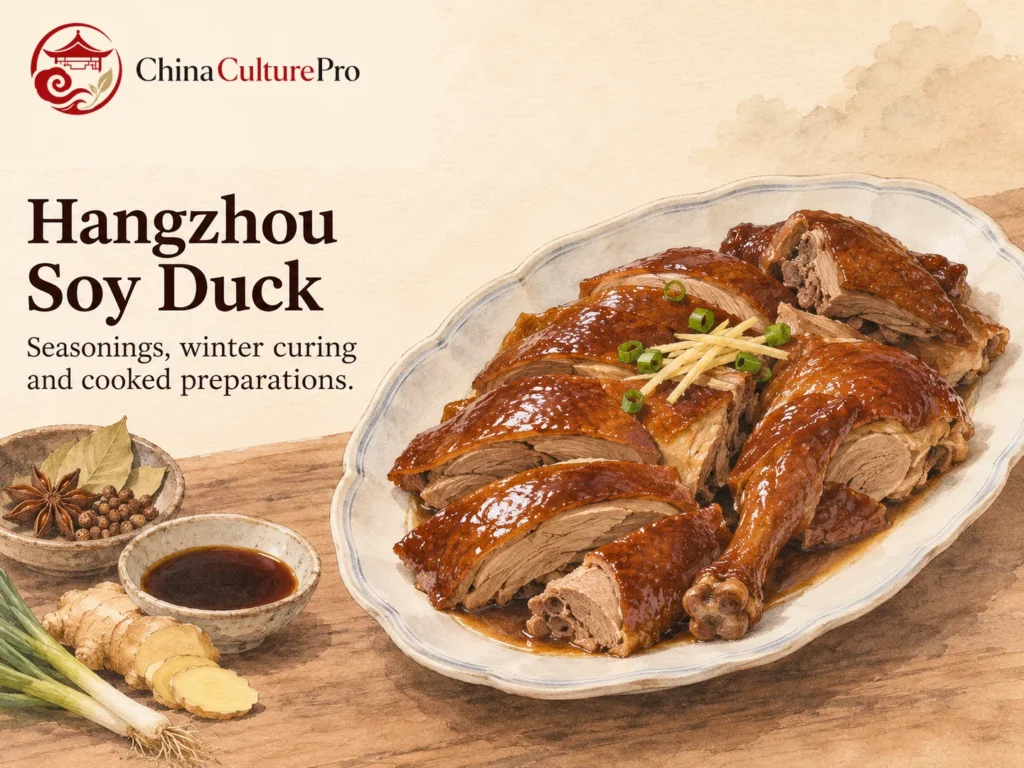

Quick Answer: What Is Hangzhou Soy-Sauce Duck?
Hangzhou jiangya(杭州酱鸭,Hángzhōu jiàngyā)is duck flavored with a savory, gently sweet soy-based seasoning. Its familiar winter form is associated with curing and drying.
- Flavor: Soy sauce, sugar and aromatics season the meat and darken the skin.
- Texture: Cured versions have a firmer bite than a freshly simmered duck dish.
- Serving: Cooked duck is cut into shared portions; the product’s cooking status must be checked.[1]
Similar English names also describe fresh duck braised in soy sauce. The name alone cannot tell you which process was used or whether a purchased duck is ready to eat.

Glossy brown skin and firm slices make Hangzhou soy-sauce duck easy to notice among a table’s lighter dishes. Yet the same English description can hide different preparations. This guide explains the seasonings, the winter-cured tradition and the questions worth asking when buying or ordering this specialty of Zhejiang cuisine.
Duck, Soy Sauce and Supporting Aromatics
Duck supplies the meat, skin and fat; Chinese soy sauce supplies much of the salt, color and savory flavor. Sugar rounds out that seasoning. Ginger, scallion, star anise and cassia or cinnamon occur in local preparations, and rice wine may also be used. Some cooks add chili, but heat is not what defines the dish.[1]
The balance matters more than a long spice list. A heavily sweetened sauce, a sharper anise note or a drier piece of duck can produce very different impressions while retaining the same broad name.
One published braised preparation uses both light and dark soy sauces with sugar, ginger, scallion, star anise and cassia.[2] That is a particular cooking formula, not proof that every winter-cured duck must contain both soy-sauce types. Likewise, Shaoxing cooking wine is an ingredient to confirm, rather than an assumption about every plate.
Curing, Drying and Cooking Have Different Jobs
Curing gives the duck time in a seasoned mixture. Drying removes moisture and changes its texture. Cooking is the separate step that heats the meat through. The language of preservation should not obscure that last distinction.
Production sequences vary. A documented Hangzhou processing study used marination, cooking and drying in that order, under a defined commercial process.[3] A local household-style product may instead be sold after curing and drying for the purchaser to steam. Local accounts describe steaming as a familiar way to prepare the purchased duck.[4]
These differences explain why a hanging duck cannot be judged ready to eat from its appearance. Dark skin records seasoning; a dry surface records moisture loss. Neither answers the question of cooking status. The process therefore needs to be identified before deciding how to prepare a purchased duck.
Two Preparations Behind Similar English Names
The most useful distinction is between the preserved winter product and a duck dish cooked directly in sauce. Both may be called soy-sauce duck, but their preparation is different.
| Preparation | Proses utama | Serving distinction |
|---|---|---|
| Cured and dried Hangzhou duck | Seasoning and drying, with cooking completed according to the product’s process.[3][4] | Often steamed before being portioned. |
| Fresh duck braised in soy sauce | Duck simmers in seasoned liquid, which is reduced into a glossy sauce.[2] | The cooked meat may be cooled, sliced and served with sauce. |
A ready-cooked shop product is another buying option rather than a third regional recipe. Sellers in Hangzhou have offered already-steamed duck for customers who want to avoid cooking it themselves.[5] Ask what has actually been done instead of treating “traditional,” “sauced” or vacuum-packed as cooking instructions.
Winter Food Culture and Ways of Serving
Rows of sauce-colored ducks hanging outside shops are part of Hangzhou’s winter food landscape. Reporting from Chayuanqian Lane in December 2025 connected the trade with winter-solstice shopping, family memories and gifts for relatives.[5] These practices link the food with the winter season and the shared family table.
Cooked duck can be portioned as part of a meal or served among Chinese cold dishes. Its firm, richly seasoned meat suits plain rice and vegetables. Another local use is paofan(泡饭,pàofàn), cooked rice heated in broth or water with vegetables and pieces of the duck. The seasoned meat flavors the liquid as it warms.[4]
That makes the dish relevant to everyday meals as well as the larger Chinese New Year food table. Portion size and accompaniments can change with the occasion.
Buying, Cooking Status and Ingredient Checks
First ask whether the product is uncooked, partly processed or fully cooked. Read the storage and preparation directions, including after opening. The old street scene of hanging ducks should not become a blanket instruction to keep every purchased product hanging at home.
If cooking raw duck, use a food thermometer. US consumer guidance specifies a minimum internal temperature of 165°F (74°C) for poultry; a soy-darkened exterior is not a doneness measure.[6] This is an internal safety endpoint, not an oven setting or a universal steaming time.
Check the actual soy sauce and other seasonings for wheat, and ask about cooking wine if avoiding alcohol. Rice dishes made with the duck or its cooking juices also contain animal ingredients. Bone-in portions also need attention when sharing.
FAQs About Hangzhou Soy-Sauce Duck
Is Hangzhou soy-sauce duck the same as roast duck?
No. Soy seasoning and curing or braising distinguish these preparations; an oven-roasted crisp skin is not the defining feature.
Can you eat it straight from the packet?
Only when it is specifically sold as ready to eat. Cured or vacuum-packed does not automatically mean fully cooked.
Is it always spicy?
No. Chili occurs in some versions, while others emphasize soy, sweetness and warm spices.
Does the dish contain gluten or alcohol?
It can. Check the soy sauce, other seasonings and any cooking wine in the particular preparation.
Sumber
[1] Hangzhou Municipal Government English Portal. Stewed duck in soy sauce
[2] Fuchsia Dunlop and the James Beard Foundation. Hangzhou spiced soy-sauce duck
[3] Kaiyong Yao and colleagues. The Overall Quality Changes of Chinese Sauced Ducks at Different Stages During Processing and Storage
[4] Hou Huihui, Hangzhou local reporting. Choosing and serving Hangzhou soy-sauce duck
[5] Chen Tianhuai, Zhejiang Online. Winter soy-cured foods in Hangzhou’s old lanes
[6] FoodSafety.gov. Cook to a Safe Minimum Internal Temperature