


Quick Answer: Who Were Chinese Scholar-Officials?
Scholar-officials (士大夫, shìdàfū) were educated people who held offices in imperial Chinese government. The term is often used for the part of the educated elite most closely associated with government service. In the Song dynasty (宋朝, Sòng cháo), examinations became a more important route to civil office, and the educated population extended well beyond the people who received appointments.[1][2][3]
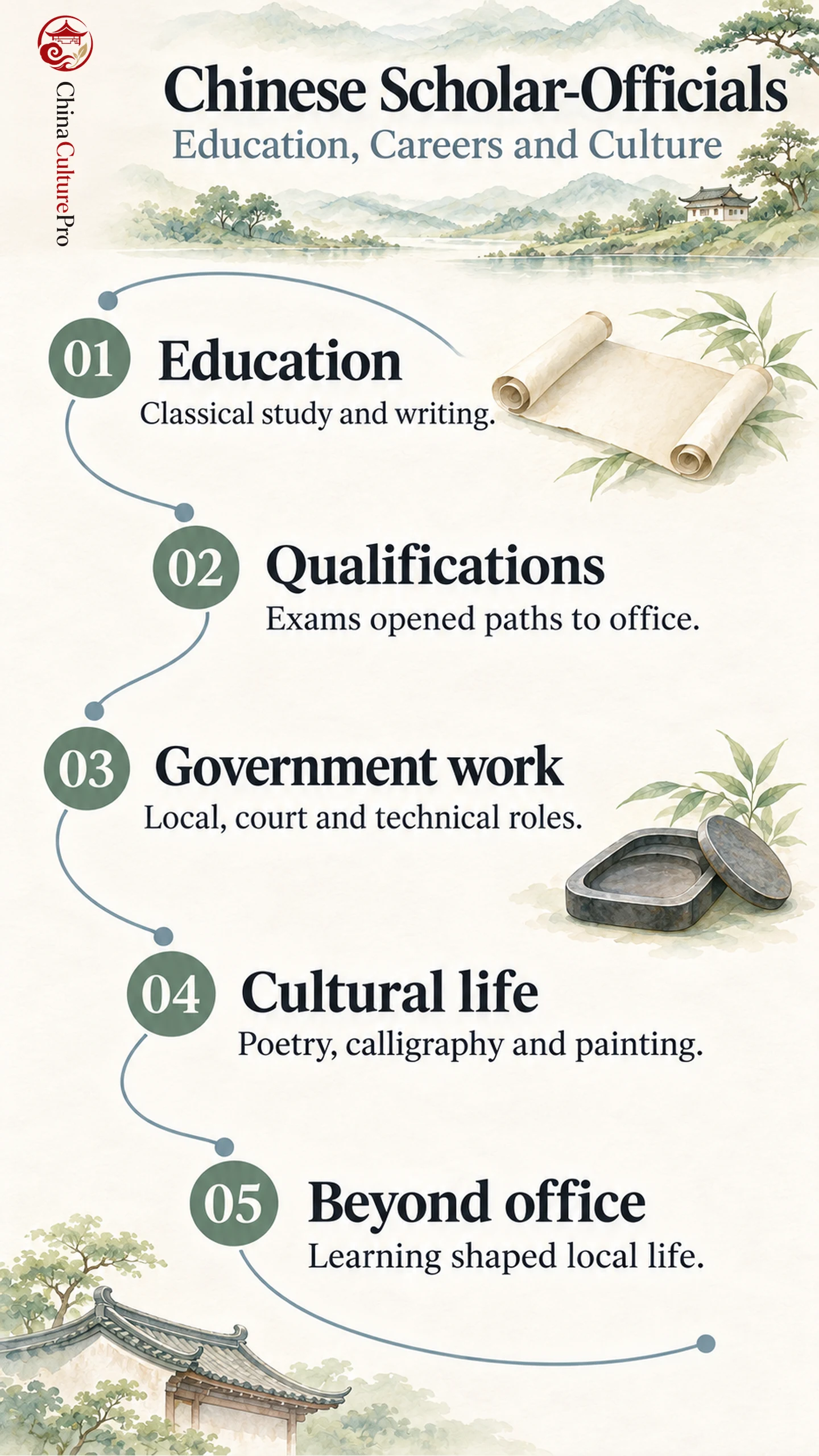
- Education: Candidates studied texts and forms of writing that changed in importance across periods.[1][2]
- Careers: An official could serve in local administration, oversight at court or a specialized post.[1][4][5]
- Culture: Poetry, calligraphy and painting could be part of a learned social life, including during retirement or exile.[6][7]
The examples here center on the Song, with some later practices used to show how the educated elite changed.[1][3][8]
A government biography, a technical notebook and a handscroll of poems can all be records of a scholar-official’s life. They show different things. The biography tells us which office a man held. The notebook records what he observed or learned. The handscroll can preserve an expression of what government service and its reversals felt like. This overlap between office and learning is an important feature of Chinese history.[4][5][7]
Education and the Meaning of Scholar-Official
The English phrase “scholar-official” joins educational identity to government service. The Chinese term could have a broader or narrower meaning in different contexts. In Song usage, it could refer to ranked officials generally or to an educated group within that larger bureaucracy. Modern historians also use “literati” for learned communities that included people outside active office.[1][3]
The curriculum varied. During the Song dynasty, government schools taught the classics even when those texts carried less weight in the most prestigious examinations. Wang Anshi and his fellow reformers promoted revised classical interpretations and government education. In the Southern Song, some scholars turned to private academies to pursue different approaches to moral learning.[2]
How a Qualification Became a Career
Examination recruitment had precedents in the Tang dynasty. Song governments used it more extensively to bring men from families with little prior officeholding into administration. Success in the imperial examinations could confer the jinshi (进士, jìnshì) qualification. The qualification mattered for entry and advancement. Different posts still required appointments, and education and recruitment routes varied across the civilian and military offices.[1][3]
Learning and public service also had different thresholds. Training could make someone part of an educated network even if he held no office. That wider group grew around schools and the examinations. Learning could carry social standing even when a man could never turn his education into a government career.[3][8]
What Officials Did in Government
The career of Bao Zheng (包拯, Bāo Zhěng) shows how appointments could change. His biography in the official Song history records service in local administration, censorial oversight and government finance. His duties at court included reviewing officials’ conduct and advising on the operation of government. The official biography gives a fuller range of duties than the courtroom image of later storytelling.[4]
Other appointments relied on particular kinds of knowledge. Shen Kuo (沈括, Shěn Kuò) worked on matters including surveying, military administration and the calendar. His writings preserve some of the observations and techniques that officials could encounter in their work. These two careers illustrate different ways trained men served within the same dynasty.[4][5]
Why Writing and Art Mattered
Classical learning and cultivated pursuits were part of the social world of the literati. Poetry, Chinese calligraphy and painting could communicate taste, learning or an emotional response to events. Collecting earlier works and studying inscriptions were other ways learned people engaged with the past.[6]
The Cold Food Observance handscroll provides a particular example. Su Shi (苏轼, Sū Shì) composed the poems while in exile at Huangzhou and later wrote them out in a calligraphic work. The script varies in the size of the characters and the spacing between lines. Huang Tingjian added a colophon, a written comment attached to the work. The finished scroll preserves two encounters with the same poems: Su’s later rendering of what he wrote in exile, and Huang’s response as a reader and calligrapher.[7]
The connection between painting and writing also changed after the Song. The Met describes Yuan-period scholar-artists using brushwork associated with calligraphy to depict landscapes. In such works, the brush could express an individual style or a reference to earlier art. That relationship between brush marks and learning helps explain why Chinese ink painting can preserve evidence of a shared literary culture.[6]
The Influence of Educated People Outside Office
Local influence could take shape outside government appointment. In Southern Song Mingzhou, local elites revived a community drinking ceremony and restricted its attendance to officeholders and literati. In other Southern Song writings, schools appear as places where educated people could discuss policy and offer counsel to officials. The examples show how a learned identity could carry weight in a community. In later imperial society, schooling could also lead toward teaching or professions such as medicine. Officeholding and cultural authority could overlap, but one did not always follow from the other.[3][8]
FAQs About Chinese Scholar-Officials
Were all literati government officials?
The literati included educated people who taught, wrote or participated in local affairs without holding an official appointment. Scholar-official usually emphasizes the part of that world connected to government service.
Did scholar-officials all pass the same examinations?
The importance, subjects and route through examinations changed by dynasty. Even in the Song, the official class included people with different educational and career routes.
Why did scholar-officials practice calligraphy and painting?
These arts could express education, personal experience and taste. They also gave scholars ways to respond to one another and preserve writing outside official records.
Sumber
[1] Cambridge University Press. Sung Government and Politics
[2] Cambridge University Press. Studying the Classics
[3] Song Chen. The State, the Gentry, and Local Institutions
[4] History of Song. Volume 316: Biography of Bao Zheng
[5] Nathan Sivin. Shen Kua
[6] Metropolitan Museum of Art. Scholar-Officials of China
[7] National Palace Museum. The Cold Food Observance
[8] Benjamin A. Elman. The Civil Examination System in Late Imperial China, 1400–1900